 Back
BackChapter 7: Fundamental Trigonometric Identities and Their Applications
Study Guide - Smart Notes
 Tailored notes based on your materials, expanded with key definitions, examples, and context.
Chapter 7: Trigonometric Identities and Equations
Fundamental Trigonometric Identities
Trigonometric identities are equations involving trigonometric functions that are true for all values of the variable for which both sides are defined. These identities are essential tools for simplifying expressions and solving trigonometric equations.
Reciprocal Identities: These relate each trigonometric function to its reciprocal.

Quotient Identities: These express tangent and cotangent in terms of sine and cosine.

Pythagorean Identities: These are derived from the Pythagorean Theorem and relate the squares of sine, cosine, and tangent.
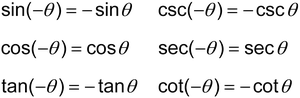
Even-Odd Identities: These describe the symmetry properties of trigonometric functions with respect to the origin.

Understanding the Argument of Trigonometric Functions
In trigonometric identities, the argument (such as \( \theta \)) can represent an angle in degrees, a real number, or a variable. It is important to always specify the argument when writing trigonometric expressions to avoid ambiguity.
Evaluating Trigonometric Functions Given One Value and the Quadrant
When given the value of one trigonometric function and the quadrant in which the angle lies, you can use identities to find the values of the other trigonometric functions. The sign of each function depends on the quadrant.
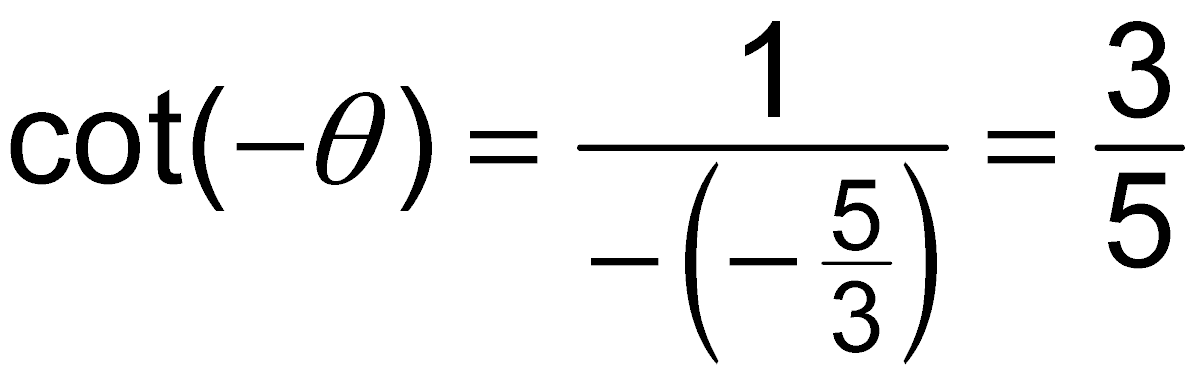
Example 1: Given \( \tan \theta = -\frac{5}{3} \) and \( \theta \) is in quadrant II, find the values of the other trigonometric functions.
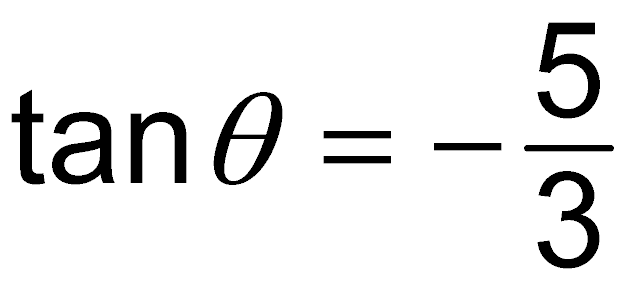
(a) Finding \( \sec \theta \): Use the Pythagorean identity \( 1 + \tan^2 \theta = \sec^2 \theta \) to solve for \( \sec \theta \).
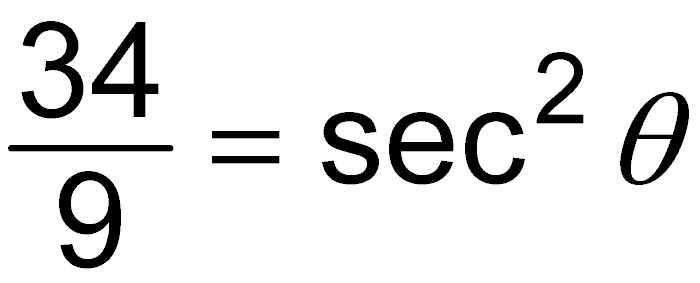

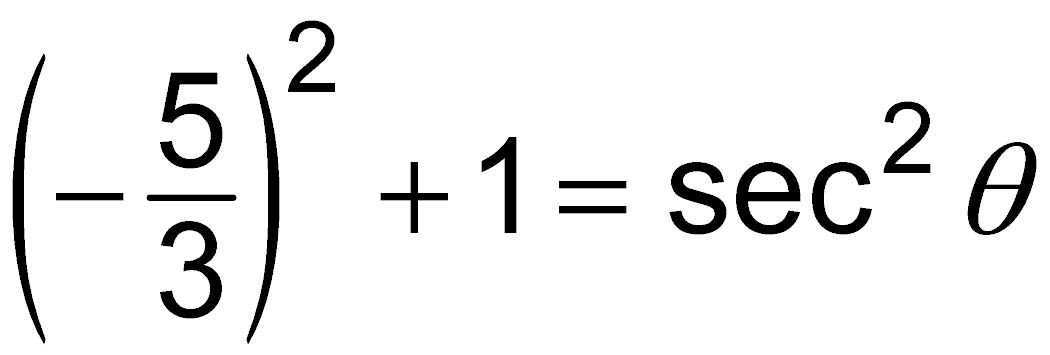
(b) Finding \( \sin \theta \): Use the reciprocal and quotient identities to express \( \sin \theta \) in terms of \( \tan \theta \) and \( \sec \theta \).
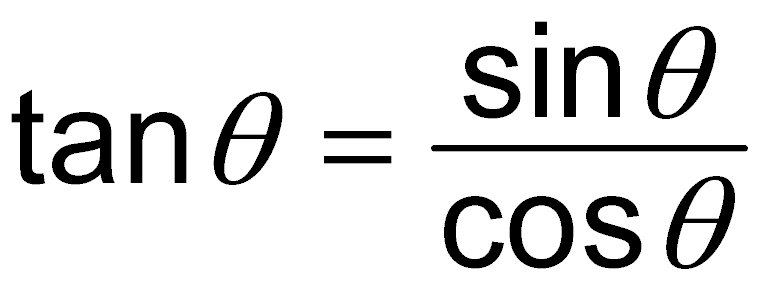
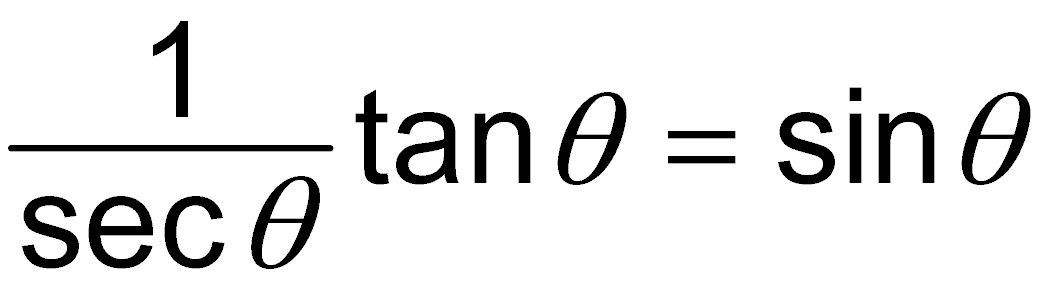
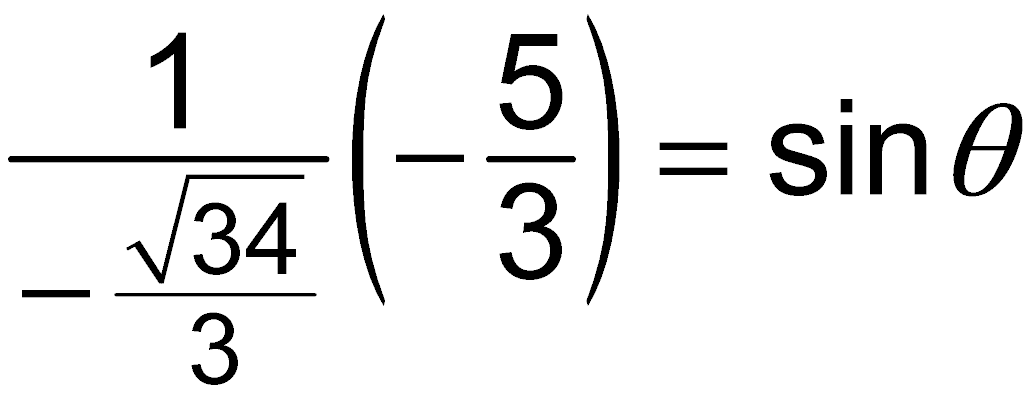
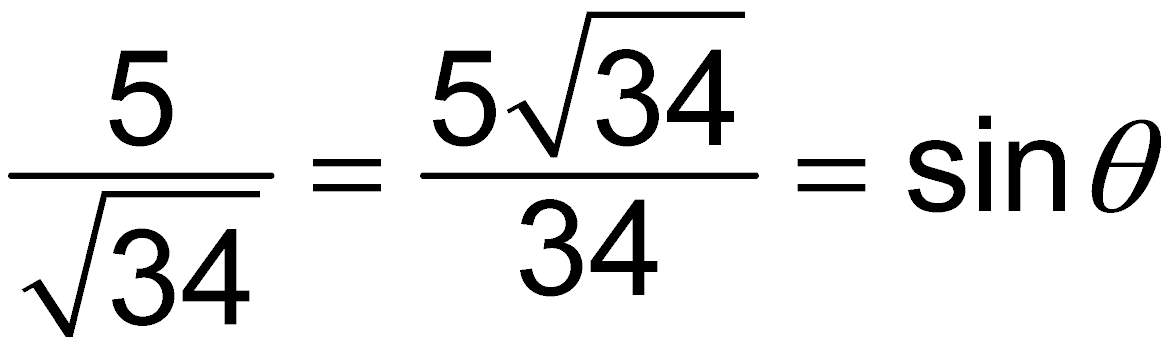

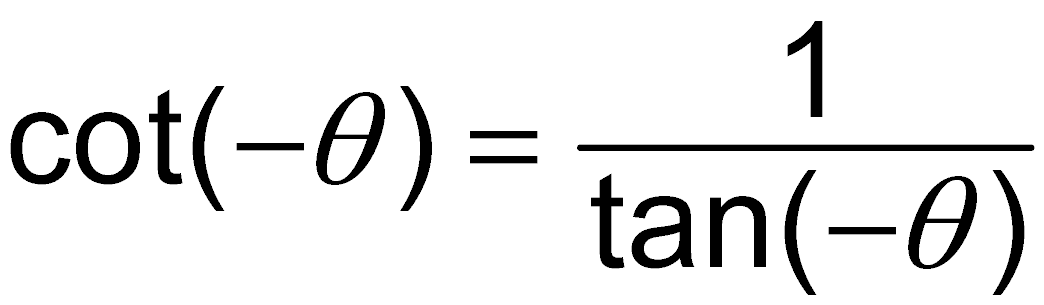
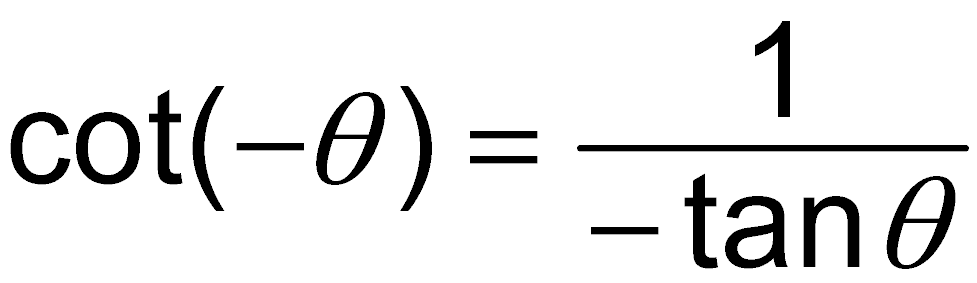
(c) Finding \( \cot(-\theta) \): Use the reciprocal and negative-angle identities.
Caution: When taking square roots, always choose the sign based on the quadrant of \( \theta \) and the function being evaluated.
Expressing One Trigonometric Function in Terms of Another
It is often useful to rewrite one trigonometric function in terms of another using identities. This is especially helpful when solving equations or simplifying expressions.
Example 2: Write \( \cos x \) in terms of \( \tan x \).
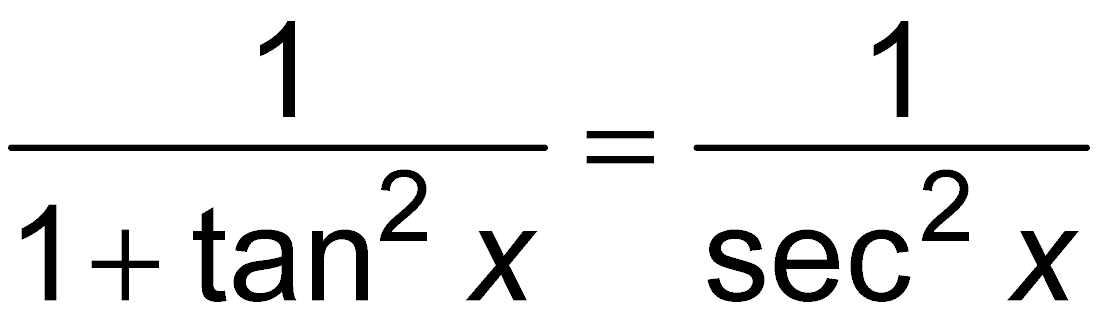
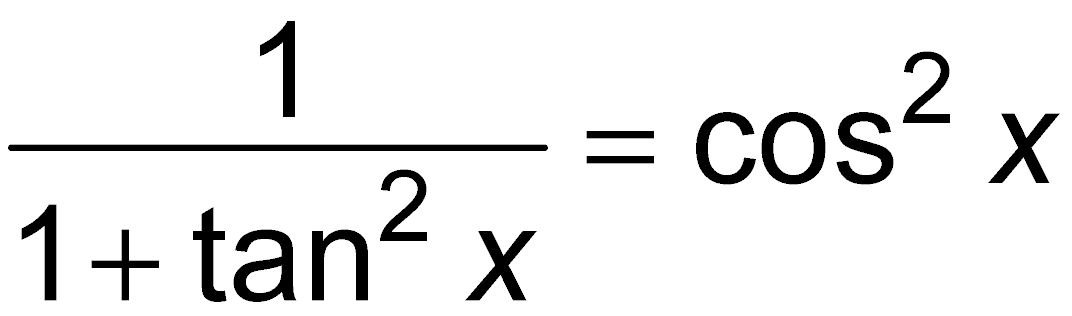

The sign of the result depends on the quadrant of \( x \).
Rewriting Expressions in Terms of Sine and Cosine
Many trigonometric expressions can be simplified by rewriting all functions in terms of sine and cosine, then using algebraic techniques and identities to eliminate quotients.
Example 3: Rewrite an expression in terms of sine and cosine, and simplify so that no quotients appear.
Use quotient identities, multiply numerator and denominator by the least common denominator (LCD), and apply reciprocal and Pythagorean identities as needed.
Importance of Arguments in Trigonometric Identities
Always include the argument (such as \( \theta \)) when writing trigonometric identities. Omitting the argument can lead to confusion or incorrect statements.

Caution: When working with trigonometric expressions and identities, always write the argument of the function.
Practice Problems
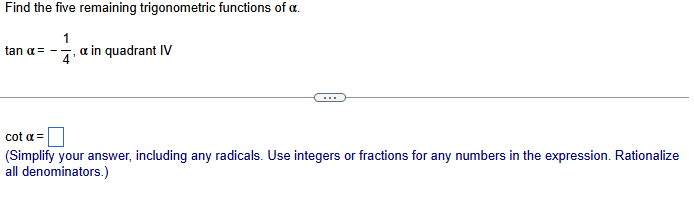
Question 1: Find the five remaining trigonometric functions of \( \alpha \) given \( \tan \alpha = -\frac{1}{4} \), \( \alpha \) in quadrant IV.
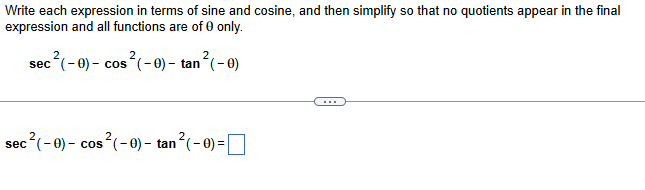
Question 2: Write each expression in terms of sine and cosine, and then simplify so that no quotients appear in the final expression and all functions are of \( \theta \) only.
Additional info: The above notes are based on standard precalculus curriculum and the provided textbook images, focusing on Chapter 7: Trigonometric Identities and Equations.
