 Back
BackChapter 9: The Unit Circle and the Functions of Trigonometry – Angles, Arc, and Their Measures
Study Guide - Smart Notes
 Tailored notes based on your materials, expanded with key definitions, examples, and context.
9.1 Angles, Arcs, and Their Measures
Basic Terminology
Understanding the foundational elements of geometry is essential for studying trigonometry. The concepts of lines, segments, rays, and angles are the building blocks for measuring rotation and position in the plane.
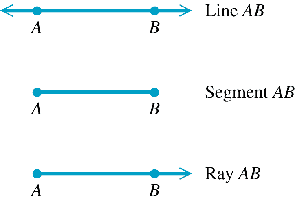
Line AB: Extends infinitely in both directions through points A and B.
Segment AB: The portion of the line between points A and B, including both endpoints.
Ray AB: Starts at point A and passes through B, extending infinitely in one direction.
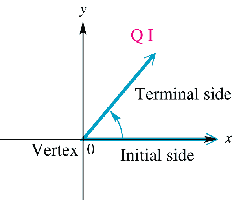
Angle: Formed by rotating a ray (the initial side) around its endpoint (the vertex) to a terminal side.
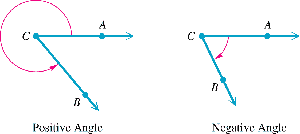
Positive angles are generated by counterclockwise rotation, while negative angles are generated by clockwise rotation.
Degree Measure
The degree is a common unit for measuring angles, dividing a full circle into 360 equal parts.
Acute angle: Between 0° and 90°.
Right angle: Exactly 90°.
Obtuse angle: Greater than 90° but less than 180°.
Straight angle: Exactly 180°.
Complementary and Supplementary Angles
Angles can be classified based on their sums:
Complementary angles: Two positive angles whose sum is 90°.
Supplementary angles: Two positive angles whose sum is 180°.
Finding Measures of Angles
To find unknown angle measures, use the properties of complementary and supplementary angles.
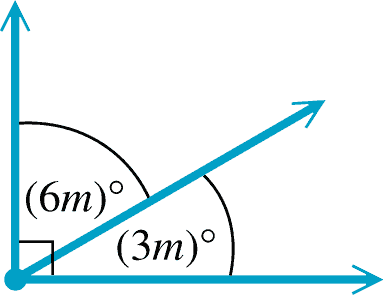
Example a: If two angles are complementary and one is twice the other, let the smaller be m. Then, .
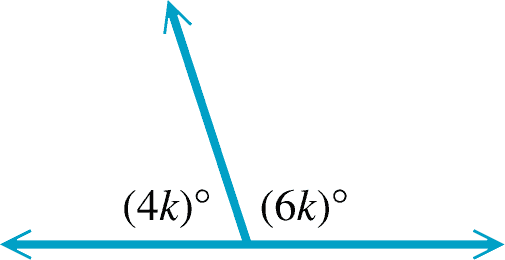
Example b: If two angles are supplementary and one is 1.5 times the other, let the smaller be k. Then, .
Calculating With Degrees, Minutes, and Seconds
Units of Angle Measure
1 degree (°) = 60 minutes (')
1 minute (') = 60 seconds (")
These subdivisions allow for precise measurement of angles.
Performing Calculations
To add or subtract angles in DMS (degrees, minutes, seconds), align units and carry over as needed.
Example:
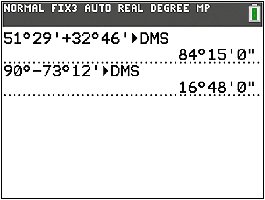
Converting Between Decimal Degrees and DMS
To convert DMS to decimal degrees:
To convert decimal degrees to DMS: Multiply the decimal part by 60 for minutes, then the decimal part of minutes by 60 for seconds.
Example:
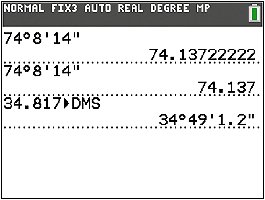
Quadrantal and Coterminal Angles
Quadrantal Angles
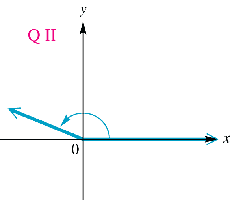
Quadrantal angles are angles in standard position whose terminal sides lie along the x- or y-axis (e.g., 0°, 90°, 180°, 270°, 360°).
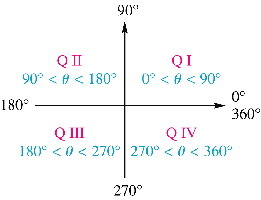
Coterminal Angles
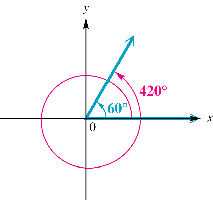
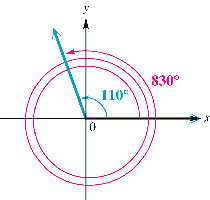
Coterminal angles share the same initial and terminal sides but differ by multiples of 360°.
To find a coterminal angle between 0° and 360°, add or subtract 360° as needed.
Example:
Radian Measure
Definition and Relationship to Degrees
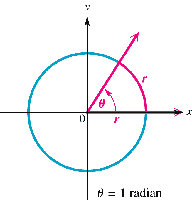
A radian is the measure of a central angle that intercepts an arc equal in length to the radius of the circle. The circumference of a circle is , so a full rotation (360°) is radians.
radians
radians
Converting Between Degrees and Radians
Degrees to radians: Multiply by
Radians to degrees: Multiply by
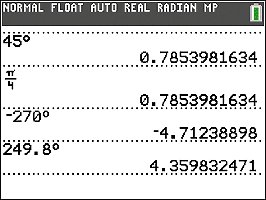
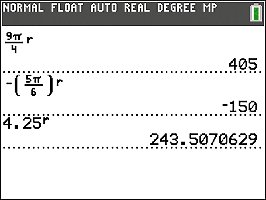
Equivalent Angle Measures
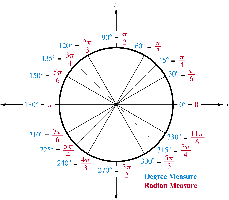
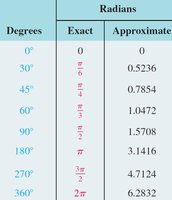
Common angles and their equivalent measures in degrees and radians are summarized below:
Degrees | Radians (Exact) | Radians (Approximate) |
|---|---|---|
0° | $0$ | 0 |
30° | 0.5236 | |
45° | 0.7854 | |
60° | 1.0472 | |
90° | 1.5708 | |
180° | 3.1416 | |
270° | 4.7124 | |
360° | 6.2832 |
Arc Length and Area of a Sector
Arc Length
The length s of an arc intercepted by a central angle (in radians) in a circle of radius r is:
Example: For cm and ,
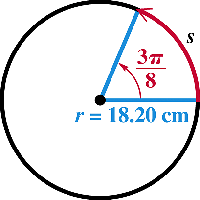
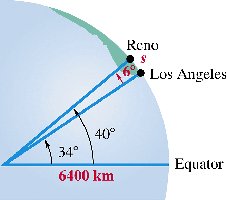
Applications: Using Latitudes to Find Distance
Latitude differences can be used to find the north-south distance between two cities on Earth, modeled as a circle of radius 6400 km. The central angle is the difference in latitude, converted to radians, and the arc length formula is applied.
Area of a Sector
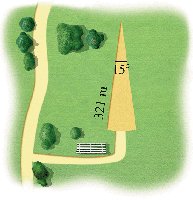
The area A of a sector with radius r and central angle (in radians) is:
Example: For a field shaped as a sector with m and radians,
Linear and Angular Speed
Definitions
Angular speed (\omega): The rate at which an angle is swept out, measured in radians per unit time.
Linear speed (v): The rate at which a point moves along the circumference, .
Applications: Circular Motion and Pulley Systems
Example: A point on a circle of radius 10 cm rotates with angular speed rad/s. In 6 seconds, the angle generated is . The distance traveled is and the linear speed is .
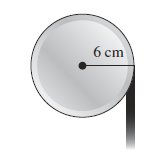
Pulley Example: For a pulley of radius 6 cm rotating at 80 revolutions per minute, angular speed is radians per second, and linear speed is .
Additional info: These concepts are foundational for understanding trigonometric functions, circular motion, and applications in physics and engineering.
