 Back
BackChapter 9: The Unit Circle and the Functions of Trigonometry – Study Notes
Study Guide - Smart Notes
 Tailored notes based on your materials, expanded with key definitions, examples, and context.
Chapter 9: The Unit Circle and the Functions of Trigonometry
9.6 Evaluating Trigonometric Functions
This section explores the definitions, properties, and evaluation techniques for trigonometric functions, focusing on their geometric and algebraic interpretations. It covers right-triangle-based definitions, special angles, reference angles, and the use of calculators for trigonometric computations.
Trigonometric Functions and Right-Triangle Definitions
Standard Position and Right-Triangle Definitions
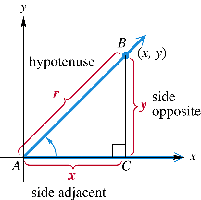
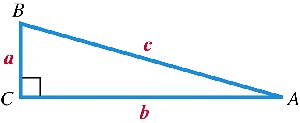
Trigonometric functions are initially defined for acute angles using right triangles. An angle is in standard position if its vertex is at the origin and its initial side lies along the positive x-axis.
Sine (sin): Ratio of the length of the side opposite the angle to the hypotenuse.
Cosine (cos): Ratio of the length of the side adjacent to the angle to the hypotenuse.
Tangent (tan): Ratio of the length of the side opposite the angle to the side adjacent.
Finding Trigonometric Function Values in a Right Triangle
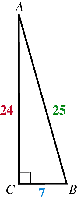
Given a right triangle with side lengths, the trigonometric functions can be evaluated directly:
Let the side opposite angle A be 7, the side adjacent be 24, and the hypotenuse be 25.
Then:
Trigonometric Function Values of Special Angles
Special Angles: 30°, 45°, and 60°
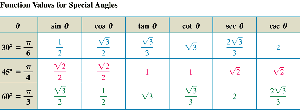
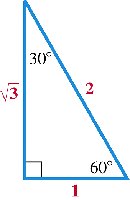
The trigonometric functions for 30°, 45°, and 60° (or , , radians) have exact values derived from special right triangles.
$2$ | ||||||
$1$ | $1$ | |||||
$2$ |
Geometric Derivation of Special Angles
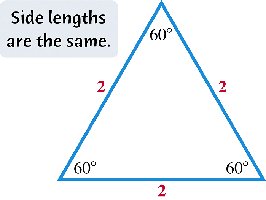
These values are derived from equilateral and isosceles right triangles:
Equilateral triangle split in half yields a 30-60-90 triangle.
Isosceles right triangle yields a 45-45-90 triangle.
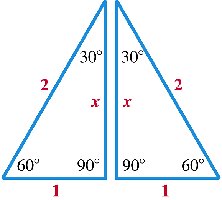
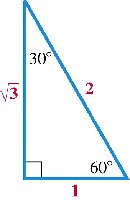
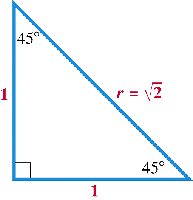
Example: Finding Trigonometric Function Values for 60°
For a 60° angle in a 30-60-90 triangle with hypotenuse 2, the side opposite 60° is and the side adjacent is 1:
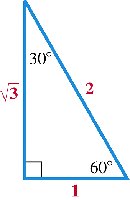
Cofunction Identities
Definition and Properties
Cofunction identities relate the trigonometric functions of complementary angles (angles that sum to 90° or radians):
These identities also hold for radian measure, replacing 90° with .
Example: Writing Functions in Terms of Cofunctions
cos 52°16' = sin(90° – 52°16') = sin 37°44'
Reference Angles
Definition and Use
A reference angle for an angle is the positive acute angle formed by the terminal side of $\theta$ and the x-axis. Reference angles are used to evaluate trigonometric functions for any angle.
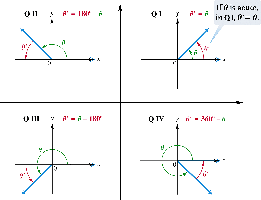
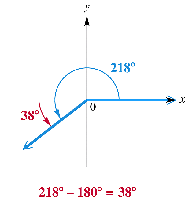
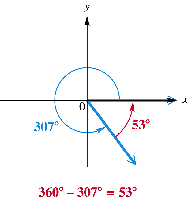
Finding Reference Angles: Examples
For ,
For , (then )
For ,
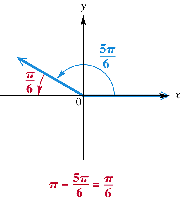
Special Angles as Reference Angles
To find trigonometric values for angles like 210°, use the reference angle (30°) and determine the sign based on the quadrant.
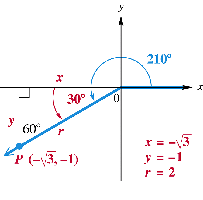
Steps for Finding Trigonometric Values for Any Nonquadrantal Angle
Find a coterminal angle between 0° and 360° (or 0 and radians).
Find the reference angle.
Evaluate the trigonometric function for the reference angle.
Assign the correct sign based on the quadrant.
Examples Using Reference Angles
cos(–240°): Coterminal with 120°, reference angle is 60°, cosine is negative in quadrant II.
tan(675°): Coterminal with 315°, reference angle is 45°, tangent is negative in quadrant IV.
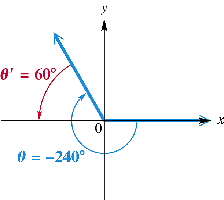
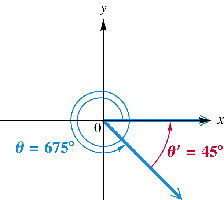
Finding Trigonometric Values by Reference Angles
For (Quadrant II): Reference angle is , sine is positive, cosine is negative.
For (Quadrant III): Reference angle is , both sine and cosine are negative.
Calculator Use for Trigonometric Values
Evaluating Trigonometric Functions with a Calculator
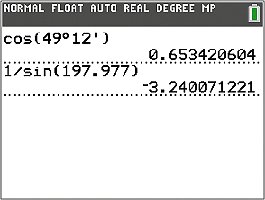
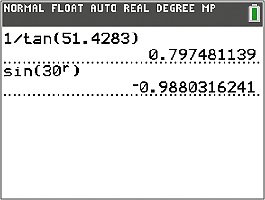
Calculators can be used to approximate trigonometric values for arbitrary angles. Ensure the calculator is in the correct mode (degree or radian).
cos(49°12') ≈ 0.6534
csc(197.977°) ≈ –3.2401
cot(51.4283°) ≈ 0.7975
sin(30 radians) ≈ –0.9880
Using Inverse Trigonometric Functions
Inverse trigonometric functions are used to find angles given a trigonometric value.
If , then
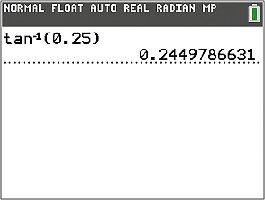
If , then radians
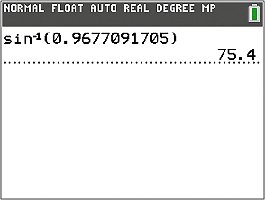
Finding Angle Measures
Solving for Angles Given Trigonometric Values
To find all angles in a given interval that satisfy a trigonometric equation, use the reference angle and consider the sign of the function in each quadrant.
For in , reference angle is .
Quadrant II:
Quadrant III:
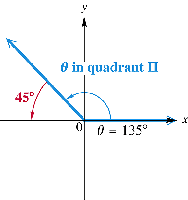
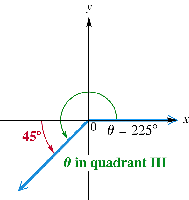
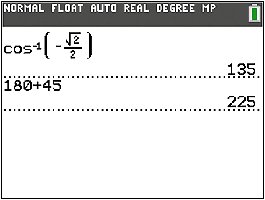
Finding Angle Measures in Radians
For in , use the calculator to find the reference angle and determine all solutions in the interval.
(Quadrant I) (Quadrant IV)
Right Triangle Ratios and Applications
Summary of Right Triangle Ratios
For a right triangle with sides (opposite), (adjacent), and hypotenuse :
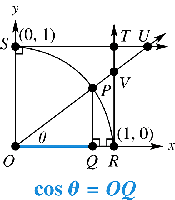
Finding Lengths of Line Segments Using Trigonometry
Given a geometric figure with right triangles and known angles, use trigonometric ratios to find unknown side lengths. For example, if angle TVU measures 60°, use the properties of 30-60-90 triangles to determine segment lengths.
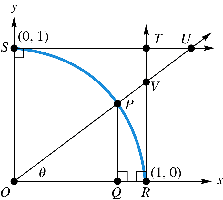
Additional info: The above notes include expanded explanations, examples, and context to ensure completeness and clarity for precalculus students.
