 Back
BackChapter 9: The Unit Circle and the Functions of Trigonometry - Precalculus Study Notes
Study Guide - Smart Notes
 Tailored notes based on your materials, expanded with key definitions, examples, and context.
Chapter 9: The Unit Circle and the Functions of Trigonometry
9.1 Angles, Arc, and Their Measures
Angles and Arcs Basic Terminology
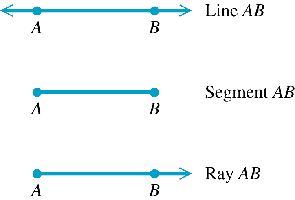
Understanding the basic geometric elements is essential for studying trigonometry. Two distinct points, A and B, can define a line, a segment, or a ray:
Line AB: Extends infinitely in both directions through points A and B.
Segment AB: The portion of the line between A and B, including both endpoints.
Ray AB: Starts at A and passes through B, extending infinitely in one direction.
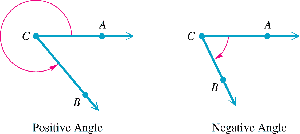
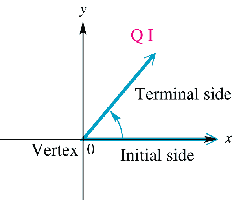
An angle is formed by rotating a ray (the initial side) around its endpoint (the vertex) to a terminal side.
Degree Measure
The degree is a unit for measuring angles, dividing the circle's circumference into 360 parts. Key angle types:
Acute angle: Between 0° and 90°
Right angle: Exactly 90°
Obtuse angle: Greater than 90° but less than 180°
Straight angle: Exactly 180°
Complementary and Supplementary Angles
Complementary angles: Two positive angles whose sum is 90°.
Supplementary angles: Two positive angles whose sum is 180°.
Finding Measures of Angles
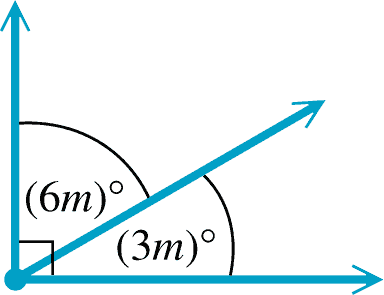
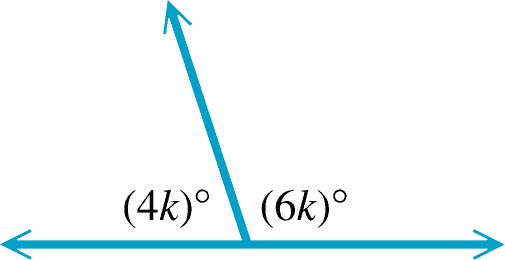
Given figures, you may be asked to find the measures of angles. For example:
Angles are 60° and 30°.
Angles are 72° and 108°.
Calculating With Degrees, Minutes, and Seconds
Angles can be measured in degrees (°), minutes ('), and seconds (").
1 minute (1') = 1/60 of a degree
1 second (1") = 1/60 of a minute
Calculations often require converting between these units or adding/subtracting them.
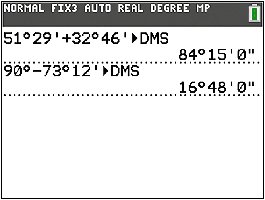
Converting Between Decimal Degrees, Minutes, and Seconds
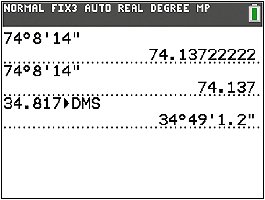
Conversion between decimal degrees and DMS (degrees, minutes, seconds) is a common task:
To convert DMS to decimal degrees:
To convert decimal degrees to DMS: Multiply the decimal part by 60 for minutes, and again by 60 for seconds.
Quadrantal Angles
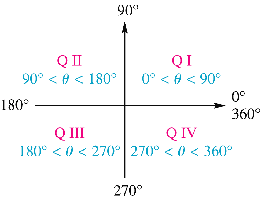
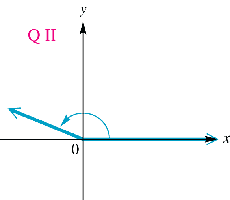
Quadrantal angles are angles in standard position whose terminal sides lie along the x- or y-axis (e.g., 0°, 90°, 180°, 270°, 360°).
Coterminal Angles
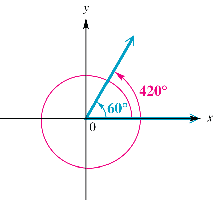
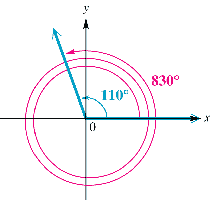
Coterminal angles share the same initial and terminal sides but differ by multiples of 360°.
Radian Measure
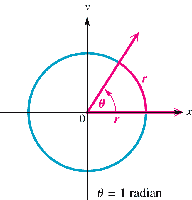
The radian is another unit for measuring angles. One radian is the angle subtended by an arc equal in length to the radius of the circle.
The circumference of a circle is .
360° corresponds to radians.
Converting Between Degrees and Radians
To convert degrees to radians:
To convert radians to degrees:
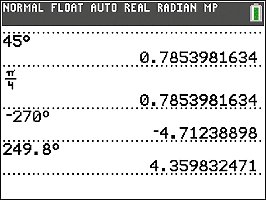
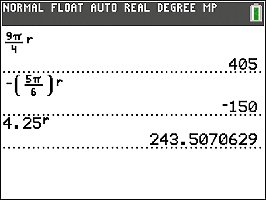
Equivalent Angle Measures in Degrees and Radians
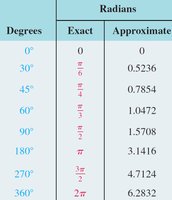
Common angles and their radian equivalents:
Degrees | Exact Radians | Approximate Radians |
|---|---|---|
0° | 0 | 0 |
30° | 0.5236 | |
45° | 0.7854 | |
60° | 1.0472 | |
90° | 1.5708 | |
180° | 3.1416 | |
270° | 4.7124 | |
360° | 6.2832 |
Arc Length
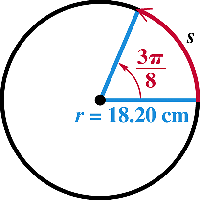
The length s of an arc intercepted by a central angle (in radians) in a circle of radius r is:
Applications: Latitude and Distance
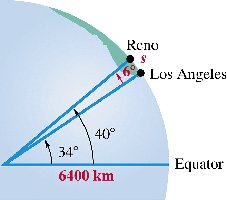
Latitude can be used to find distances between cities using the arc length formula. For example, the distance between Reno and Los Angeles is calculated using their latitudes and Earth's radius.
Area of a Sector
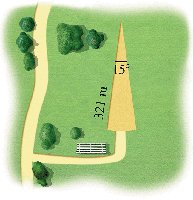
The area A of a sector of a circle of radius r and central angle (in radians) is:
Linear and Angular Speed
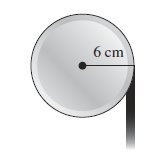
Angular speed (): Rate of change of angle, in radians per unit time.
Linear speed (): Rate of change of arc length, .
9.2 The Unit Circle and Its Functions
The Unit Circle
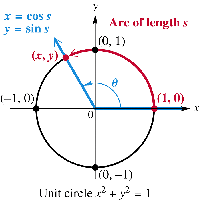
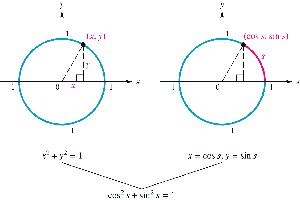
The unit circle is a circle with center at the origin and radius 1. It is fundamental for defining trigonometric functions for all real numbers.
Circular (Trigonometric) Functions
If (x, y) is a point on the unit circle corresponding to real number s:
Domains of Trigonometric Functions
Sine and Cosine: Domain is all real numbers.
Tangent and Secant: Domain excludes values where .
Cotangent and Cosecant: Domain excludes values where .
Trigonometric Identities
If ,
If ,
Finding Function Values Using the Unit Circle
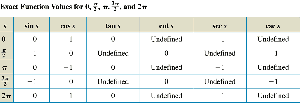
For specific values of s, the unit circle provides exact values for sine, cosine, and other functions. For example:
s | sin s | cos s | tan s | cot s | sec s | csc s |
|---|---|---|---|---|---|---|
0 | 0 | 1 | 0 | Undefined | 1 | Undefined |
0 | -1 | 0 | Undefined | -1 | Undefined | |
1 | 0 | Undefined | 0 | Undefined | 1 | |
0 | 1 | 0 | Undefined | 1 | Undefined |
Function Values at Multiples of
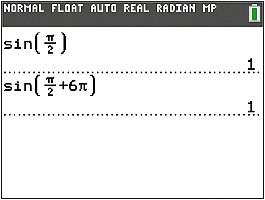
Adding integer multiples of to s does not change the sine or cosine values:
Signs of Trigonometric Functions in Quadrants
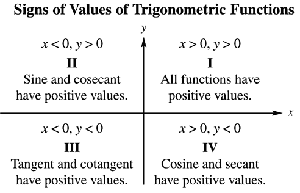
The sign of each trigonometric function depends on the quadrant:
Quadrant | Sign of sin | Sign of cos | Sign of tan |
|---|---|---|---|
I | + | + | + |
II | + | - | - |
III | - | - | + |
IV | - | + | - |
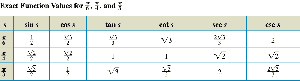
Exact Function Values for , , and
These angles correspond to important points on the unit circle:
s | sin s | cos s | tan s | cot s | sec s | csc s |
|---|---|---|---|---|---|---|
2 | ||||||
1 | 1 | |||||
2 |
9.3 Graphs of the Sine and Cosine Functions
Periodic Functions
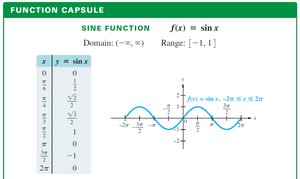
A periodic function repeats its values in regular intervals. Sine and cosine are classic examples:
for all real x, integer n, and period p.
The smallest positive p is the period.
Amplitude
The amplitude of a sinusoidal function is half the difference between its maximum and minimum values. For or , amplitude is .
Graphing y = a sin x and y = sin bx
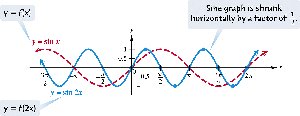
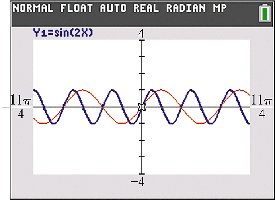
Changing the coefficient a stretches or compresses the graph vertically. Changing b affects the period:
Period of is
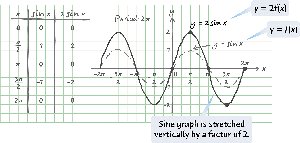
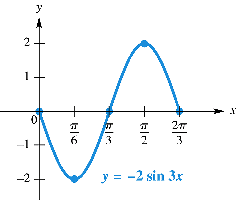
Graphing y = a sin bx
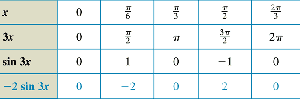
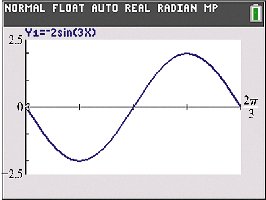
For negative a, the graph is reflected across the x-axis.
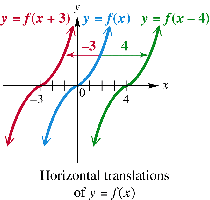
Horizontal and Vertical Translations
Horizontal translation (phase shift): shifts the graph d units right if d > 0.
Vertical translation: shifts the graph c units up if c > 0.
9.4 Graphs of the Other Circular Functions
Graphs of Cosecant and Secant Functions
Cosecant and secant are reciprocals of sine and cosine, respectively. Their graphs have vertical asymptotes where the guide function (sine or cosine) is zero.
Graphing y = a sec bx and y = a csc bx
To graph these functions:
Graph the corresponding guide function (cosine or sine).
Draw vertical asymptotes at the x-intercepts of the guide function.
Sketch U-shaped branches between asymptotes.
Graphing y = a csc(x – d)
Graph the guide function, identify asymptotes, and sketch the branches.
Graphs of Tangent and Cotangent Functions
Tangent and cotangent functions have vertical asymptotes and periods determined by their coefficients:
Period of is
Period of is
Determining Equations for Graphs
Given a graph, you can determine its equation by identifying period, amplitude, phase shift, and vertical translation.
Additional info: These notes cover the essential concepts, definitions, and graphical representations of trigonometric functions, their properties, and applications, as required for a precalculus course.
