 Back
BackCircle and Parabola Test Practice Problems – Step-by-Step Precalculus Guidance
Study Guide - Smart Notes
 Tailored notes based on your materials, expanded with key definitions, examples, and context.
Q1. Find the length and midpoint of the segment connecting (-3, 7) and (-9, 4).
Background
Topic: Distance and Midpoint Formulas
This question tests your understanding of how to calculate the distance between two points and the midpoint of a segment in the coordinate plane.
Key Terms and Formulas:
Distance formula:
Midpoint formula:
Step-by-Step Guidance
Label the points: and .
For the distance, substitute the coordinates into the distance formula: .
Simplify inside the parentheses: and .
For the midpoint, substitute into the midpoint formula: .
Try solving on your own before revealing the answer!
Q2. Write the equation of a circle with center (0, -5) and radius 7.
Background
Topic: Equation of a Circle
This question tests your ability to write the equation of a circle given its center and radius.
Key Terms and Formulas:
Standard form of a circle:
Where is the center and is the radius.
Step-by-Step Guidance
Identify the center and radius .
Substitute these values into the standard form: .
Simplify the equation as much as possible.
Try solving on your own before revealing the answer!
Q3. Write the equation of a circle with endpoints of a diameter at (-9, 2) and (1, 4).
Background
Topic: Equation of a Circle from Diameter Endpoints
This question tests your ability to find the center and radius of a circle when given the endpoints of its diameter.
Key Terms and Formulas:
Midpoint formula for center:
Distance formula for diameter:
Radius is half the diameter.
Circle equation:
Step-by-Step Guidance
Find the center by calculating the midpoint of and .
Find the length of the diameter using the distance formula.
Divide the diameter by 2 to get the radius.
Substitute the center and radius into the standard form of the circle equation.
Try solving on your own before revealing the answer!
Q4. Determine the center and radius of the circle .
Background
Topic: Completing the Square for Circles
This question tests your ability to rewrite a general equation of a circle in standard form by completing the square.
Key Terms and Formulas:
Standard form:
Complete the square for and terms.
Step-by-Step Guidance
Group and terms: .
Complete the square for and terms separately.
Add the necessary constants to both sides to balance the equation.
Rewrite in standard form to identify the center and radius .
Try solving on your own before revealing the answer!
Q5. Which points are on the circle ?
Background
Topic: Points on a Circle
This question tests your ability to determine if a point lies on a given circle by substituting the coordinates into the equation.
Key Terms and Formulas:
Substitute into the equation and check if the equation is satisfied.
Step-by-Step Guidance
For each point, substitute and into the equation .
Simplify to see if the left side equals 100.
Repeat for all points.
Try solving on your own before revealing the answer!
Q6. Write the equation of a parabola with a maximum value of -7 at and passing through (3, -19). Leave your answer in vertex form.
Background
Topic: Vertex Form of a Parabola
This question tests your ability to write the equation of a parabola given its vertex and a point it passes through.
Key Terms and Formulas:
Vertex form:
Vertex:
Step-by-Step Guidance
Identify the vertex: .
Substitute the vertex into the vertex form: .
Substitute the point into the equation to solve for .
Solve for but do not substitute back yet.
Try solving on your own before revealing the answer!
Q7. An object is thrown vertically upward from the edge of a 240-foot building. The function models the height of the object in feet seconds after it was thrown. What is the maximum height of the object?
Background
Topic: Quadratic Functions – Maximum Value
This question tests your ability to find the maximum value of a quadratic function, which represents the object's maximum height.
Key Terms and Formulas:
Quadratic function:
Maximum occurs at for .
Substitute back into to find the maximum height.
Step-by-Step Guidance
Identify the coefficients , , and from the given function.
Calculate to find the time at which the maximum occurs.
Substitute this value back into the function to find the maximum height.
Try solving on your own before revealing the answer!
Q8. Quadratic Functions: For each function, determine the vertex, axis of symmetry, max/min value, domain, range, y-intercept, intervals of increase, and x-intercepts.
Background
Topic: Analyzing Quadratic Functions
This question tests your ability to analyze the properties of quadratic functions, including their graphs and key features.
Key Terms and Formulas:
Vertex: ,
Axis of symmetry:
Domain: All real numbers
Range: Depends on whether the parabola opens up or down
y-intercept: Set
x-intercepts: Set and solve for
Step-by-Step Guidance
For each function, identify , , and .
Calculate the vertex using and .
Write the equation of the axis of symmetry.
Determine if the vertex is a maximum or minimum based on the sign of .
Find the y-intercept by evaluating .
Set and solve for to find the x-intercepts.
Try solving on your own before revealing the answer!
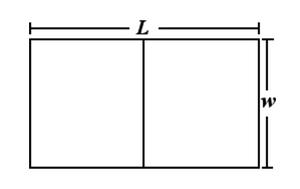
Q9. You have a 500-foot roll of fencing and a large field. You want to fence a rectangular playground. What are the dimensions of the largest playground you can fence? What is the largest area?
Background
Topic: Optimization with Quadratic Functions
This question tests your ability to use quadratic functions to maximize area given a fixed perimeter.
Key Terms and Formulas:
Let = length and = width.
Perimeter:
Area:
Step-by-Step Guidance
Express one variable in terms of the other using the perimeter equation: .
Solve for in terms of (or vice versa).
Substitute this expression into the area formula to get as a function of one variable.
Write as a quadratic function and identify the value of that maximizes .
Try solving on your own before revealing the answer!
Q10. Factor the following expressions:
Background
Topic: Factoring Quadratic and Higher Degree Polynomials
This question tests your ability to factor various types of polynomials, including quadratics and higher degree expressions.
Key Terms and Formulas:
Factoring quadratics: where and are numbers that multiply to and add to .
Difference of squares:
Factoring by grouping for higher degree polynomials.
Step-by-Step Guidance
For each expression, look for common factors first.
For quadratics, identify , , and and find two numbers that multiply to and add to $b$.
For special forms (like ), recognize patterns such as difference of squares.
For higher degree polynomials, try factoring by grouping or other methods as appropriate.
Try solving on your own before revealing the answer!
Q11. Graph the circle .
Background
Topic: Graphing Circles by Completing the Square
This question tests your ability to rewrite the equation of a circle in standard form and graph it on the coordinate plane.
Key Terms and Formulas:
Complete the square for and terms to rewrite in standard form:
Identify the center and radius .
Step-by-Step Guidance
Group and terms: .
Complete the square for both and terms.
Add the necessary constants to both sides to balance the equation.
Identify the center and radius from the standard form.
Try solving on your own before revealing the answer!
Q12. Write the equation of the circle whose diameter has endpoints (-5, 3) and (-7, 33).
Background
Topic: Equation of a Circle from Diameter Endpoints
This question tests your ability to find the center and radius of a circle given the endpoints of its diameter.
Key Terms and Formulas:
Midpoint formula for center:
Distance formula for diameter:
Radius is half the diameter.
Circle equation:
Step-by-Step Guidance
Find the center by calculating the midpoint of and .
Find the length of the diameter using the distance formula.
Divide the diameter by 2 to get the radius.
Substitute the center and radius into the standard form of the circle equation.
Try solving on your own before revealing the answer!
Q13. Write in vertex form. Name the vertex and y-intercept.
Background
Topic: Completing the Square for Parabolas
This question tests your ability to rewrite a quadratic in vertex form and identify key features.
Key Terms and Formulas:
Vertex form:
Complete the square to convert from standard to vertex form.
y-intercept: Set .
Step-by-Step Guidance
Group terms: .
Complete the square for .
Rewrite the equation in vertex form.
Identify the vertex and y-intercept.
Try solving on your own before revealing the answer!
Q14. Write in standard form. Name the vertex and y-intercept.
Background
Topic: Standard Form of a Quadratic
This question tests your ability to rewrite a quadratic in standard form and identify key features.
Key Terms and Formulas:
Standard form:
Vertex:
y-intercept: Set .
Step-by-Step Guidance
Combine like terms to write the equation in standard form.
Identify , , and .
Find the vertex using and .
Find the y-intercept by evaluating .
Try solving on your own before revealing the answer!
Q15. The parabola is written in factored form:
Background
Topic: Factored and Standard Forms of Quadratics
This question tests your ability to interpret and rewrite quadratic equations from factored to standard form.
Key Terms and Formulas:
Factored form:
Standard form:
Roots (x-intercepts) are and .
Step-by-Step Guidance
Identify the roots from the factored form.
Expand the expression to write it in standard form.
Identify the coefficients , , and .
Try solving on your own before revealing the answer!
