 Back
BackComposite and Inverse Functions: Precalculus Study Notes
Study Guide - Smart Notes
 Tailored notes based on your materials, expanded with key definitions, examples, and context.
Composite Functions
Definition and Formation of Composite Functions
Composite functions are formed when the output of one function becomes the input of another. If f and g are functions, the composite function f ∘ g is defined as (f ∘ g)(x) = f(g(x)). The domain of f ∘ g consists of all x in the domain of g such that g(x) is in the domain of f.
Key Point 1: The notation f ∘ g means "f composed with g" or "f of g of x".
Key Point 2: The domain of f ∘ g is restricted by both the domain of g and the requirement that g(x) must be in the domain of f.
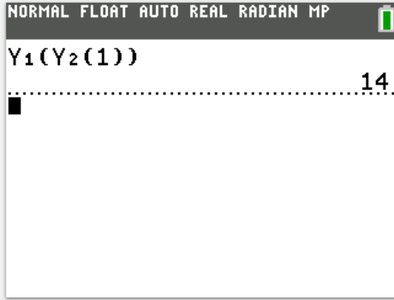
Example: If f(x) = 5x - 1 and g(x) = 3x^2, then (f ∘ g)(1) = f(g(1)) = f(3) = 5(3) - 1 = 14.

Evaluating Composite Functions
To evaluate a composite function at a specific value, substitute the value into the inner function, then use the result as the input for the outer function.
Example: Given f(x) = 5x - 1 and g(x) = 3x^2:
(f ∘ g)(1) = f(g(1)) = f(3) = 14
(g ∘ f)(1) = g(f(1)) = g(4) = 3(4^2) = 48
(f ∘ f)(-2) = f(f(-2)) = f(-11) = 5(-11) - 1 = -56
(g ∘ g)(-2) = g(g(-2)) = g(12) = 3(12^2) = 432
Composite Functions with Radicals
When composite functions involve radicals, ensure the input values are within the domain of the radical function (i.e., the radicand is non-negative for even roots).
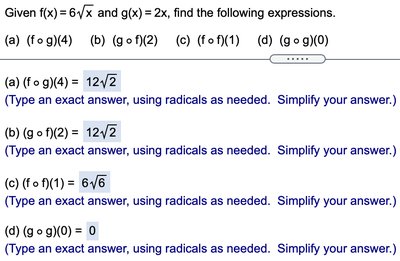
Example: If f(x) = 6\sqrt{x} and g(x) = 2x, then (f ∘ g)(4) = f(g(4)) = f(8) = 6\sqrt{8} = 12\sqrt{2}.
Finding the Domain of a Composite Function
To determine the domain of (f ∘ g)(x), exclude any x not in the domain of g and any x for which g(x) is not in the domain of f.
Example: If f(x) = x^2 + 2x - 5 and g(x) = 3x + 1, both have domain all real numbers, so f ∘ g and g ∘ f also have domain all real numbers.
Example: If f(x) = \frac{2}{x+4} and g(x) = \frac{4}{x-3}, then the domain of g is x ≠ 3. For f ∘ g, also exclude x such that g(x) = -4, which leads to further restrictions.
Summary Table: Domain Restrictions in Composite Functions
Step | Restriction |
|---|---|
1. Domain of g | Exclude values not in domain of g |
2. Domain of f ∘ g | Exclude values where g(x) is not in domain of f |
One-to-One and Inverse Functions
One-to-One Functions
A function is one-to-one if every output is paired with exactly one input. That is, if f(x_1) = f(x_2) implies x_1 = x_2.
Key Point 1: One-to-one functions pass the horizontal-line test: every horizontal line intersects the graph at most once.
Key Point 2: If a function is strictly increasing or decreasing on an interval, it is one-to-one on that interval.
Example: f(x) = x^5 is one-to-one, but f(x) = x^2 is not.
Inverse Functions
If f is a one-to-one function, its inverse function f^{-1} reverses the mapping of f. That is, f^{-1}(f(x)) = x and f(f^{-1}(x)) = x for all x in the appropriate domains.
Key Point 1: The domain of f is the range of f^{-1}, and vice versa.
Key Point 2: The graph of f^{-1} is the reflection of the graph of f across the line y = x.
Example: If f(x) = 3x - 5, then f^{-1}(x) = \frac{x + 5}{3}.
Finding the Inverse of a Function
To find the inverse of a one-to-one function defined by an equation:
Replace f(x) with y.
Interchange x and y.
Solve for y in terms of x; this is f^{-1}(x).
Verify by checking f(f^{-1}(x)) = x and f^{-1}(f(x)) = x.
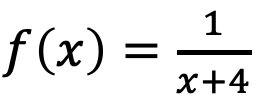
Example: For f(x) = \frac{1}{x+4}, interchange variables to get x = \frac{1}{y+4}, then solve for y to find the inverse.
Verifying Inverse Functions
To verify that two functions are inverses, show that composing one with the other yields the identity function:
f(f^{-1}(x)) = x for all x in the domain of f^{-1}
f^{-1}(f(x)) = x for all x in the domain of f
Summary Table: Properties of Inverse Functions
Property | Description |
|---|---|
Domain of f | Range of f^{-1} |
Range of f | Domain of f^{-1} |
f(f^{-1}(x)) | x |
f^{-1}(f(x)) | x |
Additional info:
Composite functions are often illustrated with diagrams showing the flow from the domain of g to the range of f.
One-to-one functions are essential for the existence of inverse functions.
When working with rational or radical functions, always check for domain restrictions due to division by zero or even roots of negative numbers.
