Back
BackComprehensive Precalculus Final Exam Review Guidance
Study Guide - Smart Notes
 Tailored notes based on your materials, expanded with key definitions, examples, and context.
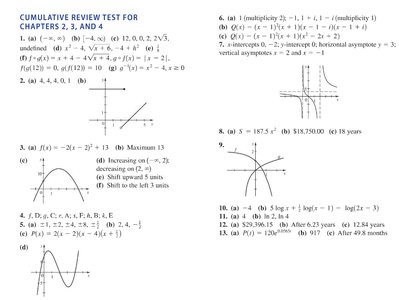
Q1. Let and . Find each of the following:
Background
Topic: Functions, Domains, and Operations
This question tests your understanding of function domains, evaluating functions, average rate of change, and finding inverses.
Key Terms and Formulas:
Domain: The set of all input values (x) for which the function is defined.
Average Rate of Change:
Inverse Function: If and are inverses, then .
Step-by-Step Guidance
For the domain of , consider what values of make $f(x)$ defined. Since $f(x)$ is a quadratic, it is defined for all real numbers.
For the domain of , set the expression under the square root and solve for .
To evaluate , substitute each value into the respective function and simplify.
For , replace with the new expression in each function and simplify.
To find the average rate of change of between and , use the formula .
Try solving on your own before revealing the answer!
Q2. Let . Evaluate and sketch the graph of .
Background
Topic: Piecewise Functions
This question tests your ability to evaluate and graph piecewise-defined functions.
Key Terms and Formulas:
Piecewise Function: A function defined by different expressions for different intervals of the domain.
Step-by-Step Guidance
For each value, determine which piece of the function applies (check if or ).
Substitute the value into the appropriate expression and simplify.
To sketch the graph, plot the constant value for and the linear part for .
Try solving on your own before revealing the answer!
Q3. Let be the quadratic function .
Background
Topic: Quadratic Functions and Their Properties
This question tests your ability to rewrite quadratics in standard form, find extrema, and analyze intervals of increase/decrease.
Key Terms and Formulas:
Standard Form:
Vertex:
Maximum/Minimum Value: Occurs at the vertex for a quadratic.
Step-by-Step Guidance
Rewrite in standard form by completing the square.
Find the vertex using and substitute back to find the maximum/minimum value.
Determine the intervals where is increasing or decreasing based on the sign of and the vertex.
Describe how the graph changes with horizontal and vertical shifts.
Try solving on your own before revealing the answer!
Q4. Without using a graphing calculator, match each function to the graphs below. Give reasons for your choices.
Background
Topic: Function Graphs and Characteristics
This question tests your ability to recognize function types (linear, quadratic, cubic, rational) and their graphical features.
Key Terms and Formulas:
Graph Shape: Linear (straight), Quadratic (parabola), Cubic (S-shaped), Rational (asymptotes).
Step-by-Step Guidance
Analyze each function for degree, leading coefficient, and intercepts.
Compare these features to the provided graphs (A–F).
Match each function to the graph based on shape and behavior.
Try solving on your own before revealing the answer!
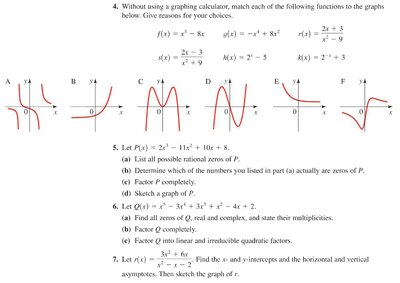
Q5. Let .
Background
Topic: Polynomial Functions and Factoring
This question tests your ability to find rational zeros, factor polynomials, and sketch graphs.
Key Terms and Formulas:
Rational Root Theorem: Possible rational zeros are , where divides the constant term and divides the leading coefficient.
Factoring: Expressing a polynomial as a product of lower-degree polynomials.
Step-by-Step Guidance
List all possible rational zeros using the Rational Root Theorem.
Test each possible zero by substitution or synthetic division to determine which are actual zeros.
Factor completely using the found zeros.
Try solving on your own before revealing the answer!
Q6. Let .
Background
Topic: Polynomial Roots and Factoring
This question tests your ability to find all zeros (real and complex), state their multiplicities, and factor polynomials.
Key Terms and Formulas:
Multiplicity: The number of times a root appears.
Irreducible Quadratic: A quadratic that cannot be factored further over the real numbers.
Step-by-Step Guidance
Use Rational Root Theorem to list possible rational zeros.
Test each possible zero to find actual zeros and their multiplicities.
Factor completely, including irreducible quadratics.
Try solving on your own before revealing the answer!
Q7. Let . Find the -intercepts and the horizontal and vertical asymptotes. Then sketch the graph of .
Background
Topic: Rational Functions and Asymptotes
This question tests your ability to find intercepts and asymptotes for rational functions.
Key Terms and Formulas:
Vertical Asymptote: Set denominator equal to zero and solve for .
Horizontal Asymptote: Compare degrees of numerator and denominator.
-intercept: Set and solve for .
Step-by-Step Guidance
Find the -intercept by evaluating .
Find vertical asymptotes by solving .
Find horizontal asymptotes by comparing degrees of numerator and denominator.
Try solving on your own before revealing the answer!
Q8. A survey finds that the average starting salary for young people in their first full-time job is proportional to the square of the number of years of education they have completed. College graduates with 16 years of education have an average starting salary of $48,000.
Background
Topic: Mathematical Modeling and Proportional Relationships
This question tests your ability to write equations for proportional relationships and interpret their meaning.
Key Terms and Formulas:
Proportional Relationship: where is a constant.
Step-by-Step Guidance
Write the equation relating salary to years of education using the given proportional relationship.
Use the data point (16 years, k$.
Use the equation to answer the other parts (e.g., salary for different years of education).
Try solving on your own before revealing the answer!
Q9. Sketch graphs of the following functions on the same coordinate plane: ,
Background
Topic: Exponential and Logarithmic Functions
This question tests your ability to graph exponential and logarithmic functions and understand their properties.
Key Terms and Formulas:
Exponential Function:
Logarithmic Function:
Step-by-Step Guidance
Identify the domain and range for each function.
Plot key points for and (e.g., ).
Sketch the general shape of each graph, noting asymptotes and intercepts.
Try solving on your own before revealing the answer!
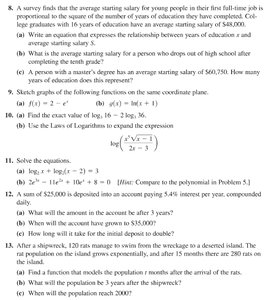
Q10. Find the exact value of
Background
Topic: Logarithms and Properties
This question tests your ability to use logarithm properties to simplify expressions.
Key Terms and Formulas:
Logarithm Properties: , ,
Step-by-Step Guidance
Rewrite as .
Apply logarithm properties to simplify .
Try solving on your own before revealing the answer!
Q11. Solve the equations: (a) (b)
Background
Topic: Solving Logarithmic Equations
This question tests your ability to solve equations involving logarithms.
Key Terms and Formulas:
Inverse Property:
Step-by-Step Guidance
Rewrite each equation in exponential form using the inverse property.
Solve for in each case.
Try solving on your own before revealing the answer!
Q12. A sum of is deposited into an account paying interest per year, compounded daily.
Background
Topic: Exponential Growth and Compound Interest
This question tests your ability to use the compound interest formula to solve for future value and doubling time.
Key Terms and Formulas:
Compound Interest Formula:
Doubling Time:
Step-by-Step Guidance
Identify , , (daily compounding).
Plug values into the compound interest formula to solve for after 5 years.
Set and solve for to find the doubling time.
Try solving on your own before revealing the answer!
Q13. After a shipwreck, 120 rats are released onto an island. After 15 months there are 280 rats on the island. Assume the population grows exponentially.
Background
Topic: Exponential Growth Modeling
This question tests your ability to model population growth using exponential functions.
Key Terms and Formulas:
Exponential Growth Model:
Step-by-Step Guidance
Set up the exponential growth equation using the initial and later population values.
Solve for the growth rate using the data provided.
Use the model to predict population at future times.
Try solving on your own before revealing the answer!
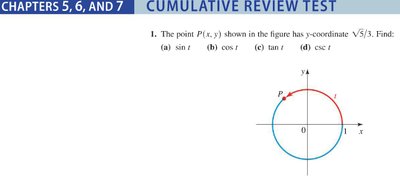
Q1 (Chapters 5, 6, and 7). The point shown in the figure has -coordinate . Find: (a) (b) (c) (d)
Background
Topic: Unit Circle and Trigonometric Functions
This question tests your ability to use the unit circle to find trigonometric values given a coordinate.
Key Terms and Formulas:
Unit Circle:
Trigonometric Functions: , , ,
Step-by-Step Guidance
Use the given -coordinate to find .
Use the unit circle equation to solve for .
Find , , and using the values found.
Try solving on your own before revealing the answer!
Q7. The figure below shows a model Ferris wheel that a child has constructed using a toy building kit. The wheel has a radius of 40 cm, and the center of the wheel is 45 cm above the floor. An electric motor causes it to turn at 4 rotations per minute.
Background
Topic: Trigonometric Modeling and Applications
This question tests your ability to model periodic motion using trigonometric functions and solve geometric problems.
Key Terms and Formulas:
Periodic Function:
Distance Formula:
Step-by-Step Guidance
Express the height of the point as a function of time using cosine.
Use the geometry of the Ferris wheel to find the distance between points AB and AC.
Try solving on your own before revealing the answer!
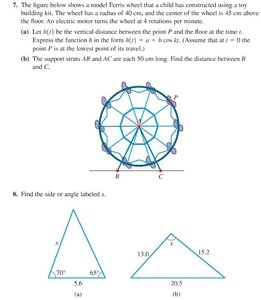
Q8. Find the side or angle labeled in the given triangles.
Background
Topic: Triangle Trigonometry
This question tests your ability to use the Law of Sines and Law of Cosines to solve for unknown sides or angles.
Key Terms and Formulas:
Law of Sines:
Law of Cosines:
Step-by-Step Guidance
Identify which law applies based on the given information.
Set up the equation and solve for the unknown side or angle.
Try solving on your own before revealing the answer!
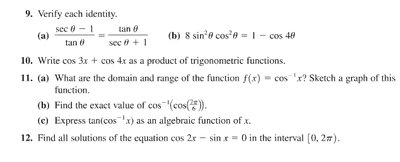
Q9. Verify each trigonometric identity.
Background
Topic: Trigonometric Identities
This question tests your ability to manipulate and verify trigonometric identities.
Key Terms and Formulas:
Trigonometric Identities: Fundamental relationships between trigonometric functions.
Step-by-Step Guidance
Start with one side of the identity and use algebraic and trigonometric properties to transform it.
Show each step clearly, justifying the use of identities.
Try solving on your own before revealing the answer!
Q10. Write as a product of trigonometric functions.
Background
Topic: Trigonometric Sum-to-Product Formulas
This question tests your ability to use sum-to-product identities to rewrite trigonometric expressions.
Key Terms and Formulas:
Sum-to-Product Formula:
Step-by-Step Guidance
Identify , .
Apply the sum-to-product formula to rewrite the expression.
Try solving on your own before revealing the answer!
Q11. (a) What are the domain and range of the function ? Sketch a graph of this function.
Background
Topic: Inverse Trigonometric Functions
This question tests your understanding of the domain, range, and graph of the inverse cosine function.
Key Terms and Formulas:
Domain of :
Range of :
Step-by-Step Guidance
State the domain and range based on the definition of inverse cosine.
Sketch the graph, noting endpoints and shape.
Try solving on your own before revealing the answer!