 Back
BackComprehensive Precalculus Finals Review Notes
Study Guide - Smart Notes
 Tailored notes based on your materials, expanded with key definitions, examples, and context.
Parent Functions
Overview of Parent Functions
Parent functions are the simplest forms of functions in various families and serve as the foundation for understanding more complex transformations and behaviors. Recognizing these basic graphs and their equations is essential for analyzing and graphing functions.
Linear Function:
Quadratic Function:
Cubic Function:
Rational Function:
Square Root Function:
Absolute Value Function:
Exponential Function:
Logarithmic Function: or
Sine Function:
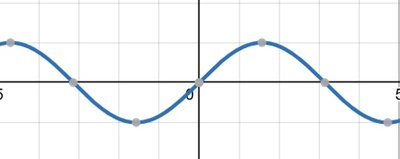
Additional info: The image above shows the graph of the sine function, which is periodic with a period of , amplitude 1, and passes through the origin.
Polynomials
Polynomial Identities and Theorems
Polynomials are algebraic expressions consisting of variables and coefficients, involving only non-negative integer powers of variables. Key identities and theorems help in factoring and solving polynomial equations.
Square of a Sum:
Square of a Difference:
Difference of Squares:
Difference of Cubes:
Sum of Cubes:
Rational Root Theorem: Possible rational roots of a polynomial are (factors of the constant term) (factors of the leading coefficient).
Standard Form with Given Roots: For roots and , .
Conjugate Roots: If a polynomial with real coefficients has an irrational or imaginary root, its conjugate is also a root.
General Functions
Operations and Inverses
Functions can be combined and manipulated in various ways. Understanding these operations is crucial for function analysis.
Addition:
Subtraction:
Multiplication:
Division:
Composition:
Inverses: and are inverses if
Example: If and , then:
Radical Functions and Rational Exponents
Properties and Simplification
Radical functions involve roots, and rational exponents provide an alternative notation for roots and powers.
General Equation:
Rational Expressions
Operations and Restrictions
Rational expressions are fractions involving polynomials. Special care must be taken with their domains and simplification.
Extraneous Solutions: Solutions that do not satisfy the original equation after simplification.
Excluded Values: Values that make the denominator zero.
Multiplying/Dividing: Factor and cancel common terms before simplifying.
Adding/Subtracting: Use a common denominator.
Logarithmic Expressions
Properties and Equations
Logarithms are the inverses of exponential functions and have unique properties for simplifying expressions.
Change of Base:
General Form: or
Vertical Asymptote:
Rational Functions
Asymptotes and Holes
Rational functions are ratios of polynomials and can have vertical, horizontal, or slant asymptotes, as well as holes.
General Form:
Vertical Asymptote: (zeros of denominator)
Horizontal Asymptote: (for simple forms)
Degree Analysis:
If numerator degree < denominator degree:
If degrees are equal:
If numerator degree is one more: slant asymptote (use division)
Holes: Occur at values canceled out from both numerator and denominator.
Exponentials and Compound Interest
Growth, Decay, and Financial Applications
Exponential functions model rapid growth or decay, and are used in compound interest calculations.
General Exponential:
Compound Interest:
Continuous Compound Interest:
n values: 1 (annually), 2 (semi-annually), 4 (quarterly), 12 (monthly), 365 (daily)
Vectors
Magnitude, Direction, and Operations
Vectors have both magnitude and direction and are used to represent quantities in physics and geometry.
Component Form:
Magnitude:
Direction:
Dot Product:
Orthogonality:
Angle Between Vectors:
Partial Fraction Decomposition
Breaking Down Rational Expressions
Partial fraction decomposition expresses a rational function as a sum of simpler fractions, useful for integration and simplification.
For , :
For repeated or quadratic factors, include terms like or
Function Characteristics and Transformations
Effects of Parameters on Graphs
Transformations shift, reflect, stretch, or compress the graph of a function.
Vertical Reflection: Negative sign in front of reflects across x-axis.
Horizontal Reflection: Negative sign in front of reflects across y-axis.
Vertical Stretch/Compression: stretches, compresses vertically.
Horizontal Stretch/Compression: compresses, stretches horizontally.
Horizontal Shift: left, right.
Vertical Shift: up, down.
Trigonometry
Identities and Formulas
Trigonometric identities and formulas are essential for simplifying expressions and solving equations.
Pythagorean Identity:
Sum/Difference Formulas:
Double Angle Formulas:
Law of Sines:
Law of Cosines:
Area of Triangle:
Graphing Trigonometric Functions
Sine, Cosine, and Tangent Graphs
Trigonometric functions have characteristic graphs with specific amplitude, period, and phase shift.
General Form: or
Period: for sine and cosine, for tangent
Midline:
Amplitude:
Phase Shift:
Example: The sine function starts at the midline, reaches a maximum at , returns to the midline at , reaches a minimum at , and completes a period at .
Trigonometric Inverses
Domains and Ranges
Inverse trigonometric functions return the angle for a given trigonometric value.
: ,
: ,
: ,
Polar Coordinates and Representations
Conversion and Operations
Polar coordinates represent points using a radius and angle. Conversion between polar and rectangular forms is common in analytic geometry.
Distance:
Matrices
Determinants and Inverses
Matrices are arrays of numbers used to solve systems of equations and perform transformations.
Determinant: For matrix ,
Inverse: Exists if determinant
Classifying Curves
Polar Graphs: Limacons and Rose Curves
Limacons: or
Rose Curves: or
Classification:
Inner Loop:
Cardioid:
Dimple:
Convex:
Sequences and Series
Arithmetic and Geometric Progressions
Arithmetic Sequence:
Explicit:
Recursive: ,
Sum:
Geometric Sequence:
Explicit:
Recursive: ,
Sum:
Infinite Sum: ,
Conic Sections
Circles, Ellipses, Hyperbolas, and Parabolas
Conic sections are curves obtained by intersecting a plane with a double-napped cone. Each has a standard equation and unique properties.
Circle:
Ellipse:
Hyperbola:
Parabola: or
Eccentricity:
For Ellipses:
For Hyperbolas:
Vertex: or
Focus: or
Directrix (parabola): ,
Axis of Symmetry (parabola):
