 Back
BackComprehensive Study Notes: Trigonometric Functions and Their Applications
Study Guide - Smart Notes
 Tailored notes based on your materials, expanded with key definitions, examples, and context.
Angles, Arc Length, and Circular Motion
Angle Measurement and Conversions
Understanding angle measurement is fundamental in trigonometry. Angles can be measured in degrees, minutes, seconds (DMS), or radians. Converting between these units is essential for solving trigonometric problems.
DMS Conversions: 1 degree (1º) = 60 minutes (60'), 1 minute (1') = 60 seconds (60'').
Degree to Radian Conversion:
Radian to Degree Conversion:
Arc Length and Area of a Sector
For a circle of radius r and a central angle (in radians):
Arc Length:
Area of a Sector:
Circular Motion
Circular motion describes how a point moves along a circle. Two key quantities are linear speed and angular speed.
Linear Speed:
Angular Speed: (where is in radians)
Right Triangle Trigonometry
Trigonometric Functions
Trigonometric functions relate the angles of a right triangle to the ratios of its sides.
Pythagorean Theorem:
Complementary Angles
Similar relationships hold for secant and cosecant.
Graphs of Trigonometric Functions
General Equation and Parameters
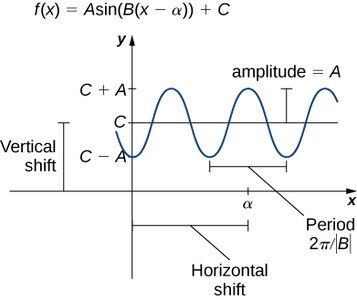
The general form for the sine and cosine functions is:
Amplitude (A): The maximum displacement from the midline.
Period (P):
Horizontal Shift (\varphi): The phase shift of the graph.
Vertical Shift (\beta): The upward or downward translation of the graph.
Asymptotes for Reciprocal Functions
Reciprocal trigonometric functions (secant, cosecant, tangent, cotangent) have vertical asymptotes where their base functions are undefined.
Tangent:
Cotangent:
Secant:
Cosecant:
Asymptotes repeat every radians due to periodicity.
Inverse Trigonometric Functions
Definition and Properties
Inverse trigonometric functions allow us to find angles given function values. Each function has a restricted range to ensure it is one-to-one.
If , then
(within restricted interval)
Restriction Intervals
Function | Principal Interval for y | Undefined at |
|---|---|---|
sin / csc | (csc) | |
cos / sec | (sec) | |
tan | – | |
cot | – |
Note: [ ] includes endpoint, ( ) excludes endpoint.
Trigonometric Identities
Pythagorean Identities
Even-Odd Identities
Similar relationships hold for secant, cosecant, and cotangent.
Sum and Difference Formulas
Double Angle Formulas
Half Angle Formulas
Product-to-Sum and Sum-to-Product Formulas
Applications of Trigonometric Functions
Law of Sines
For any triangle,
Law of Cosines
Simple Harmonic Motion
or
Frequency:
Damped motion: (amplitude decreases over time)
Polar Coordinates
Conversion Between Polar and Rectangular Coordinates
(if )
Polar Equations
: Circle, center at
: Circle, center at
: Horizontal line units above/below the pole
: Vertical line units right/left of the pole
