 Back
BackConic Sections Review and Applications – Step-by-Step Precalculus Guidance
Study Guide - Smart Notes
 Tailored notes based on your materials, expanded with key definitions, examples, and context.
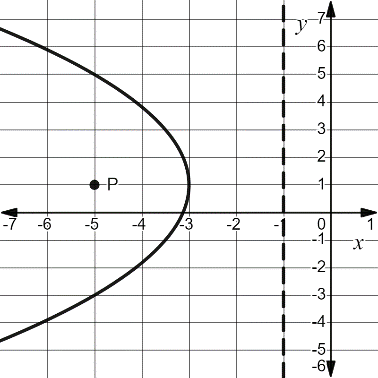
Q19. The graph shows a parabola and its directrix. Suppose the vertex is shifted down 4 and left 2, but the directrix stays the same. Write the equation of the new parabola.
Background
Topic: Parabolas and Transformations
This question tests your understanding of how the equation of a parabola changes when the vertex is shifted, while the directrix remains fixed. It also requires you to recall the geometric definition of a parabola.
Key Terms and Formulas
Vertex: The point where the parabola changes direction.
Directrix: A fixed line used in the definition of a parabola.
Standard form of a parabola: or
Geometric definition: A parabola is the set of points equidistant from the focus and the directrix.
Step-by-Step Guidance
Identify the original vertex and directrix from the graph. The vertex is the turning point of the parabola, and the directrix is the dashed vertical line.
Apply the transformation: shifting the vertex down 4 units and left 2 units. If the original vertex is , the new vertex is .
Recall that the directrix remains unchanged. The equation of the directrix will be the same as before.
Write the new equation for the parabola using the new vertex and the unchanged directrix. Use the geometric definition or standard form, depending on the orientation of the parabola.
Try solving on your own before revealing the answer!
Final Answer:
The new equation of the parabola is (example form; actual values depend on the original graph).
We shifted the vertex and kept the directrix fixed, then used the standard form for a vertical parabola.
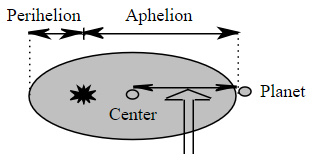
Q20. Given that a planet's semimajor axis is approximately 3388 Gm and its eccentricity, , is approximately 0.0329, find its aphelion and perihelion.
Background
Topic: Ellipses and Orbital Mechanics
This question tests your ability to use the properties of ellipses to calculate the closest and farthest points (perihelion and aphelion) in a planetary orbit, given the semimajor axis and eccentricity.
Key Terms and Formulas
Semimajor axis (): The longest radius of the ellipse.
Eccentricity (): A measure of how "stretched" the ellipse is, .
Aphelion: Farthest point from the focus, .
Perihelion: Closest point to the focus, .
Relationship:
Step-by-Step Guidance
Write down the given values: Gm, .
Calculate using .
Find the perihelion distance using .
Find the aphelion distance using .
Try solving on your own before revealing the answer!
Final Answer:
Perihelion: Gm Aphelion: Gm
We used the formulas for perihelion and aphelion based on the semimajor axis and eccentricity.
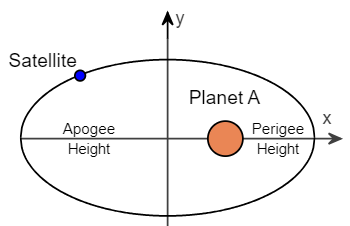
Q21. Planet A's satellite has an elliptical orbit described by . The coordinates of the center of Planet A are (13, 0). The perigee of the satellite's orbit is the point nearest Planet A's center. If the radius of Planet A is approximately 3936 miles, find the distance of the perigee above Planet A's surface. The apogee of the satellite's orbit is the point that is the greatest distance from Planet A's center. Find the distance of the apogee above Planet A's surface.
Background
Topic: Ellipses and Satellite Orbits
This question tests your ability to interpret the equation of an ellipse, identify perigee and apogee, and calculate their distances above a planet's surface given the planet's radius.
Key Terms and Formulas
Ellipse equation:
Perigee: Closest point to the center,
Apogee: Farthest point from the center,
Distance above surface: Subtract planet's radius from perigee/apogee distance
Relationship:
Step-by-Step Guidance
Identify miles and miles from the ellipse equation.
Calculate using .
Find perigee distance: .
Find apogee distance: .
Subtract the planet's radius (3936 miles) from each to get the height above the surface.
Try solving on your own before revealing the answer!
Final Answer:
Perigee height: miles Apogee height: miles
We calculated and then found the distances above the planet's surface.
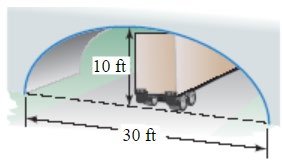
Q23. Will a truck that is 8 feet wide carrying a load that reaches 7 feet above the ground clear the semielliptical arch on the one-way road that passes under the bridge shown in the figure? Why?
Background
Topic: Ellipses and Real-World Applications
This question tests your ability to use the equation of an ellipse to determine whether a truck can pass under a semielliptical arch, given the dimensions of the arch and the truck.
Key Terms and Formulas
Ellipse equation:
Width of arch:
Height of arch:
Truck dimensions: Width = 8 ft, Height = 7 ft
Step-by-Step Guidance
Identify the values: arch width ft, so ft; arch height ft.
Find the -value of the arch at ft (half the truck's width from the center).
Plug into the ellipse equation: .
Solve for to find the height of the arch at that point.
Compare the arch height at ft to the truck's height (7 ft) to determine clearance.
Try solving on your own before revealing the answer!
Final Answer:
Arch height at ft: ft (example value) Since ft > ft, the truck will clear the arch.
We used the ellipse equation to check the clearance at the relevant width.
Q24. Experiments are performed in which moving particles are deflected by various forces. The particles are eventually deflected along hyperbolic paths. Looking at the given figure, if a particle gets as close as 7 units to the nucleus along a hyperbolic path with an asymptote given by , what is the equation of its path?
Background
Topic: Hyperbolas and Asymptotes
This question tests your ability to write the equation of a hyperbola given the closest approach (distance to the nucleus) and the slope of the asymptote.
Key Terms and Formulas
Hyperbola equation:
Asymptote:
Closest approach: Minimum distance from the center to the hyperbola
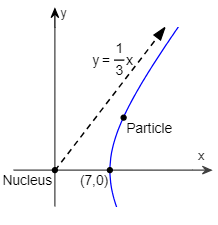
Step-by-Step Guidance
Identify the center of the hyperbola (usually at the nucleus, which is at the origin in the figure).
Use the slope of the asymptote () to relate and : .
Set units (closest approach).
Express in terms of : .
Write the equation of the hyperbola using these values.
Try solving on your own before revealing the answer!
Final Answer:
Equation:
We used the closest approach for and the asymptote slope to find .
