 Back
Equations and Inequalities: Precalculus Study Notes
Study Guide - Smart Notes
 Tailored notes based on your materials, expanded with key definitions, examples, and context.
Equations and Inequalities
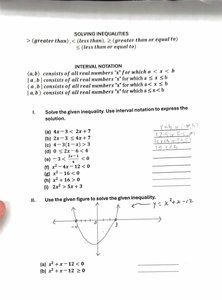
Solving Inequalities
Inequalities are mathematical statements that compare two values or expressions using symbols such as > (greater than), < (less than), ≥ (greater than or equal to), and ≤ (less than or equal to). Solving inequalities involves finding the set of values that satisfy the inequality.
> (greater than): Indicates that one value is larger than another.
< (less than): Indicates that one value is smaller than another.
≥ (greater than or equal to): Indicates that one value is larger than or equal to another.
≤ (less than or equal to): Indicates that one value is smaller than or equal to another.
Interval Notation
Interval notation is a concise way to describe sets of real numbers that satisfy inequalities. It uses parentheses and brackets to indicate whether endpoints are included or excluded.
(a, b): All real numbers x for which a < x < b (endpoints not included).
[a, b]: All real numbers x for which a ≤ x ≤ b (endpoints included).
(a, b]: All real numbers x for which a < x ≤ b.
[a, b): All real numbers x for which a ≤ x < b.
Solving Linear Inequalities
Linear inequalities are similar to linear equations but use inequality signs. The solution is often expressed in interval notation.
Example: Solve Step 1: Subtract 2 from both sides: Step 2: Divide both sides by 3: Solution:
Example: Solve Step 1: Add 5 to both sides: Step 2: Divide both sides by 2: Solution:
Solving Quadratic Inequalities
Quadratic inequalities involve expressions of the form . Solutions are often found by factoring or using the quadratic formula, then testing intervals.
Example: Solve Step 1: Factor: Step 2: Find zeros: , Step 3: Test intervals:
: Both factors negative, product positive
: One factor positive, one negative, product negative
: Both factors positive, product positive
Solution:
Solving Equations: Linear, Quadratic, Rational, and Radical
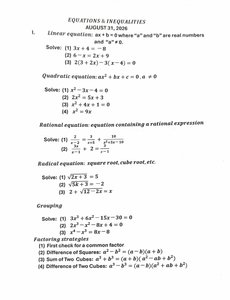
Equations are mathematical statements asserting equality. Different types require different methods:
Linear Equation: Example: Solution:
Quadratic Equation: Example: Solution:
Rational Equation: Contains fractions with variables in the denominator. Example: Solution:
Radical Equation: Contains square roots or other roots. Example: Solution:
Factoring Techniques
Factoring is a method used to solve equations and simplify expressions. Common techniques include:
Difference of Squares:
Sum and Difference of Cubes:
Grouping: Used for polynomials with four or more terms.
Grouping Example
Example: Step 1: Factor: Step 2: Set each factor to zero: or Solution: or
Summary Table: Types of Equations and Methods
Type of Equation | General Form | Solution Method |
|---|---|---|
Linear | Isolate variable | |
Quadratic | Factoring, quadratic formula | |
Rational | Clear denominators, solve | |
Radical | Isolate radical, square both sides |
Additional info:
Interval notation is essential for expressing solutions to inequalities.
Factoring is a foundational skill for solving quadratic and higher-order equations.
Graphical representations, such as the parabola in image_1, help visualize solutions to quadratic inequalities.
