 Back
BackExponential and Logarithmic Functions: Precalculus Study Guide
Study Guide - Smart Notes
 Tailored notes based on your materials, expanded with key definitions, examples, and context.
Expoznctions
Definition and Properties
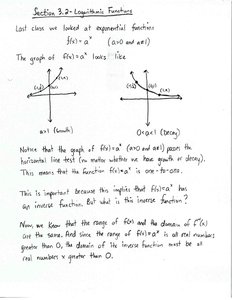
Exponential functions are fundamental in precalculus, modeling growth and decay processes. A function of the form f(x) = ax (where a > 0 and a ≠ 1) is called an exponential function with base a.
Domain: All real numbers,
Range: All real numbers greater than 0,
Key Properties:
Example: Evaluate for :
Graphing Exponential Functions
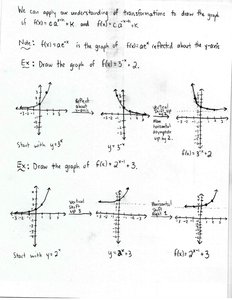
Exponential functions can be graphed by evaluating the function at various points and plotting the results. The graph of is always increasing for and decreasing for .
Transformations of Exponential Functions
Transformations such as shifts and reflections can be applied to exponential functions. For example, is the graph of reflected about the y-axis.
Logarithmic Functions
Definition and Properties
A logarithmic function is the inverse of an exponential function. The function (where and ) is called the logarithmic function with base a.
Domain:
Range:
Inverse Property:
Graphs of Logarithmic Functions
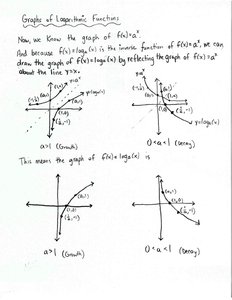
The graph of is obtained by reflecting the graph of about the line . The graph is increasing for and decreasing for .
Properties of Logarithmic Functions
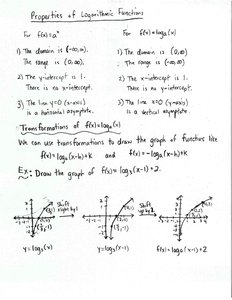
Domain:
Range:
Vertical Asymptote:
Transformations: Shifts and reflections can be applied to logarithmic functions.
Common and Natural Logarithms
If the base of a logarithm is 10, it is called a common logarithm (). If the base is (Euler's number, approximately 2.71828), it is called a natural logarithm ().
Common Logarithm:
Natural Logarithm:
Rules of Logarithms
Product, Quotient, and Power Rules
Logarithms follow several important rules:
Product Rule:
Quotient Rule:
Power Rule:
Expanding and Condensing Logarithmic Expressions
Logarithmic expressions can be expanded or condensed using the above rules.
Example (Expand):
Example (Condense):
Change of Base Formula
The change of base formula allows us to convert logarithms to a different base:
This is commonly used to convert logarithms to base 10 or base for calculator computations.
Solving Exponential and Logarithmic Equations
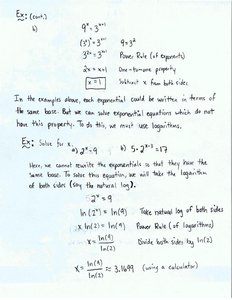
Solving Exponential Equations
To solve exponential equations, use properties of exponents or logarithms:
If possible, rewrite both sides with the same base and use the one-to-one property.
If not possible, take the logarithm of both sides and solve for the variable.
Example: Solve :
Take natural log:
Apply power rule:
Solve:
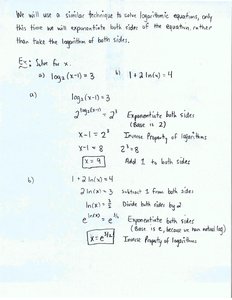
Solving Logarithmic Equations
To solve logarithmic equations, isolate the logarithm and exponentiate both sides:
Example:
Exponentiate:
Solve:
Applications: Exponential Growth, Decay, and Compound Interest
Exponential Growth and Decay
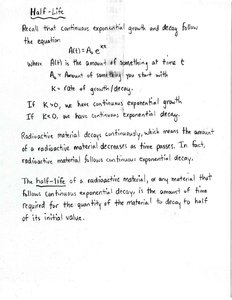
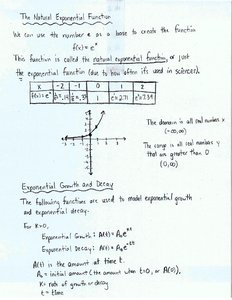
Exponential functions model population growth, radioactive decay, and other processes. The general formula is:
: Initial amount
: Growth () or decay () rate
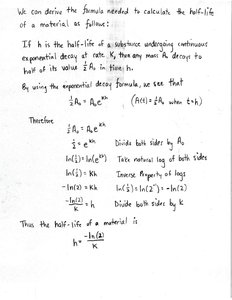
Half-Life
The half-life of a substance is the time required for its amount to decrease to half its initial value. The formula is:
Compound Interest
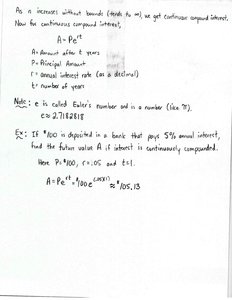
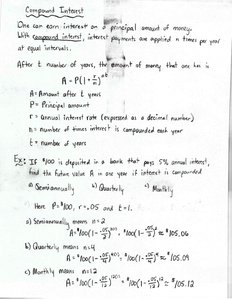
Compound interest is calculated using exponential functions. The formula for compound interest is:
: Amount after years
: Principal amount
: Annual interest rate (decimal)
: Number of times interest is compounded per year
: Number of years
For continuous compounding:
The Natural Exponential Function
Definition
The natural exponential function uses Euler's number as the base: .
Domain:
Range:
Summary Table: Exponential vs. Logarithmic Functions
Function Type | General Form | Domain | Range | Key Property |
|---|---|---|---|---|
Exponential | Inverse of logarithmic | |||
Logarithmic | Inverse of exponential |
