 Back
BackExponential and Logarithmic Functions: Properties, Graphs, and Transformations
Study Guide - Smart Notes
 Tailored notes based on your materials, expanded with key definitions, examples, and context.
Exponential Functions
Definition and Basic Properties
An exponential function is defined as , where is a positive constant other than 1 (, ), and is any real number. Exponential functions are fundamental in modeling growth and decay in various fields such as biology, finance, and physics.
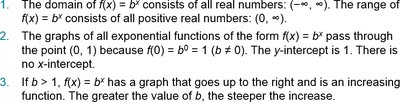
Domain: All real numbers
Range: All positive real numbers
Y-intercept: since
No X-intercept: The graph never crosses the x-axis.
One-to-one function: Each value corresponds to a unique value, and vice versa.
Horizontal asymptote:
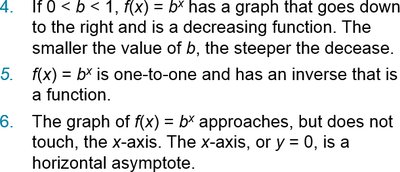
If , is increasing (rises to the right).
If , is decreasing (falls to the right).
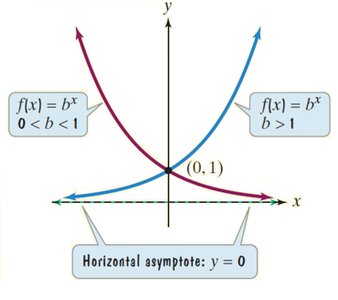
Example: is increasing; is decreasing.
Graphing Exponential Functions
To graph an exponential function, plot several points by substituting values for and calculate . Identify the horizontal asymptote and the y-intercept.
For transformations such as , shift the graph horizontally by units and vertically by units.
Logarithmic Functions
Definition and Basic Properties
A logarithmic function with base is defined as , where and . The logarithmic function is the inverse of the exponential function.
Domain: All positive real numbers
Range: All real numbers
X-intercept: since
No Y-intercept: The graph never crosses the y-axis.
Vertical asymptote:
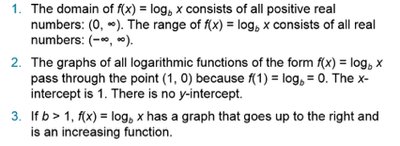
If , is increasing.
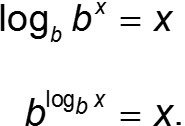
Inverse Properties:
Common and Natural Logarithms
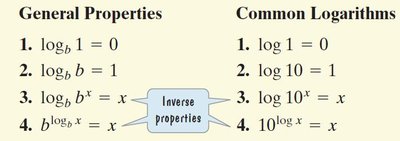
Common logarithm: Base 10, written as
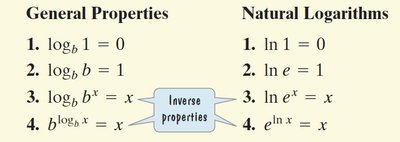
Natural logarithm: Base , written as
Properties of Logarithms
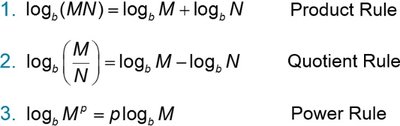
Product Rule:
Quotient Rule:
Power Rule:
Transformations of Logarithmic Functions
Logarithmic functions can be shifted, reflected, stretched, or shrunk using transformations:
Transformation | Equation | Description |
|---|---|---|
Vertical translation |
| Shifts graph up/down units |
Horizontal translation |
| Shifts graph left/right units; vertical asymptote at or |
Reflection |
| Reflects graph about x-axis or y-axis |
Vertical stretching/shrinking | Stretches if , shrinks if | |
Horizontal stretching/shrinking | Shrinks if , stretches if |
Solving Logarithmic Equations Using the One-to-One Property
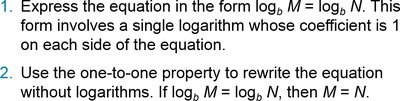
To solve equations involving logarithms, use the one-to-one property:
Express the equation in the form .
By the one-to-one property, .
Summary Table: Key Properties of Exponential and Logarithmic Functions
Function | Domain | Range | Intercepts | Asymptote |
|---|---|---|---|---|
Y: | ||||
X: |
