 Back
BackExponential Functions and Their Applications
Study Guide - Smart Notes
 Tailored notes based on your materials, expanded with key definitions, examples, and context.
Exponential Functions
Definition and Properties of Exponents
Exponential functions are mathematical expressions in which a constant base is raised to a variable exponent. They are fundamental in modeling growth and decay processes in mathematics and science. The properties of exponents are essential for simplifying and manipulating exponential expressions.
Multiplying Powers:
Dividing Powers:
Power to a Power:
Zero Power: (for )
Negative Exponents:
Example: Simplify using the properties above.
Exponential Function: General Form
An exponential function with base (where and ) is defined as:
These functions are one-to-one, continuous, and have important applications in modeling real-world phenomena.
Graphs of Exponential Functions
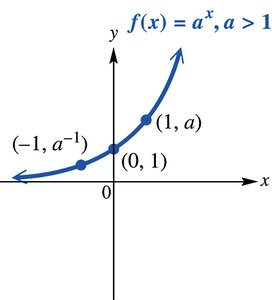
Case 1: (Exponential Growth)
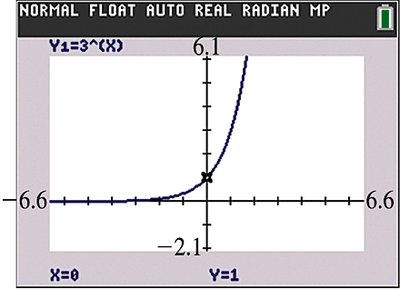
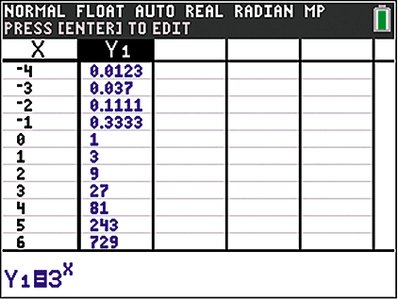
When the base is greater than 1, the function models exponential growth. The graph increases rapidly as increases.
Domain:
Range:
Horizontal Asymptote: as
Key Points: , ,
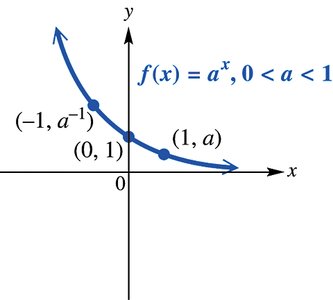
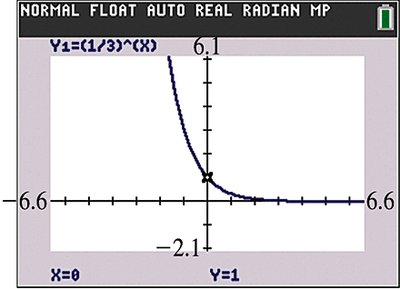
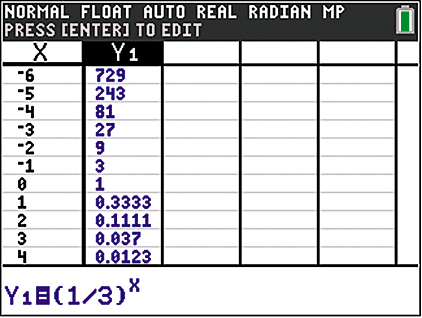
Case 2: (Exponential Decay)
When the base is between 0 and 1, the function models exponential decay. The graph decreases as increases.
Domain:
Range:
Horizontal Asymptote: as
Key Points: , ,
Reflections and Translations of Exponential Functions
Exponential functions can be reflected and translated by modifying their equations. For example, reflects the graph across the x-axis, while translates the graph horizontally.
Reflection: reflects across the x-axis.
Horizontal Translation: shifts the graph left by units.
Vertical Translation: shifts the graph up by units.
Example: Graph , , and and state their domains and ranges.
Solving Exponential Equations and Inequalities
Solving Exponential Equations
To solve equations involving exponents, rewrite both sides with the same base if possible, then set the exponents equal to each other.
Example: Solve .
Rewrite as so .
Other examples include solving equations like and .
Solving Exponential Inequalities
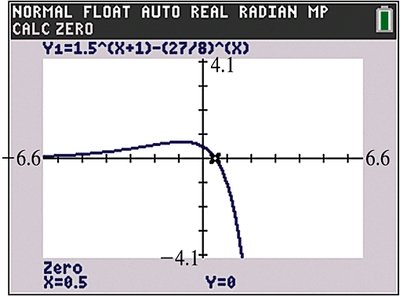
Exponential inequalities can be solved analytically or graphically. For example, to solve , rewrite $81 and solve .
Graphical solutions involve plotting the functions and identifying the regions where the inequality holds.
Applications of Exponential Functions
Compound Interest
Exponential functions are used to model compound interest, where interest is earned on both the initial principal and accumulated interest.
Simple Interest:
Compound Interest (compounded n times per year):
Continuous Compounding:
Example: If $1000 is invested at 1.5% annual interest, compounded quarterly for 10 years, the final amount is calculated using the compound interest formula.
The Natural Number
The number is an important mathematical constant, approximately . It is the base for natural exponential functions and arises in continuous growth and decay models.

Modeling Real-World Phenomena
Exponential functions are used to model population growth, radioactive decay, and risk assessment. For example, the risk of heart disease after age 40 can be modeled by , where is the number of years after age 40.
Summary Table: Properties of Exponential Functions
Base | Behavior | Domain | Range | Asymptote | Key Points |
|---|---|---|---|---|---|
Increasing (Growth) | |||||
Decreasing (Decay) |
Additional info: The notes above include expanded academic context and examples to ensure completeness and clarity for precalculus students.
