 Back
BackExponential Functions: Graphs, Properties, and Applications
Study Guide - Smart Notes
 Tailored notes based on your materials, expanded with key definitions, examples, and context.
Exponential and Logarithmic Functions
Exponential Functions
Exponential functions are a fundamental class of functions in precalculus, characterized by a constant base raised to a variable exponent. They are widely used to model growth and decay in natural and applied sciences.
Definition: An exponential function is of the form , where and .
Domain: All real numbers .
Range: All positive real numbers .
Y-intercept: Always at since .
X-intercept: None, as for all real .
Horizontal Asymptote: The line (x-axis).
One-to-one: Each value corresponds to a unique value.
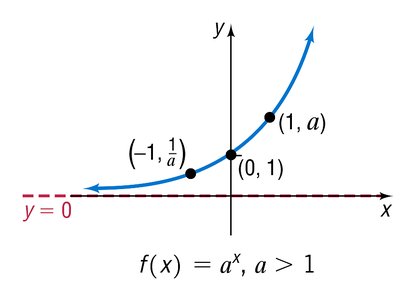
Graphing Exponential Functions
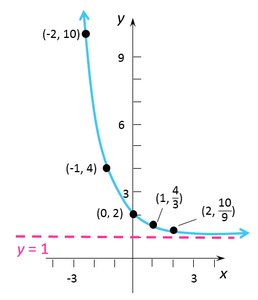
To graph an exponential function, evaluate the function at several values of and plot the corresponding points. The graph will show rapid growth or decay depending on the base .
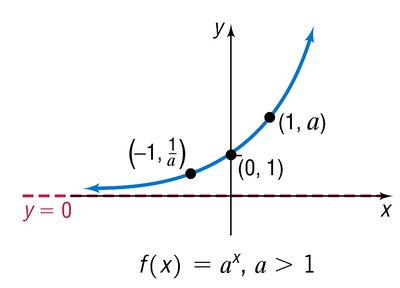
For : The function increases as increases (exponential growth).
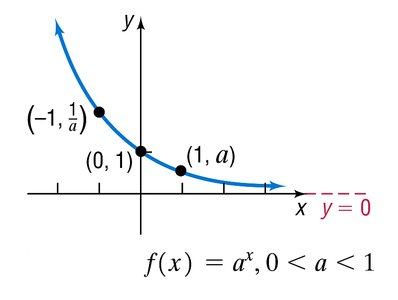
For : The function decreases as increases (exponential decay).
Properties of Exponential Functions
The properties of exponential functions depend on the value of the base :
Property | ||
|---|---|---|
Domain | ||
Range | ||
Y-intercept | ||
X-intercept | None | None |
Horizontal Asymptote | ||
Monotonicity | Increasing | Decreasing |
Transformations of Exponential Functions
Exponential functions can be transformed by shifting, reflecting, or stretching/compressing their graphs. The general form is .
Horizontal Shifts: shifts the graph units right.
Vertical Shifts: shifts the graph units up.
Reflections: reflects the graph about the -axis; reflects about the -axis.
Exponential Growth and Decay
Exponential functions model many real-world phenomena, such as population growth, radioactive decay, and compound interest.
Exponential Growth: , where and is the initial value.
Exponential Decay: , where and is the initial value.
The Number
The number is a mathematical constant that is the base of the natural exponential function. It is an irrational number approximately equal to 2.71828.
Definition:
Properties: is used in continuous growth and decay models, such as continuously compounded interest.
Solving Exponential Equations
To solve exponential equations, express both sides with the same base if possible, then set the exponents equal to each other.
Property: If , then .
Example: Solve .
Solution:
Express both sides with base 3: , .
Rewrite:
Simplify:
Set exponents equal:
Solve:
Example: Solving with Base
Given , set exponents equal:
Rearrange:
Factor:
Solutions: or
Summary Table: Properties of Exponential Functions
Base | Monotonicity | Asymptote | Y-intercept |
|---|---|---|---|
Increasing | |||
Decreasing |
