 Back
BackExponents and Their Properties
Study Guide - Smart Notes
 Tailored notes based on your materials, expanded with key definitions, examples, and context.
Exponents
Definition and Basic Concepts
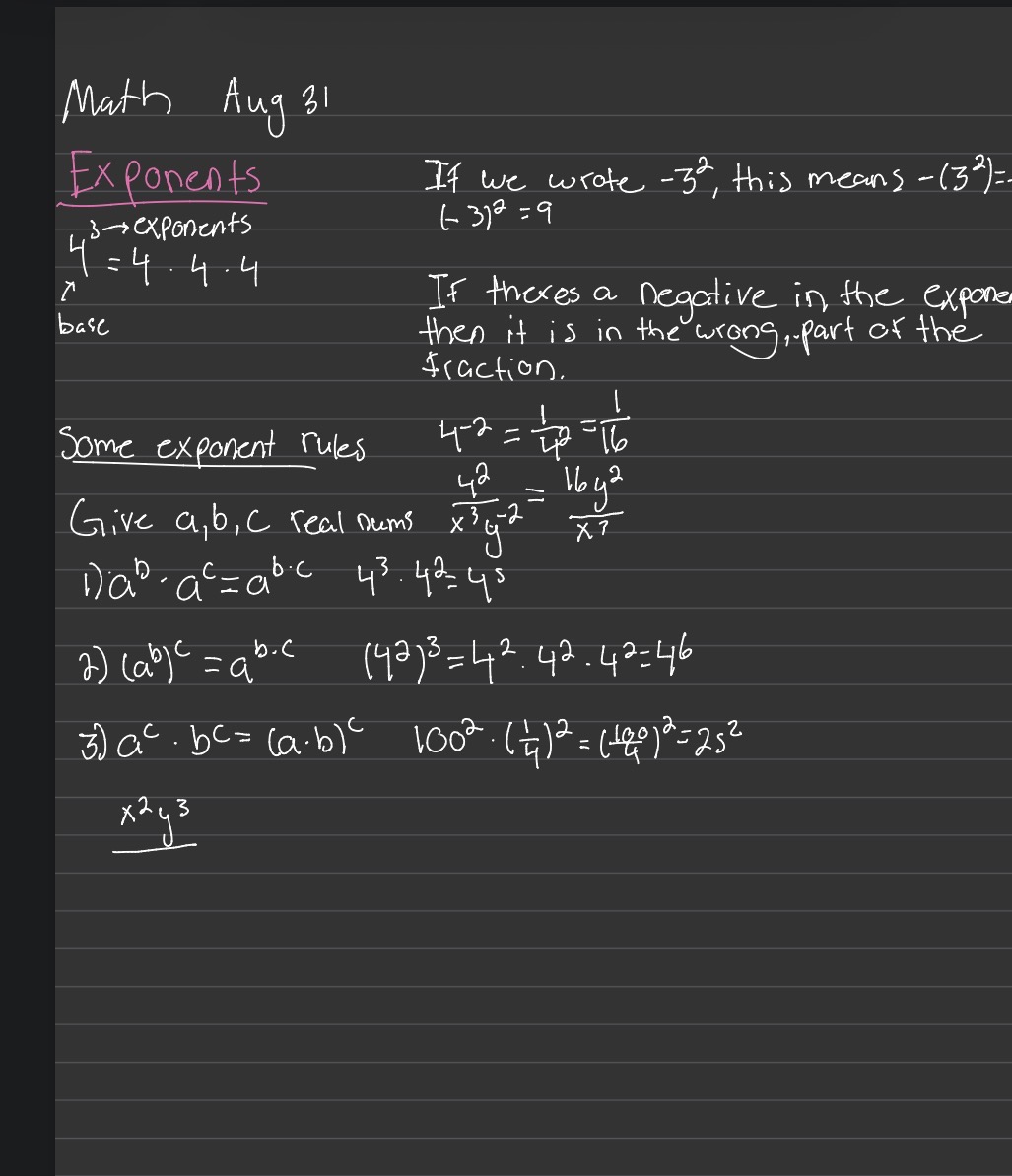
Exponents are a mathematical notation indicating the number of times a number, called the base, is multiplied by itself. The exponent is written as a superscript to the right of the base.
Base: The number being multiplied.
Exponent: The number of times the base is used as a factor.
Example:
Negative Exponents
A negative exponent indicates the reciprocal of the base raised to the corresponding positive exponent.
Rule:
Example:
If there is a negative in the exponent, the base moves to the opposite part of the fraction (numerator to denominator or vice versa).
Negative Bases and Parentheses
When a negative sign is outside the parentheses, it is not included in the exponentiation. Parentheses change the meaning:
means
Exponent Rules
Product of Powers Rule
When multiplying like bases, add the exponents.
Rule:
Example:
Power of a Power Rule
When raising a power to another power, multiply the exponents.
Rule:
Example:
Power of a Product Rule
When raising a product to a power, raise each factor to the power.
Rule:
Example:
Quotient of Powers Rule
When dividing like bases, subtract the exponents.
Rule:
Example:
Summary Table: Exponent Rules
Rule Name | Formula | Example |
|---|---|---|
Product of Powers | ||
Power of a Power | ||
Power of a Product | ||
Quotient of Powers | ||
Negative Exponent |
Additional info:
These exponent rules are foundational for simplifying algebraic expressions and are essential for understanding polynomial, rational, exponential, and logarithmic functions in Precalculus.
