 Back
BackFunctions and Their Graphs: Foundations and Representations
Study Guide - Smart Notes
 Tailored notes based on your materials, expanded with key definitions, examples, and context.
Chapter 2: Functions and Their Graphs
Section 2.1: Functions
Objective 1: Describe a Relation
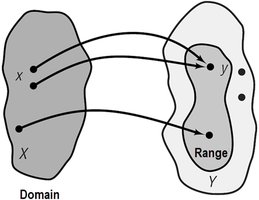
A relation is a correspondence between two sets: a set X, called the domain, and a set Y, called the range. In a relation, each element from the domain corresponds to at least one element from the range. If x is an element of the domain and y is an element of the range, and if a relation exists from x to y, then we say that y is related to x, or that y corresponds to x, and we write (x, y). It is helpful to think of x as the input and y as the output of the relation.
Ways to express a relation:
Verbally (using words)
Numerically (using a table of numbers or a set of ordered pairs)
Graphically (plotting points or mapping)
Algebraically (using an equation)
Example: Describing a Relation A scientist measures the average high temperature in Los Angeles for the first five months of the year. The months (January to May) are the domain, and the corresponding temperatures (68℉, 69℉, 70℉, 73℉, 74℉) are the range.
Domain: {January, February, March, April, May}
Range: {68℉, 69℉, 70℉, 73℉, 74℉}
Set of ordered pairs: {(January, 68), (February, 69), (March, 70), (April, 73), (May, 74)}
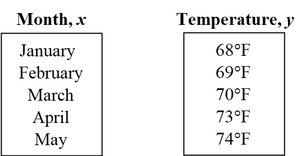
Mapping Representation: The relation can be shown as a mapping from each month to its corresponding temperature.
Graphical Representation: The relation can also be plotted as points on a coordinate plane, with months on the x-axis and temperatures on the y-axis.
Objective 2: Determine Whether a Relation Represents a Function
A function from X into Y is a relation that associates with each element of X exactly one element of Y.
The set X is called the domain of the function.
For each element x in X, the corresponding element y in Y is called the image of the function at x, or the value of x.
The set of all images of the elements in the domain is called the range of the function.
The key property of a function is that each input has exactly one output. If an input is given, the function determines the output uniquely. If a relation does not have this property, it is not a function.
Example: Determining Whether a Relation Represents a Function
For each relation, state the domain and range, and determine if it is a function.
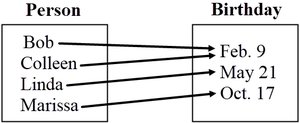
In the above mapping, each person is assigned to exactly one birthday, so this is a function.
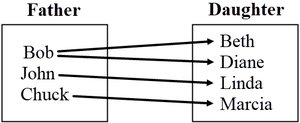
In this mapping, a father can have more than one daughter, but each father is still mapped to at least one daughter. However, if a single father is mapped to multiple daughters, but not vice versa, this can still be considered a function if the context allows multiple outputs for one input. In standard function definition, each input must have exactly one output, so this would not be a function if multiple outputs exist for a single input.
Is it okay for more than one element in the domain to correspond to the same element in the range? Yes, as long as each input (domain element) has only one output (range element), it is still a function. Multiple inputs can share the same output.
Objective 3: Use Function Notation; Find the Value of a Function
If f is a function, then for each number x in the domain, the corresponding number y in the range is designated by the symbol f(x), read as “f of x,” and we write y = f(x). This is called function notation.
f(x) is the value of the function f at the number x.
For example, if f(x) = 2x + 3, then f(1) = 5, f(2) = 7, etc.
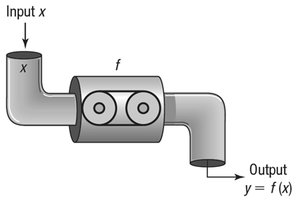
Think of a function as a machine: it takes an input from the domain, processes it, and produces an output in the range. The restrictions are:
It accepts only numbers from the domain of the function.
For each input, there is exactly one output (though different inputs may have the same output).
In the function f(x), x is called the independent variable because it can be assigned any number from the domain. The variable y is called the dependent variable because its value depends on x. The independent variable is also called the argument of the function.
Objective 4: Find the Difference Quotient of a Function
The difference quotient of a function f at x is given by:
The difference quotient is used in calculus to define the derivative. It measures the average rate of change of the function over an interval of length h.
Objective 5: Find the Domain of a Function Defined by an Equation
When the domain of a function f is not specified, it is assumed to be the largest set of real numbers for which f(x) is a real number. To find the domain:
Start with the set of all real numbers.
If the equation has a denominator, exclude any numbers for which the denominator is zero.
If the equation has a radical with an even index, exclude any numbers for which the expression inside the radical (the radicand) is negative.
Express the domain using interval notation, set notation, or a list, whichever is most convenient.
In applications, the domain may be restricted by physical or geometric considerations. For example, if x represents the side length of a square, only positive values are meaningful.
Objective 6: Find the Sum, Difference, Product, and Quotient of Two Functions
Given functions f and g, we can define new functions as follows:
Sum:
Difference:
Product:
Quotient: , where
The domain of each new function is the intersection of the domains of f and g, with additional restrictions for the quotient (where g(x) ≠ 0).
Summary Table: Ways to Express a Relation
Method | Description |
|---|---|
Verbally | Describing the relation in words |
Numerically | Using a table or set of ordered pairs |
Graphically | Plotting points or mapping diagram |
Algebraically | Using an equation |
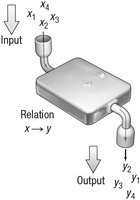
Additional info: The images included above visually reinforce the concepts of relations, mappings, and functions as machines, which are foundational to understanding functions in precalculus.
