 Back
Functions and Their Graphs: Intercepts, Symmetry, Domain, Range, and Operations
Study Guide - Smart Notes
 Tailored notes based on your materials, expanded with key definitions, examples, and context.
Graphs, Equations, and Intercepts
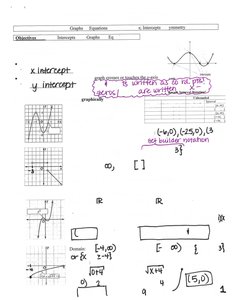
Intercepts of a Graph
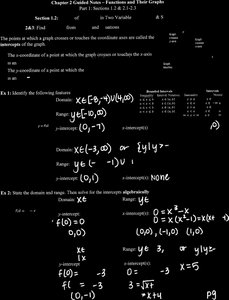
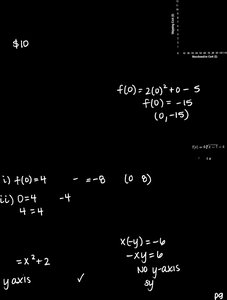
Intercepts are key points where a graph crosses the axes. The x-intercept is where the graph crosses the x-axis (y = 0), and the y-intercept is where the graph crosses the y-axis (x = 0).
x-intercept: Set y = 0 and solve for x.
y-intercept: Set x = 0 and solve for y.
Intercepts are written as coordinate points, e.g., (x, 0) or (0, y).
Multiple intercepts may exist for a single graph.
Domain and Range of Functions
Definitions and Notation
The domain of a function is the set of all possible input values (x-values) for which the function is defined. The range is the set of all possible output values (y-values) the function can produce.
Domain and range can be written in interval notation or set-builder notation.
Example: Domain: or
Example: Range:
Symmetry in Graphs
Types of Symmetry
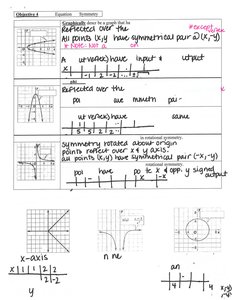
Symmetry helps classify graphs and functions:
y-axis symmetry (Even functions): The graph is unchanged when reflected over the y-axis. For every (x, y), there is a (-x, y).
x-axis symmetry: The graph is unchanged when reflected over the x-axis. For every (x, y), there is a (x, -y). Note: Not a function if x-axis symmetry exists.
Origin symmetry (Odd functions): The graph is unchanged when rotated 180° about the origin. For every (x, y), there is a (-x, -y).
Testing for Symmetry Algebraically
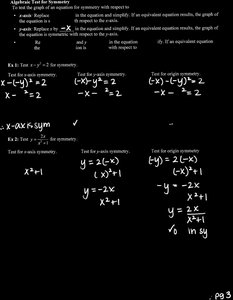
y-axis: Replace x with -x. If the equation is unchanged, the graph is symmetric about the y-axis.
x-axis: Replace y with -y. If the equation is unchanged, the graph is symmetric about the x-axis.
Origin: Replace x with -x and y with -y. If the equation is unchanged, the graph is symmetric about the origin.
Even and Odd Functions
Definitions and Properties
Functions can be classified as even, odd, or neither based on their symmetry:
Even function: for all x in the domain. Graph is symmetric about the y-axis.
Odd function: for all x in the domain. Graph is symmetric about the origin.
Neither: If neither condition holds, the function is neither even nor odd.
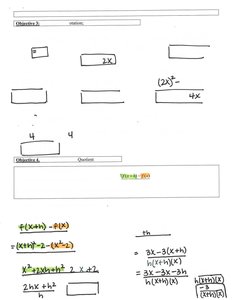
Operations with Functions
Sum, Difference, Product, and Quotient
Functions can be combined using arithmetic operations. The domain of the resulting function is the intersection of the domains of the original functions (except for division, where the denominator cannot be zero).
Sum:
Difference:
Product:
Quotient: ,
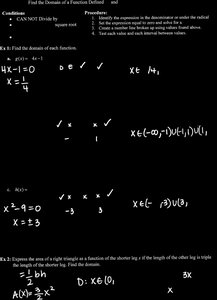
Difference Quotient
Definition and Application
The difference quotient is a formula used to compute the average rate of change of a function over an interval and is foundational for calculus.
Formula: ,
Used to find slopes of secant lines and to introduce the concept of derivatives.
Intervals of Increase, Decrease, and Constancy
Definitions
A function is:
Increasing on an interval if, as x increases, f(x) increases.
Decreasing on an interval if, as x increases, f(x) decreases.
Constant on an interval if, as x increases, f(x) remains the same.
These intervals are often described using interval notation.
Local and Absolute Extrema
Definitions
Local maximum and local minimum are the highest and lowest points in a small neighborhood of the graph. Absolute maximum and absolute minimum are the highest and lowest points over the entire domain.
To find extrema, analyze the graph or use calculus techniques (not covered here).
Summary Table: Symmetry Tests
Type of Symmetry | Test | Result |
|---|---|---|
y-axis | Replace x with -x | Equation unchanged: y-axis symmetry |
x-axis | Replace y with -y | Equation unchanged: x-axis symmetry |
Origin | Replace x with -x and y with -y | Equation unchanged: origin symmetry |
Practice Problems and Applications
Find intercepts, domain, and range for given functions.
Test for symmetry algebraically and graphically.
Classify functions as even, odd, or neither.
Combine functions and determine the domain of the result.
Compute the difference quotient for given functions.
