Back
BackFunctions and Their Graphs: Precalculus Study Notes
Study Guide - Smart Notes
 Tailored notes based on your materials, expanded with key definitions, examples, and context.
Functions and Their Graphs
Relations
A relation is a correspondence between two sets, where the value of one variable is linked to the value of another. In mathematics, relations are often described using ordered pairs, mapping elements from one set (domain) to another set (range).
Domain: The set of all possible input values (first elements).
Range: The set of all possible output values (second elements).
Ordered pairs: Expressed as (x, y), where x is from the domain and y is from the range.
Example: The relation between states and their number of representatives in the House of Representatives.
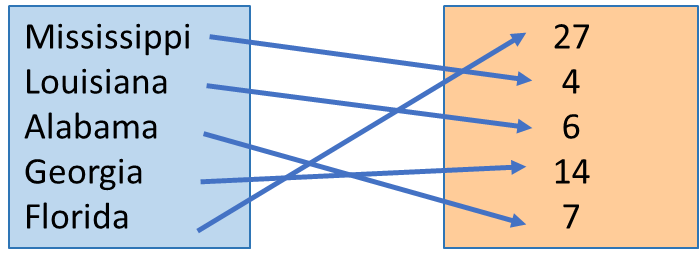
Additional info: Relations can be visualized using mapping diagrams or tables, which clarify how each element in the domain corresponds to elements in the range.
Functions
A function is a special type of relation where each element in the domain is associated with exactly one element in the range. Functions are fundamental in mathematics, as they describe deterministic relationships between variables.
Definition: If X and Y are two nonempty sets, a function f from X into Y associates each element of X with exactly one element of Y.
Notation: denotes the function value at x.
Example: Mapping diagrams can illustrate whether a relation is a function.
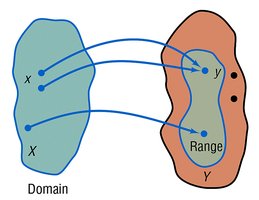
Additional info: It is acceptable for multiple domain elements to correspond to the same range element, but not for a single domain element to correspond to multiple range elements.
Determining Whether a Relation is a Function
To determine if a relation is a function, check that no domain element is paired with more than one range element. This can be done using ordered pairs, mapping diagrams, or equations.
Ordered pairs: If no first element repeats with different second elements, the relation is a function.
Equations: If each input x yields only one output y, the equation defines a function.
Example: is a function because each x produces one y.
Counterexample: is not a function of x, since some x values yield two y values.
Function Notation and Values
Function notation is used to express the output of a function for a given input. The variable x is the independent variable (or argument), and y is the dependent variable (value of the function at x).
Notation:
Example: For , .
Calculator Use: Functions can be evaluated using graphing calculators.
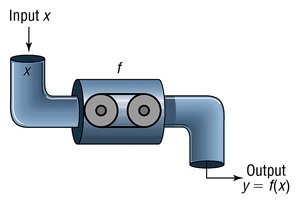
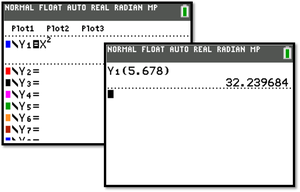
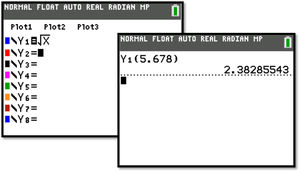
Additional info: Functions can be given in implicit or explicit form. Explicit form solves for y in terms of x.
Difference Quotient
The difference quotient is a fundamental concept in calculus and precalculus, used to measure the average rate of change of a function over an interval.
Definition: The difference quotient of a function f at x is given by:
Example: For , the difference quotient is .
Domain of a Function
The domain of a function is the set of all input values for which the function is defined. Restrictions may arise from denominators (cannot be zero) or radicals (even index cannot have negative radicands).
Procedure:
Start with all real numbers.
Exclude values that make denominators zero.
Exclude values that make radicands negative (for even roots).
Example: For , require and .
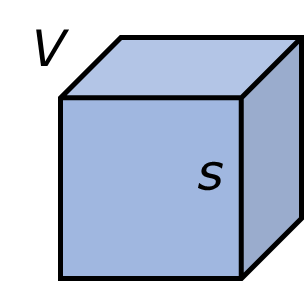
Application: Expressing the volume of a cube as a function of its side length: , domain .
Operations on Functions
Functions can be combined using addition, subtraction, multiplication, and division. The domain of the resulting function is the intersection of the domains of the original functions, with additional restrictions for division (denominator cannot be zero).
Sum:
Difference:
Product:
Quotient: ,
Example: If and , the domain of excludes and .
Summary Table: Key Facts about Functions
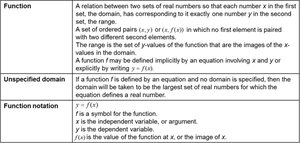
The following table summarizes important facts about functions, domains, and function notation.
Concept | Description |
|---|---|
Function | A relation between two sets of real numbers so that each number x in the first set (domain) has corresponding to it exactly one number y in the second set (range). A set of ordered pairs (x, y) in which no first element is paired with two different second elements. The range is the set of y-values that are the images of the x-values in the domain. A function f may be defined implicitly by an equation involving x and y or explicitly by writing y = f(x). |
Unspecified domain | If a function f is defined by an equation and no domain is specified, then the domain is taken to be the largest set of real numbers for which the equation defines a real number. |
Function notation | y = f(x) f is the symbol for the function. x is the independent variable, or argument. y is the dependent variable. f(x) is the value of the function at x, or the image of x. |