 Back
BackFundamental Concepts of Algebra: Real Numbers, Intervals, and Operations
Study Guide - Smart Notes
 Tailored notes based on your materials, expanded with key definitions, examples, and context.
Fundamental Concepts of Algebra
Classification of Numbers
The real number system is foundational to algebra and precalculus. Understanding the different types of numbers and their properties is essential for further study in mathematics.
Natural Numbers (\( \mathbb{N} \)): The set of counting numbers: 1, 2, 3, ...
Whole Numbers (\( \mathbb{W} \)): The set of natural numbers plus zero: 0, 1, 2, 3, ...
Integers (\( \mathbb{Z} \)): The set of whole numbers and their negatives: ..., -2, -1, 0, 1, 2, ...
Rational Numbers (\( \mathbb{Q} \)): Numbers that can be expressed as a ratio of two integers, where the denominator is not zero. Their decimal representations either terminate or repeat.
Irrational Numbers (\( \mathbb{P} \)): Real numbers that cannot be written as a ratio of integers. Their decimal representations neither terminate nor repeat (e.g., \( \sqrt{2} \), \( \pi \)).
Real Numbers (\( \mathbb{R} \)): All numbers that can be represented on the number line, including both rational and irrational numbers.
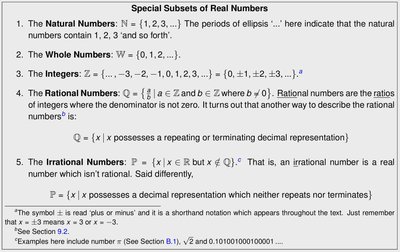
Example: \( \frac{1}{2} \) is rational, \( \sqrt{2} \) is irrational, and -3 is an integer.
Visualizing Real Numbers and the Number Line
The real number line is a visual tool where each point corresponds to a unique real number. The order of numbers is represented by their position: if \( a < b \), then \( a \) is to the left of \( b \).

Law of Trichotomy
For any two real numbers \( a \) and \( b \), exactly one of the following is true:
\( a < b \)
\( a > b \)
\( a = b \)

Intervals and Interval Notation
Definition and Types of Intervals
Intervals are segments of the real number line and are used to describe sets of numbers between two endpoints. Interval notation provides a concise way to represent these sets.
Set of Real Numbers | Interval Notation | Region on the Real Number Line |
|---|---|---|
\( \{ x \mid 1 \leq x < 3 \} \) | [1, 3) | 1 (closed) to 3 (open) |
\( \{ x \mid -1 \leq x \leq 4 \} \) | [-1, 4] | -1 (closed) to 4 (closed) |
\( \{ x \mid x \leq 5 \} \) | (-\infty, 5] | All numbers less than or equal to 5 |
\( \{ x \mid x > -2 \} \) | (-2, \infty) | All numbers greater than -2 |
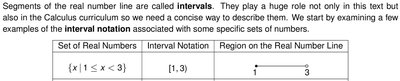
Open intervals: (a, b), (-∞, b), (a, ∞) (endpoints not included) Closed intervals: [a, b], [a, ∞), (-∞, b] (endpoints included)
Practice with Interval Notation
Express the following sets using interval notation:
Set of Real Numbers | Interval Notation | Region on the Real Number Line |
|---|---|---|
\( \{ x \mid -1 \leq x < 5 \} \) | [-1, 5) | From -1 (closed) to 5 (open) |
\( \{ x \mid -5 < x \leq 0 \} \) | (-5, 0] | From -5 (open) to 0 (closed) |
\( \{ x \mid x \leq 3 \} \) | (-\infty, 3] | All numbers less than or equal to 3 |
\( \{ x \mid x \geq -3 \} \) | [-3, \infty) | All numbers greater than or equal to -3 |

Properties of Real Numbers
Properties of Addition
Closure: The sum of any two real numbers is a real number.
Commutativity: \( a + b = b + a \)
Associativity: \( (a + b) + c = a + (b + c) \)
Identity: \( a + 0 = a \)
Inverse: For every \( a \), there exists \( -a \) such that \( a + (-a) = 0 \)
Definition of Subtraction: \( a - b = a + (-b) \)
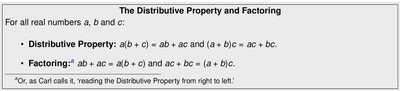
The Distributive Property and Factoring
Distributive Property: \( a(b + c) = ab + ac \) and \( (a + b)c = ac + bc \)
Factoring: \( ab + ac = a(b + c) \) and \( ac + bc = (a + b)c \)
Example: \( 5(2 + x) = 10 + 5x \)
Properties of Zero
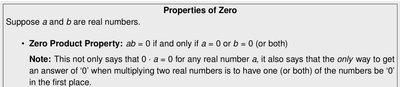
Zero Product Property: \( ab = 0 \) if and only if \( a = 0 \) or \( b = 0 \) (or both).
Zeros in Fractions: If \( a \neq 0 \), \( 0 \cdot a = 0 \) and \( 0/a = 0 \).
Undefined: \( a/0 \) is undefined.

Example: To solve \( x^2 - x - 6 = 0 \), factor to \( (x-3)(x+2) = 0 \), so \( x = 3 \) or \( x = -2 \).
Properties of Negatives
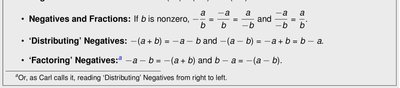
Additive Inverse: \( -a = (-1)a \) and \( -(-a) = a \)
Products of Negatives: \( (-a)(-b) = ab \)
Negatives and Products: \( -ab = (-a)b = a(-b) \)
Negatives and Fractions: \( -\frac{a}{b} = \frac{-a}{b} = \frac{a}{-b} \)
Distributing Negatives: \( -(a + b) = -a - b \)
Factoring Negatives: \( -a - b = -(a + b) \)
Properties of Fractions
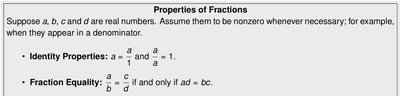
Identity: \( \frac{a}{1} = a \) and \( \frac{a}{a} = 1 \) (if \( a \neq 0 \))
Fraction Equality: \( \frac{a}{b} = \frac{c}{d} \) if and only if \( ad = bc \)
Multiplication: \( \frac{a}{b} \cdot \frac{c}{d} = \frac{ac}{bd} \)
Division: \( \frac{a}{b} \div \frac{c}{d} = \frac{ad}{bc} \)
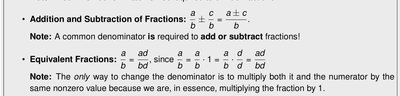
Addition/Subtraction: \( \frac{a}{b} + \frac{c}{b} = \frac{a+c}{b} \)
Equivalent Fractions: \( \frac{a}{b} = \frac{ad}{bd} \)
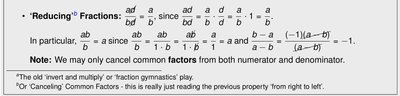
Reducing Fractions: \( \frac{ab}{b} = a \) (if \( b \neq 0 \))
Example: Simplifying Fractions
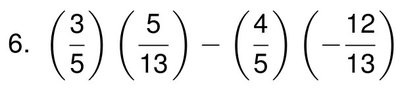
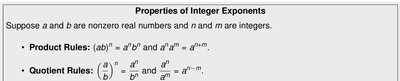
Perform the indicated operations and simplify to lowest terms:
\( \frac{1}{4} + \frac{6}{7} = \frac{7 + 24}{28} = \frac{31}{28} \)
\( \frac{5}{12} - \left( \frac{47}{30} - \frac{7}{3} \right) \)
Exponents and Their Properties
Definition and Basic Properties
Exponents represent repeated multiplication. In \( 2^3 \), 2 is the base and 3 is the exponent. Negative and zero exponents are defined as follows:
\( 2^0 = 1 \)
\( 2^{-3} = \frac{1}{2^3} = \frac{1}{8} \)
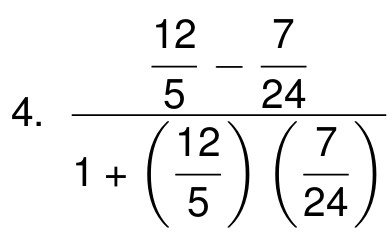
Properties of Integer Exponents
Product Rule: \( a^n a^m = a^{n+m} \)
Quotient Rule: \( \frac{a^n}{a^m} = a^{n-m} \)
Power Rule: \( (a^n)^m = a^{nm} \)
Negative Exponents: \( a^{-n} = \frac{1}{a^n} \)
Zero Powers: \( a^0 = 1 \) (for \( a \neq 0 \))
Order of Operations
Standard Order for Evaluating Expressions
To evaluate expressions involving real numbers, follow this order:
Evaluate expressions in parentheses (or other grouping symbols).
Evaluate exponents.
Evaluate multiplication and division from left to right.
Evaluate addition and subtraction from left to right.
Mnemonic: "Please Excuse My Dear Aunt Sally" (Parentheses, Exponents, Multiplication/Division, Addition/Subtraction).
Radicals and Roots
Definition of Principal nth Root
The principal nth root of a real number \( a \) (denoted \( \sqrt[n]{a} \)) is the unique real number whose nth power is \( a \). For even n, \( a \geq 0 \); for odd n, \( a \) can be any real number.
Index: The value of n in \( \sqrt[n]{a} \)
Radicand: The value of a under the radical sign

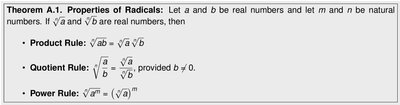
Properties of Radicals
Product Rule: \( \sqrt[n]{ab} = \sqrt[n]{a} \sqrt[n]{b} \)
Quotient Rule: \( \sqrt[n]{\frac{a}{b}} = \frac{\sqrt[n]{a}}{\sqrt[n]{b}} \), provided \( b \neq 0 \)
Power Rule: \( \sqrt[n]{a^m} = (\sqrt[n]{a})^m \)
Example: \( \sqrt{9 \cdot 4} = \sqrt{9} \cdot \sqrt{4} = 3 \cdot 2 = 6 \)
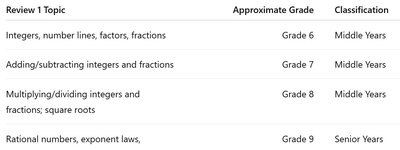
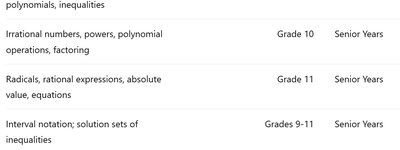
Summary Table: Review Topics by Grade
Review 1 Topic | Approximate Grade | Classification |
|---|---|---|
Integers, number lines, factors, fractions | Grade 6 | Middle Years |
Adding/subtracting integers and fractions | Grade 7 | Middle Years |
Multiplying/dividing integers and fractions; square roots | Grade 8 | Middle Years |
Rational numbers, exponent laws, polynomials, inequalities | Grade 9 | Senior Years |
Irrational numbers, powers, polynomial operations, factoring | Grade 10 | Senior Years |
Radicals, rational expressions, absolute value, equations | Grade 11 | Senior Years |
Interval notation; solution sets of inequalities | Grades 9-11 | Senior Years |
Additional info: These foundational concepts are prerequisites for all further study in algebra, functions, and calculus. Mastery of these topics is essential for success in precalculus and beyond.
