 Back
BackFundamental Trigonometric Identities and Their Applications
Study Guide - Smart Notes
 Tailored notes based on your materials, expanded with key definitions, examples, and context.
Chapter 5: Equivalent Trigonometric Representations and Polar Functions
Section 5.1: Fundamental Identities
This section introduces the essential trigonometric identities used to simplify expressions and solve equations in precalculus. Mastery of these identities is crucial for advanced work in trigonometry and calculus.
Identities
Definition: An identity is an equation that is true for all values of the variable for which both sides are defined.
Identities are used to simplify trigonometric expressions and solve trigonometric equations.
Basic Trigonometric Identities
Reciprocal Identities: These relate each trigonometric function to its reciprocal.
Quotient Identities: These express tangent and cotangent in terms of sine and cosine.
Identity Type | Formulas |
|---|---|
Reciprocal |
|
Quotient |
|
Pythagorean Identities
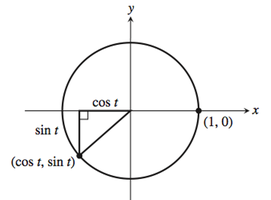
The Pythagorean identities are derived from the equation of the unit circle and are fundamental in simplifying trigonometric expressions.
Cofunction Identities
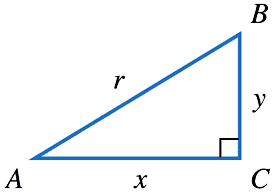
Cofunction identities relate the trigonometric functions of complementary angles (angles that add up to or radians).
Even-Odd Identities
Even-odd identities describe the symmetry properties of trigonometric functions.
Function | Even/Odd | Identity |
|---|---|---|
Odd | ||
Even | ||
Odd | ||
Odd | ||
Even | ||
Odd |
Simplifying Trigonometric Expressions
To simplify trigonometric expressions, use the identities above to rewrite the expression in a simpler or more useful form.
Factoring: Factor common terms and apply identities as needed.
Expanding: Expand products and apply identities to combine terms.
Example: Simplify .
Using the Pythagorean identity:
So,
Solving Trigonometric Equations
Solving trigonometric equations often involves using identities to rewrite the equation in terms of a single function, then solving for the variable.
Isolate the trigonometric function if possible.
Use identities to rewrite the equation.
Solve for the variable within the given interval.
Example: Solve for in .
