Back
BackGraphing Sine and Cosine Functions and Their Transformations
Study Guide - Smart Notes
 Tailored notes based on your materials, expanded with key definitions, examples, and context.
Q1. Use your unit circle to identify the sine and cosine of each angle.
Background
Topic: Unit Circle Values for Sine and Cosine
This question is testing your understanding of the unit circle and your ability to find the sine and cosine values for common angles measured in radians.
Key Terms and Formulas
Unit Circle: A circle with radius 1 centered at the origin of the coordinate plane.
Sine (sin θ): The y-coordinate of the point on the unit circle at angle θ.
Cosine (cos θ): The x-coordinate of the point on the unit circle at angle θ.
Common angles: $0, \frac{\pi}{6}, \frac{\pi}{4}, \frac{\pi}{3}, \frac{\pi}{2}, \pi, \frac{3\pi}{2}, 2\pi$ and their multiples.
Step-by-Step Guidance
Draw or visualize the unit circle. Mark the given angles in standard position (measured from the positive x-axis).
Recall the coordinates for each angle. For example, at $\theta = 0$, the coordinates are $(1, 0)$, so $\cos 0 = 1$ and $\sin 0 = 0$.
For each angle, identify the corresponding point on the unit circle and write down the x-coordinate (cosine) and y-coordinate (sine).
Use symmetry and reference angles to find values for angles in different quadrants (e.g., $\sin(\pi - x) = \sin x$, $\cos(\pi - x) = -\cos x$).
Try solving on your own before revealing the answer!
Q2. Graph $f(\theta) = \sin \theta$ and $f(\theta) = \cos \theta$
Background
Topic: Graphs of Sine and Cosine Functions
This question is testing your ability to sketch the basic sine and cosine curves over one period, using key points from the unit circle.
Key Terms and Formulas
Amplitude: The maximum value of the function (for basic sine/cosine, amplitude = 1).
Period: The length of one complete cycle ($2\pi$ for sine and cosine).
Midline: The horizontal line halfway between the maximum and minimum values (for basic sine/cosine, $y = 0$).
Step-by-Step Guidance
Mark the x-axis with key points: $0, \frac{\pi}{2}, \pi, \frac{3\pi}{2}, 2\pi$.
For $y = \sin \theta$, plot points at these x-values using the unit circle: $\sin 0 = 0$, $\sin \frac{\pi}{2} = 1$, $\sin \pi = 0$, $\sin \frac{3\pi}{2} = -1$, $\sin 2\pi = 0$.
For $y = \cos \theta$, plot points: $\cos 0 = 1$, $\cos \frac{\pi}{2} = 0$, $\cos \pi = -1$, $\cos \frac{3\pi}{2} = 0$, $\cos 2\pi = 1$.
Connect the points smoothly to form the characteristic wave shape for each function.
Try solving on your own before revealing the answer!
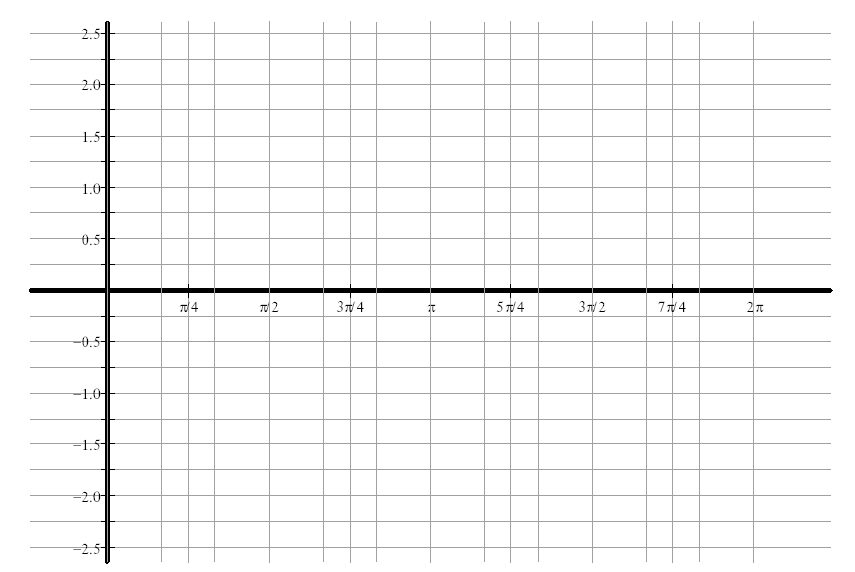
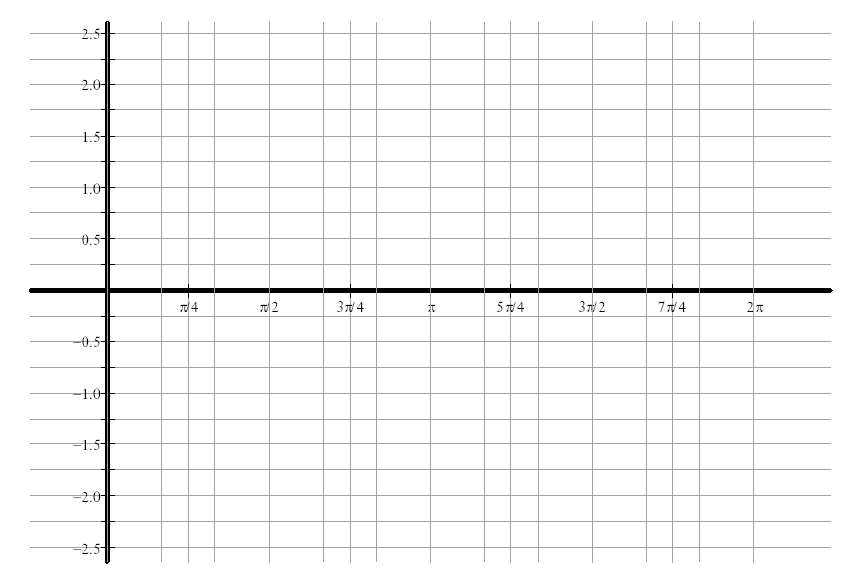
Q3. Graphing with Transformations: $y = A\sin(Bx - C) + D$ and $y = A\cos(Bx - C) + D$
Background
Topic: Transformations of Sine and Cosine Functions
This question is testing your ability to apply amplitude, period, phase shift, and vertical shift to the basic sine and cosine graphs.
Key Terms and Formulas
Amplitude ($A$): $|A|$ is the distance from the midline to the maximum or minimum.
Period: $\frac{2\pi}{|B|}$
Phase Shift: $\frac{C}{B}$ (horizontal shift)
Vertical Shift ($D$): Moves the midline up or down.
Step-by-Step Guidance
Identify $A$, $B$, $C$, and $D$ from the equation.
Calculate the amplitude ($|A|$), period ($\frac{2\pi}{|B|}$), phase shift ($\frac{C}{B}$), and vertical shift ($D$).
Draw the midline at $y = D$.
Mark the key points for one period, starting at the phase shift.
Try solving on your own before revealing the answer!
Q4. The sinusoidal function $h(\theta)$ has a maximum at $(\pi, 8)$ and the first minimum after this maximum at $(3\pi, -2)$.
Background
Topic: Writing Sinusoidal Equations from Key Points
This question is testing your ability to determine the equation of a sine or cosine function given its maximum and minimum points.
Key Terms and Formulas
Amplitude: $\frac{\text{max} - \text{min}}{2}$
Midline: $\frac{\text{max} + \text{min}}{2}$
Period: $2 \times (\text{distance between max and min})$
Step-by-Step Guidance
Find the amplitude using the maximum and minimum values.
Find the midline by averaging the maximum and minimum values.
Determine the period by doubling the distance between the maximum and the next minimum.
Write a possible equation for $h(\theta)$ using the form $A\sin(B(\theta - C)) + D$ or $A\cos(B(\theta - C)) + D$.
Try solving on your own before revealing the answer!
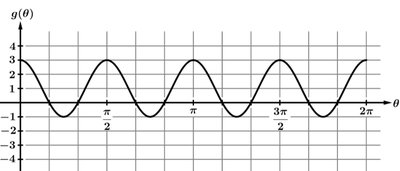
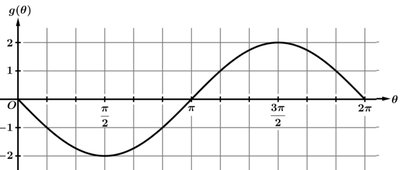
Q5. Use the graph of the sinusoidal function $g(\theta)$ to answer questions about intervals of increase/decrease and concavity.
Background
Topic: Analyzing Sinusoidal Graphs
This question is testing your ability to interpret the behavior of a trigonometric function from its graph, including intervals where it is increasing/decreasing and concave up/down.
Key Terms and Formulas
Increasing/Decreasing: Where the graph rises or falls as $\theta$ increases.
Concave Up/Down: Concave up means the graph is shaped like a cup ($\smile$), concave down like a cap ($\frown$).
Step-by-Step Guidance
Identify the intervals on the graph where the function is increasing or decreasing by looking at the slope.
Determine concavity by observing the curvature of the graph in those intervals.
Match the intervals to the behavior described in the question.
Try solving on your own before revealing the answer!
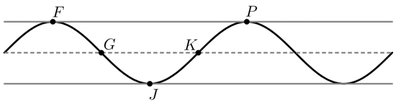
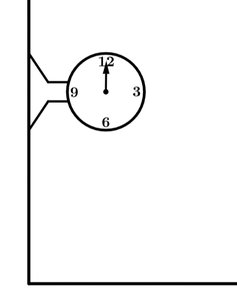
Q6. The clock problem: Modeling the distance from the minute hand to the floor as a sinusoidal function.
Background
Topic: Sinusoidal Modeling of Periodic Motion
This question is testing your ability to model real-world periodic motion with a sinusoidal function, and to interpret amplitude, period, frequency, and midline in context.
Key Terms and Formulas
Amplitude: Half the total vertical distance traveled by the endpoint of the hand.
Midline: The average height above the floor.
Period: The time for one full revolution (here, 30 minutes).
Frequency: $\frac{1}{\text{period}}$ (cycles per minute).
Step-by-Step Guidance
Identify the amplitude, period, and midline from the problem description.
Use the information to write a possible equation for $h(t)$.
Determine the coordinates of the labeled points by considering the phase of the motion at each time.
Try solving on your own before revealing the answer!
Q7. The toy car problem: Modeling the distance from a toy car to a wall as a sinusoidal function.
Background
Topic: Sinusoidal Modeling of Circular Motion
This question is testing your ability to model the periodic distance of an object moving in a circle relative to a fixed point, and to interpret amplitude, period, frequency, and midline in context.
Key Terms and Formulas
Amplitude: The radius of the circle (distance from center to wall).
Midline: The average distance from the wall.
Period: The time for one full revolution (here, 8 seconds).
Frequency: $\frac{1}{\text{period}}$ (cycles per second).
Step-by-Step Guidance
Identify the amplitude, period, and midline from the problem description.
Write a possible equation for $h(t)$ based on the starting position and motion.
Determine the coordinates of the labeled points by considering the phase of the motion at each time.
Try solving on your own before revealing the answer!