 Back
BackGraphing Techniques: Transformations of Functions in Precalculus
Study Guide - Smart Notes
 Tailored notes based on your materials, expanded with key definitions, examples, and context.
Functions and Their Graphs
Graphing Techniques: Transformations
This section explores how to graph functions using various transformations, including shifts, stretches, compressions, and reflections. Understanding these transformations is essential for analyzing and sketching the behavior of functions in Precalculus.
Vertical and Horizontal Shifts
Shifting a graph vertically or horizontally changes its position without altering its shape. These transformations are fundamental for modifying the output or input of a function.
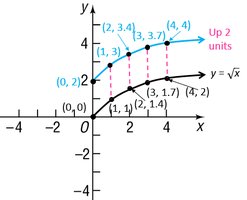
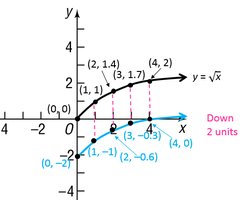
Vertical Shift: If a constant k is added to the output of a function, the graph shifts up by k units. If k is subtracted, the graph shifts down by k units.
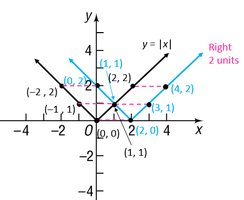
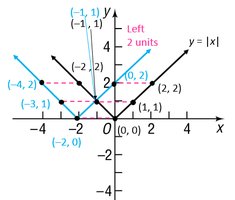
Horizontal Shift: If the input x is replaced by x - h, the graph shifts right by h units. If replaced by x + h, the graph shifts left by h units.
Formula:
Vertical: (up), (down)
Horizontal: (right), (left)
Example: The graph of shifted up 2 units becomes .
Example: The graph of shifted down 2 units becomes .
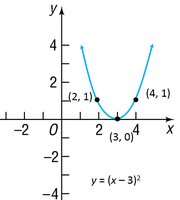
Example: The graph of shifted right 2 units becomes .
Example: The graph of shifted left 2 units becomes .
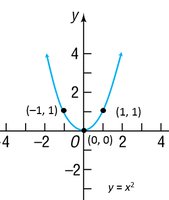
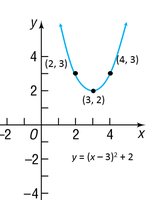
Example: Combining shifts: is a parabola shifted right 3 units and up 2 units.
Compressions and Stretches
Compressions and stretches alter the shape of a graph by changing its scale vertically or horizontally. These transformations are achieved by multiplying the function or its input by a constant.
Vertical Stretch: Multiply the function by a constant a > 1 to stretch it vertically.
Vertical Compression: Multiply the function by 0 < a < 1 to compress it vertically.
Horizontal Stretch: Replace x with x/a for a > 1 to stretch horizontally.
Horizontal Compression: Replace x with ax for a > 1 to compress horizontally.
Formula:
Vertical:
Horizontal:
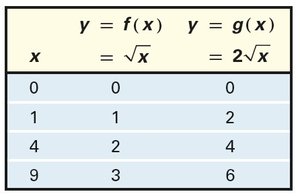
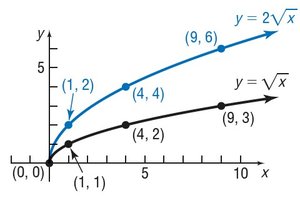
Example: is a vertical stretch of by a factor of 2.
x | y = \sqrt{x} | y = 2\sqrt{x} |
|---|---|---|
0 | 0 | 0 |
1 | 1 | 2 |
4 | 2 | 4 |
9 | 3 | 6 |
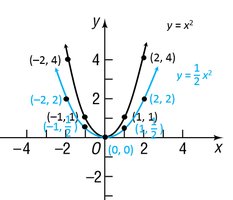
Example: is a vertical compression of .
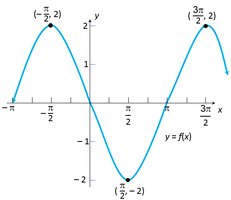
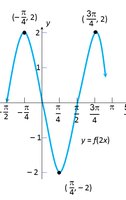
Example: Horizontal compression: compresses the graph horizontally by a factor of 2.
Reflections About the x-Axis and y-Axis
Reflections flip the graph over a specified axis, changing the sign of the output or input.
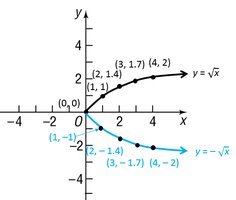
Reflection about the x-axis: Multiply the function by -1: .
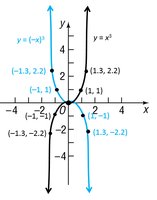
Reflection about the y-axis: Replace x with -x: .
Example: is the reflection of about the x-axis.
Example: is the reflection of about the y-axis.
Summary Table of Graphing Techniques
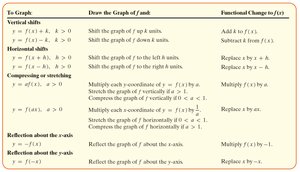
The following table summarizes the main transformations and their effects on the graph and function:
To Graph | Draw the Graph of f and: | Functional Change to f(x) |
|---|---|---|
Vertical shifts | Shift up/down k units | Add/Subtract k to f(x) |
Horizontal shifts | Shift left/right h units | Replace x by x ± h |
Compressions/Stretches | Multiply y-coordinates by a | Multiply f(x) by a |
Reflections about x-axis | Reflect about x-axis | Multiply f(x) by -1 |
Reflections about y-axis | Reflect about y-axis | Replace x by -x |
Combining Transformations
Multiple transformations can be applied sequentially to a function. The order of operations is important and affects the final graph.
Apply horizontal shifts first (replace x).
Apply stretches/compressions next.
Apply reflections.
Apply vertical shifts last.
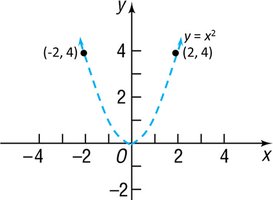
Example: is a parabola shifted right 3 units, reflected about the x-axis, and shifted down 2 units.
Example: is a parabola compressed vertically and shifted up.
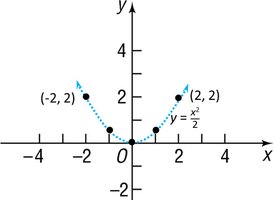
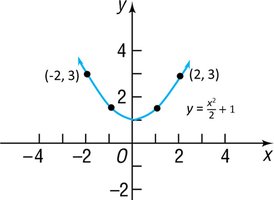
Example: is a square root function reflected about the x-axis, shifted left 2 units, and shifted up 1 unit.
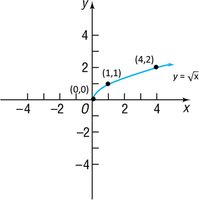
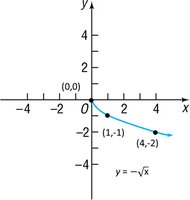
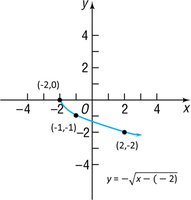
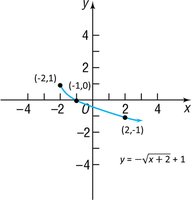
Additional info: The order of transformations is crucial for correct graphing. Always rewrite the function to match the standard transformation forms before graphing.
