 Back
BackGraphs and Properties of Tangent, Cotangent, Cosecant, and Secant Functions
Study Guide - Smart Notes
 Tailored notes based on your materials, expanded with key definitions, examples, and context.
The Graphs of the Tangent, Cotangent, Cosecant, and Secant Functions
Graph and Properties of the Tangent Function
The tangent function, defined as , is a periodic function with period . Its graph consists of repeating cycles, each with distinct vertical asymptotes and characteristic points. The tangent function is fundamentally different in shape from the sine and cosine functions, and its domain excludes points where the cosine function is zero.
Domain: , where is an integer.
Range:
Period:
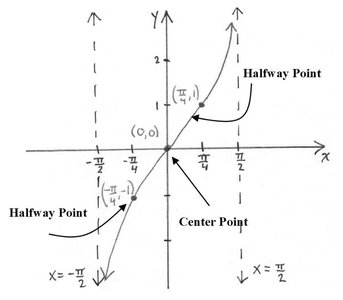
Principal Cycle: Interval
Vertical Asymptotes:
Y-intercept: $0$
Center Points: (also x-intercepts)
Halfway Points: Left: , Right:
Odd Function: (symmetric about the origin)
One-to-one on each cycle
Example: The graph below shows the principal cycle of with vertical asymptotes at and , center point at , and halfway points at and .
Sketching Transformed Tangent Functions
To sketch functions of the form , follow these steps:
If , use the odd property to rewrite with .
Find the interval and equations of vertical asymptotes for the principal cycle by solving .
Period:
Center point: x-coordinate is midway between asymptotes; y-coordinate is .
Halfway points: x-coordinates are halfway between center and nearest asymptote; y-coordinates are times the corresponding value for plus .
Sketch vertical asymptotes, plot center and halfway points, and connect with a smooth curve.
Graph and Properties of the Cotangent Function
The cotangent function, defined as , is also periodic with period . Its graph is similar to the tangent function but with key differences, including the location of vertical asymptotes and the direction of increase/decrease.
Domain: , where is an integer.
Range:
Period:
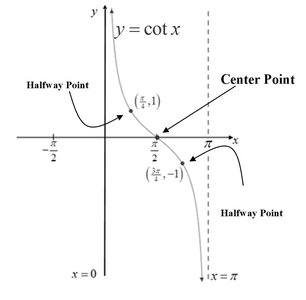
Principal Cycle: Interval
Vertical Asymptotes:
No y-intercept
Center Points: (also x-intercepts)
Halfway Points: Left: , Right:
Odd Function: (symmetric about the origin)
One-to-one on each cycle
Example: The graph below shows the principal cycle of with vertical asymptotes at and , center point at , and halfway points at and .
Sketching Transformed Cotangent Functions
To sketch functions of the form , follow these steps:
If , use the odd property to rewrite with .
Find the interval and equations of vertical asymptotes for the principal cycle by solving .
Period:
Center point: x-coordinate is midway between asymptotes; y-coordinate is .
Halfway points: x-coordinates are halfway between center and nearest asymptote; y-coordinates are times the corresponding value for plus .
Sketch vertical asymptotes, plot center and halfway points, and connect with a smooth curve.
Graphs and Properties of Cosecant and Secant Functions
The cosecant and secant functions are the reciprocals of the sine and cosine functions, respectively. Their graphs are constructed by first sketching the corresponding sine or cosine graph, then applying the reciprocal relationship.
Cosecant Function ()
Domain: , where is an integer.
Range:
Period:
Vertical Asymptotes:
Relative Maximum: at
Relative Minimum: $1x = \frac{\pi}{2} + 2n\pi$
Odd Function: (symmetric about the origin)
Secant Function ()
Domain: , where is an integer.
Range:
Period:
Vertical Asymptotes:
Relative Maximum: at
Relative Minimum: $1x = 2n\pi$
Even Function: (symmetric about the y-axis)
Example: The graphs of and feature "u-shaped" branches between vertical asymptotes, opening up or down depending on the interval.
