 Back
BackGraphs of Sine and Cosine: Sinusoids – Precalculus Study Notes
Study Guide - Smart Notes
 Tailored notes based on your materials, expanded with key definitions, examples, and context.
Trigonometric Functions
Graphs of Sine and Cosine: Sinusoids
The sine and cosine functions are fundamental in precalculus, especially for modeling periodic phenomena. Their graphs, known as sinusoids, exhibit regular, wave-like patterns and are used to describe cycles in mathematics, physics, and engineering.
The Sine Function
Domain: All real numbers ()
Range:
Continuity: The function is continuous everywhere.
Periodicity: The sine function repeats every units.
Symmetry: Odd function; symmetric with respect to the origin.
Boundedness: Maximum value is 1, minimum value is -1.
Inflection Points: Occur at all integer multiples of .
End Behavior: Does not approach any horizontal or vertical asymptotes.
The Cosine Function
Domain: All real numbers ()
Range:
Continuity: The function is continuous everywhere.
Periodicity: The cosine function repeats every units.
Symmetry: Even function; symmetric with respect to the y-axis.
Boundedness: Maximum value is 1, minimum value is -1.
Inflection Points: Occur at all odd integer multiples of .
End Behavior: Does not approach any horizontal or vertical asymptotes.
Sinusoid Definition
A sinusoid is any function that can be written in the form:
or
where a, b, c, and d are constants, and neither a nor b is zero.
Amplitude of a Sinusoid
The amplitude of a sinusoid is the absolute value of the coefficient a:
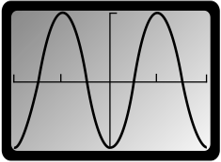
Graphically, amplitude is half the height of the wave from its maximum to minimum.
Period of a Sinusoid
The period is the length of one complete cycle of the wave. For a function or :
Frequency of a Sinusoid
The frequency is the number of cycles completed in a unit interval. It is the reciprocal of the period:
Phase Shift and Vertical Translation
Phase Shift: The horizontal shift of the graph, determined by in .
Vertical Translation: The vertical shift, determined by .
Constructing a Sinusoidal Model
To construct a sinusoidal model for periodic behavior:
Determine the maximum () and minimum () values.
Calculate amplitude:
Calculate vertical shift:
Determine the period (): the time interval of a single cycle.
Calculate horizontal stretch/shrink:
Choose the appropriate sinusoid based on initial conditions (maximum, minimum, or midpoint at a given time).
Simple Harmonic Motion
A point exhibits simple harmonic motion if its distance from the origin is given by:
or
where and are real numbers, and $b$ determines the frequency of oscillation.
Frequency:
Period:
Example: Modeling Harmonic Motion
A mass on a spring oscillates with maximum displacement 3 cm and completes one cycle in 0.5 seconds. The equation modeling this motion is:
Here, amplitude , period , so . Frequency is $2$ cycles per second.
Summary Table: Sinusoidal Function Properties
Property | Sine Function | Cosine Function |
|---|---|---|
Domain | All real numbers | All real numbers |
Range | [-1, 1] | [-1, 1] |
Period | ||
Symmetry | Odd (origin) | Even (y-axis) |
Amplitude | 1 | 1 |
Inflection Points | Integer multiples of | Odd integer multiples of |
Additional info: Academic context and formulas have been expanded for clarity and completeness. Only image_2 is included as it directly illustrates amplitude and period of a sinusoidal graph.
