 Back
BackGraphs: The Distance and Midpoint Formulas
Study Guide - Smart Notes
 Tailored notes based on your materials, expanded with key definitions, examples, and context.
Chapter 1: Graphs
Section 1.1: The Distance and Midpoint Formulas
This section introduces foundational concepts for locating points in one and two dimensions, and provides formulas for calculating the distance and midpoint between points in the Cartesian plane. These concepts are essential for understanding graphs and geometric relationships in precalculus.
Locating Points on the Real Number Line and Cartesian Plane
Coordinate: A single number assigned to a point on the real number line.
In two dimensions, points are located using two coordinates: the x-coordinate and y-coordinate.
The rectangular (Cartesian) coordinate system consists of a horizontal line called the x-axis and a vertical line called the y-axis.
The intersection of these axes is the origin, denoted as (0, 0).
The axes divide the plane into four regions called quadrants:
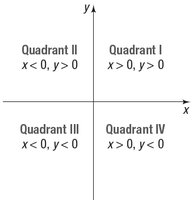
Quadrant I: x > 0, y > 0
Quadrant II: x < 0, y > 0
Quadrant III: x < 0, y < 0
Quadrant IV: x > 0, y < 0
Points are located by ordered pairs (x, y). The sign of the coordinates determines the quadrant:
Points to the left of the origin have a negative x-coordinate.
Points to the right have a positive x-coordinate.
Points below the origin have a negative y-coordinate.
Points above have a positive y-coordinate.
Every point on the x-axis has coordinates (a, 0); every point on the y-axis has coordinates (0, b).
Objective 1: Use the Distance Formula
The distance formula is used to find the length between two points in the Cartesian plane. This is derived from the Pythagorean Theorem.
Given two points and , the distance d between them is:
The horizontal leg of the triangle is .
The vertical leg is .
The hypotenuse (distance) is found using the Pythagorean Theorem.
The distance is always non-negative and is zero only if the points are identical.
The order of the points does not affect the result.
Example: Find the distance between (2, 3) and (5, 7):
Objective 2: Use the Midpoint Formula
The midpoint formula finds the center point of a line segment connecting two points.
Given endpoints and , the midpoint M is:
The midpoint is a point, so it is written as an ordered pair.
It is found by averaging the x-coordinates and y-coordinates of the endpoints.
The distance from the midpoint to each endpoint is equal.
Example: Find the midpoint between (2, 3) and (5, 7):
Applications: Solving Geometry Problems with Algebra
Plotting points and forming triangles in the plane.
Finding the length of each side using the distance formula.
Showing a triangle is a right triangle by verifying the Pythagorean Theorem.
Finding the area of a triangle using coordinates.
Example: Given points A(1, 2), B(4, 6), and C(1, 6), plot the points, form triangle ABC, and use the distance formula to find the side lengths.
Additional info: The area of a triangle with vertices , , can be found by:
