 Back
Inverse Functions: Definitions, Properties, and Graphs
Study Guide - Smart Notes
 Tailored notes based on your materials, expanded with key definitions, examples, and context.
Inverse Functions
Definition of the Inverse of a Function
An inverse function essentially reverses the roles of the input and output of the original function. If a function f is defined by ordered pairs , then its inverse, denoted as , consists of the ordered pairs .
Notation: The inverse of is written as (read as "f-inverse").
Key Property: If , then .
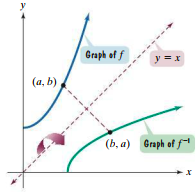
Graphs of f and f Inverse
The graph of is a reflection of the graph of about the line . This means that every point on the graph of $f$ corresponds to a point on the graph of .
Domain and Range: The domain of is the range of , and the range of $f$ is the domain of $f^{-1}$.
Example 1: Graphing an Inverse Function
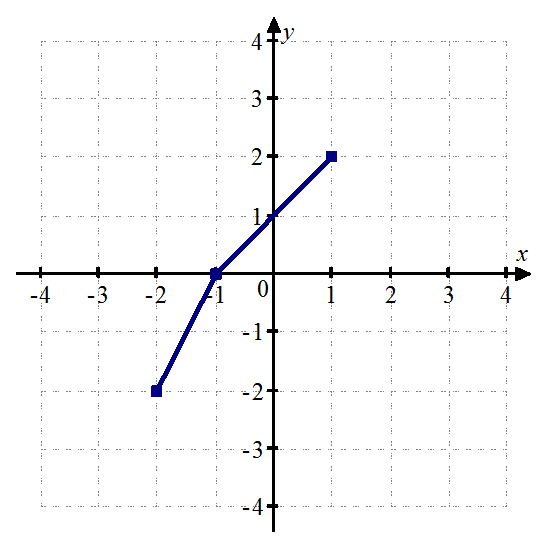
Given the graph of , you can draw the graph of its inverse by reflecting each point across the line . State the domain and range of both $f$ and .
Horizontal Line Test for Inverse Functions
A function has an inverse that is also a function if and only if no horizontal line intersects the graph of more than once. This is known as the Horizontal Line Test.
If passes the horizontal line test, it is called a one-to-one function.
Only one-to-one functions have inverses that are also functions.
Verifying Inverses
To verify that two functions and are inverses of each other, you must show:
for every in the domain of
for every in the domain of
If both conditions are satisfied, then and are inverses of each other.
Finding the Inverse of a Function Algebraically
To find the inverse of a function algebraically, follow these steps:
Replace with in the equation for $f(x)$.
Interchange and .
Solve for . Replace $y$ with .
Verify your result by showing that and .
Examples of Finding Inverses
Example 3: Show that and are inverses.
Compute
Compute
Thus, and are inverses.
Example 4: Find the inverse of .
Let
Switch and :
Solve for :
So,
Example 5: Find the inverse of .
Let
Switch and :
Solve for :
So,
Graphing Inverses
To graph and on the same axes, plot the original function and then reflect each point across the line to obtain the graph of the inverse. State the domain and range of both $f$ and $f^{-1}$.
Additional info: For piecewise or restricted domain functions, the inverse may only exist on certain intervals. Always check the domain and range when finding and graphing inverses.
