 Back
Inverse Functions: One-to-One Functions and Their Inverses
Study Guide - Smart Notes
 Tailored notes based on your materials, expanded with key definitions, examples, and context.
Inverse Functions
One-to-One Functions
A one-to-one function is a function in which every element of the domain maps to a unique element in the range. This means that no two different inputs produce the same output. Formally, a function f is one-to-one if for any two different inputs x1 and x2, f(x1) \neq f(x2).
Key Point: If two different x-values correspond to two different y-values, the function is one-to-one.
Example: The function f(x) = x is one-to-one because each x-value maps to a unique y-value.
Counterexample: The function f(x) = x^2 is not one-to-one over all real numbers because both x = 2 and x = -2 map to y = 4.
Horizontal Line Test
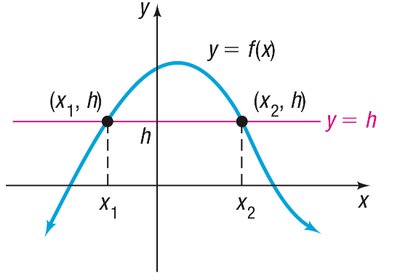
The horizontal line test is a graphical method to determine if a function is one-to-one. If every horizontal line intersects the graph of a function at most once, the function is one-to-one.
Key Point: If a horizontal line crosses the graph more than once, the function is not one-to-one.
Theorem: A function that is increasing or decreasing on an interval is one-to-one on that interval.
Inverse Functions: Definition and Properties
If y = f(x) is a one-to-one function, the correspondence from the range of f to the domain of f is called the inverse function of f. The symbol f^{-1} is used to denote the inverse function. If y = f(x) is one-to-one, then f has an inverse function f^{-1} such that:
Domain of f = Range of f-1
Range of f = Domain of f-1
f(f^{-1}(x)) = x for x in the domain of f^{-1}
f^{-1}(f(x)) = x for x in the domain of f
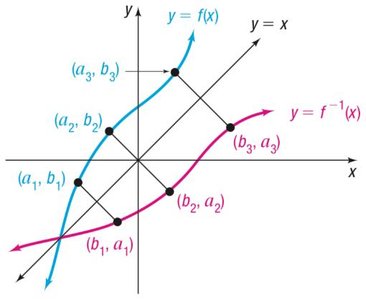
The graph of a one-to-one function f and its inverse f^{-1} are symmetric with respect to the line y = x.
Verifying Inverse Functions
To verify that two functions are inverses, compose them and check if the result is the identity function:
Example 1: For g(x) = x^3, the inverse is g^{-1}(x) = \sqrt[3]{x}. Verify: and .
Example 2: For f(x) = 2x + 3, the inverse is f^{-1}(x) = \frac{1}{2}(x - 3). Verify: .
Example 3: For h(x) = 4x - 7, the inverse is h^{-1}(x) = \frac{x + 7}{4}. Verify: .
Finding the Inverse of a Function
To find the inverse of a function f(x):
Switch x and y in the equation.
Solve for y (isolate y on one side).
Indicate that the result is f-1(x).
Check your answer by verifying and .
Example: Find the inverse of f(x) = 2x + 3.
Write y = 2x + 3.
Switch x and y: x = 2y + 3.
Solve for y: .
So, f^{-1}(x) = \frac{x - 3}{2}.
Domain-Restricted Inverses
Some functions, such as f(x) = x^2, are not one-to-one over their entire domain. To find an inverse, restrict the domain so the function becomes one-to-one.
Example: For f(x) = x^2 with x \geq 0, the inverse is f^{-1}(x) = \sqrt{x}.
Reason for restriction: Without restricting the domain, x^2 is not one-to-one because both positive and negative values of x yield the same y.
Summary Table: Properties of Inverse Functions
Property | Function f | Inverse f-1 |
|---|---|---|
Domain | Domain of f | Range of f |
Range | Range of f | Domain of f |
Composition | ||
Graph Symmetry | Symmetric about the line | |
