 Back
BackInverse Trigonometric Functions: Definitions, Properties, and Applications
Study Guide - Smart Notes
 Tailored notes based on your materials, expanded with key definitions, examples, and context.
Inverse Trigonometric Functions
Introduction to Inverse Trigonometric Functions
Inverse trigonometric functions allow us to determine the angle that corresponds to a given trigonometric ratio. Since the six basic trigonometric functions (sine, cosine, tangent, cosecant, secant, cotangent) are periodic and not one-to-one over their entire domains, we restrict their domains to intervals where they are one-to-one in order to define their inverses.
Inverse functions are denoted as arcsin, arccos, and arctan for sine, cosine, and tangent, respectively.
These functions are essential for solving trigonometric equations and for applications in geometry and physics.
Inverse Sine Function (Arcsine)
Definition and Properties
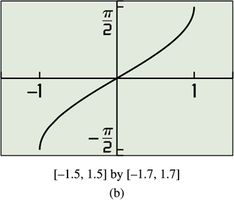
The inverse sine function, denoted as or , gives the unique angle in the interval such that .
Domain:
Range:
The function is one-to-one on this restricted domain.
![Graph of sine function restricted to [-π/2, π/2]](https://static.studychannel.pearsonprd.tech/study_guide_files/precalculus/sub_images/4c05b62e_image_2.png)
Evaluating Inverse Sine Without a Calculator
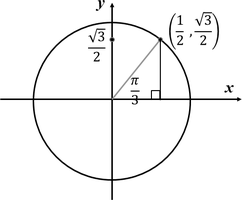
To find for special values, use the unit circle and reference triangles.
Example: , since and is in the range .
Evaluating Inverse Sine With a Calculator
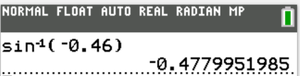
For non-special values, use a calculator set to radian mode.
Example: radians.
Inverse Cosine Function (Arccosine)
Definition and Properties
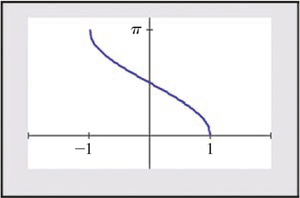
The inverse cosine function, denoted as or , gives the unique angle in the interval such that .
Domain:
Range:
![Graph of cosine function restricted to [0, π]](https://static.studychannel.pearsonprd.tech/study_guide_files/precalculus/sub_images/4c05b62e_image_6.png)
Inverse Tangent Function (Arctangent)
Definition and Properties
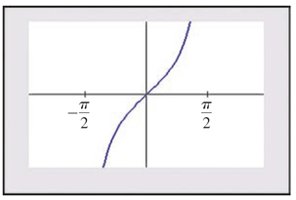
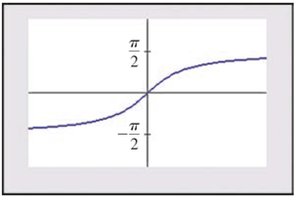
The inverse tangent function, denoted as or , gives the unique angle in the interval such that .
Domain:
Range:
End Behavior of the Inverse Tangent Function
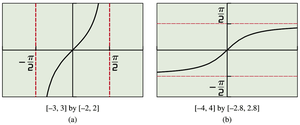
As ,
As ,
Applications of Inverse Trigonometric Functions
Example: Calculating a Viewing Angle
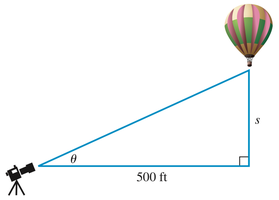
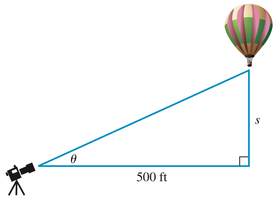
Inverse trigonometric functions are used in real-world applications such as determining angles of elevation or depression. For example, a photographer observing a hot-air balloon can use the inverse tangent function to calculate the angle of elevation based on the balloon's height and horizontal distance.
If the balloon is feet above the ground and the observer is 500 feet away, meaning that the angle is given by .
The rate of change of with respect to is greater when "s" is small, and decreases as "s" increases, due to the horizontal asymptotes of the arctangent function.
Summary Table: Inverse Trigonometric Functions
Function | Notation | Domain | Range |
|---|---|---|---|
Inverse Sine | |||
Inverse Cosine | |||
Inverse Tangent |
