Back
BackInverse Trigonometric Functions: Definitions, Properties, and Applications
Study Guide - Smart Notes
 Tailored notes based on your materials, expanded with key definitions, examples, and context.
Inverse Trigonometric Functions
Introduction to Inverse Trigonometric Functions
Inverse trigonometric functions allow us to determine the angle that corresponds to a given trigonometric value. Since the six basic trigonometric functions are periodic and not one-to-one over their entire domains, we restrict their domains to intervals where they are one-to-one to define their inverses. These inverse functions are essential for solving trigonometric equations and modeling real-world scenarios involving angles.
Key Point: The six basic trigonometric functions (sine, cosine, tangent, cosecant, secant, cotangent) are not one-to-one, so their inverses are defined on restricted domains.
Key Point: Inverse trigonometric functions are denoted as arcsin, arccos, arctan, etc.
Application: Inverse trig functions are used to solve equations and model angles in geometry and physics.
Inverse Sine Function (Arcsine)
Definition and Properties
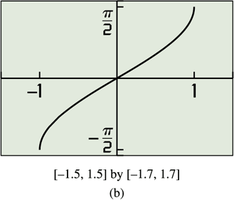
The inverse sine function, denoted as or , gives the unique angle in the interval such that .
Domain:
Range:
Equation: and
![Graph of sine function restricted to [-π/2, π/2]](https://static.studychannel.pearsonprd.tech/study_guide_files/precalculus/sub_images/e625669a_image_2.png)
Examples: Evaluating Inverse Sine Without a Calculator
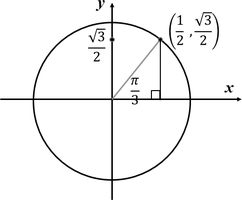
Example: Find the angle in such that . Solution:
Examples: Evaluating Inverse Sine With a Calculator
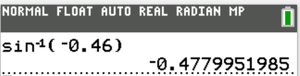
Example: Solution: Use a calculator to find radians.
Inverse Cosine Function (Arccosine)
Definition and Properties
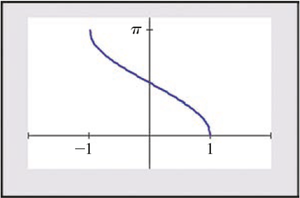
The inverse cosine function, denoted as or , gives the unique angle in the interval such that .
Domain:
Range:
Equation: and
![Graph of cosine function restricted to [0, π]](https://static.studychannel.pearsonprd.tech/study_guide_files/precalculus/sub_images/e625669a_image_6.png)
Inverse Tangent Function (Arctangent)
Definition and Properties
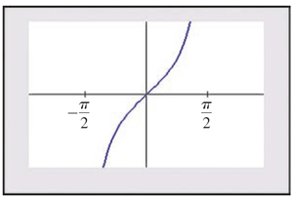
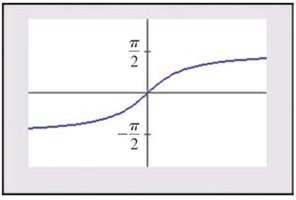
The inverse tangent function, denoted as or , gives the unique angle in the interval such that .
Domain:
Range:
Equation: and
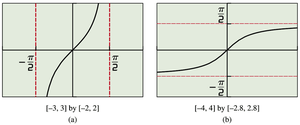
End Behavior of the Inverse Tangent Function
As approaches , approaches . As $x$ approaches , $\arctan(x)$ approaches . These are horizontal asymptotes for the function.
Composing Trigonometric and Inverse Trigonometric Functions
Key Properties and Simplification
Composing a trigonometric function with its inverse (or vice versa) can simplify to an algebraic expression, but only when the input is within the restricted domain of the inverse function.
Always True: for
Always True: for
Similar properties hold for cosine and tangent.
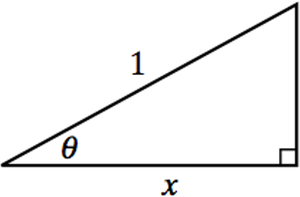
Example: Composing Trig Functions with Arccosine
To simplify , draw a right triangle with angle , so . The adjacent side is , the hypotenuse is $1\sqrt{1 - x^2}\sin(\arccos(x)) = \sqrt{1 - x^2}$.
Applications of Inverse Trigonometric Functions
Example: Calculating a Viewing Angle
Suppose a photographer is 500 feet from a rising balloon. The angle of elevation to the balloon as a function of its height is given by . The rate of change of $\theta$ with respect to $s$ is greater when $s$ is small, and decreases as $s$ increases, due to the horizontal asymptote of the arctangent function.
Equation:
Observation: The angle increases rapidly for small , but more slowly for large $s$.