 Back
BackInverse Trigonometric Functions: Definitions, Properties, and Applications
Study Guide - Smart Notes
 Tailored notes based on your materials, expanded with key definitions, examples, and context.
Inverse Trigonometric Functions
Introduction to Inverse Trigonometric Functions
Inverse trigonometric functions allow us to determine the angle that corresponds to a given trigonometric value. Since the six basic trigonometric functions are periodic and not one-to-one over their entire domains, we restrict their domains to intervals where they are one-to-one to define their inverses. These functions are essential for solving trigonometric equations and for applications in geometry and calculus.
Key Point: The inverse trigonometric functions are defined by restricting the domains of the original trigonometric functions to intervals where they are one-to-one.
Key Point: The principal values (ranges) of the inverse functions are chosen to ensure each input yields a unique output.
Inverse Sine Function (Arcsine)
Definition and Properties
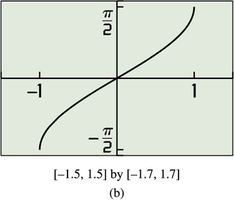
The inverse sine function, also called arcsine, is denoted as or . It gives the unique angle in the interval such that .
Domain:
Range:
Equation: and
![Graph of sine function restricted to [-π/2, π/2]](https://static.studychannel.pearsonprd.tech/study_guide_files/precalculus/sub_images/93e43653_image_2.png)
Evaluating Inverse Sine Without a Calculator
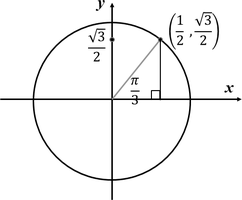
Key Point: To find for special values, locate the angle in whose sine is .
Example: , since .
Evaluating Inverse Sine With a Calculator
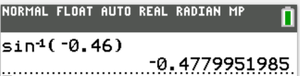
Key Point: Use the calculator's inverse sine function to find approximate values in radians or degrees.
Example: radians.
Inverse Cosine Function (Arccosine)
Definition and Properties
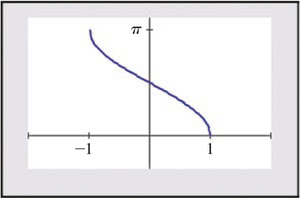
The inverse cosine function, or arccosine, is denoted as or . It gives the unique angle in the interval such that .
Domain:
Range:
Equation: and
![Graph of cosine function restricted to [0, π]](https://static.studychannel.pearsonprd.tech/study_guide_files/precalculus/sub_images/93e43653_image_6.png)
Inverse Tangent Function (Arctangent)
Definition and Properties
The inverse tangent function, or arctangent, is denoted as or . It gives the unique angle in the interval such that .
Domain:
Range:
Equation: and
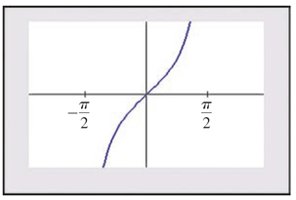
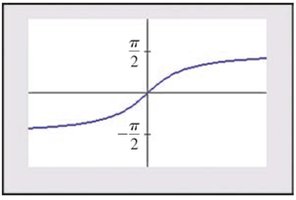
End Behavior of Inverse Tangent Function
Key Point: As , ; as , .
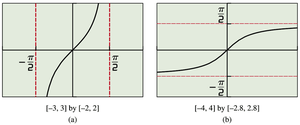
Applications of Inverse Trigonometric Functions
Example: Calculating a Viewing Angle
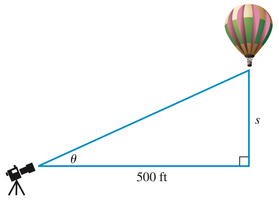
Inverse trigonometric functions are used in real-world applications such as determining angles of elevation or depression. For example, to find the angle at which a photographer must look to see a rising balloon, use the arctangent function.
Key Point: If the horizontal distance is 500 ft and the balloon's height is , then implies that .
Key Point: The rate of change of with respect to is greater when "s" is small, due to the shape of the arctangent curve.
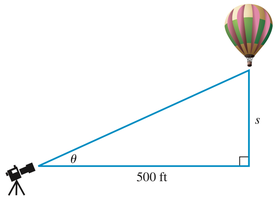
Summary Table: Inverse Trigonometric Functions
Function | Notation | Domain | Range | Equation |
|---|---|---|---|---|
Inverse Sine | ||||
Inverse Cosine | ||||
Inverse Tangent |
