 Back
BackLaw of Sines: The Ambiguous Case (SSA)
Study Guide - Smart Notes
 Tailored notes based on your materials, expanded with key definitions, examples, and context.
Law of Sines: The Ambiguous Case (SSA)
Introduction to Triangle Congruence and the Ambiguous Case
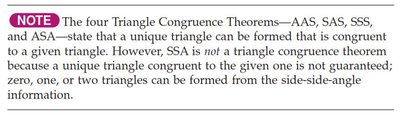
The Triangle Congruence Theorems—AAS (Angle-Angle-Side), SAS (Side-Angle-Side), SSS (Side-Side-Side), and ASA (Angle-Side-Angle)—guarantee that a unique triangle can be formed that is congruent to a given triangle. However, the SSA (Side-Side-Angle) condition does not guarantee a unique triangle. With SSA, it is possible to have zero, one, or two distinct triangles that satisfy the given measurements. This situation is known as the Ambiguous Case for the Law of Sines.
Law of Sines and the Ambiguous Case
The Law of Sines relates the sides and angles of a triangle and is given by:
When using the Law of Sines with SSA information (two sides and a non-included angle), the number of possible triangles depends on the relative lengths of the sides and the measure of the given angle. The ambiguous case primarily arises when solving for an unknown angle or side in a triangle where two sides and an angle not between them are known.
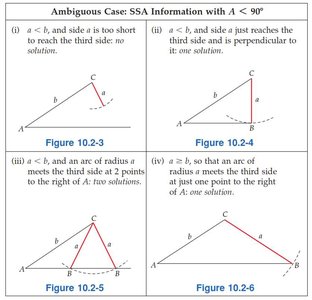
Cases for SSA: When A < 90°
Suppose you are given two sides, a and b, and an angle A opposite side a, with A being an acute angle (< 90°). The possible scenarios are:
Case | Condition | Number of Solutions | Description |
|---|---|---|---|
1 | and is too short to reach the third side | 0 | No triangle can be formed |
2 | and just reaches the third side (perpendicular) | 1 | Exactly one right triangle can be formed |
3 | and meets the third side at two points | 2 | Two distinct triangles can be formed |
4 | 1 | Exactly one triangle can be formed |
Cases for SSA: When A > 90°
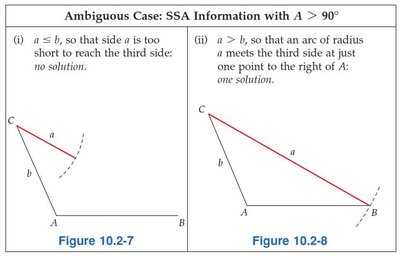
If the given angle A is obtuse (> 90°), the possibilities are more limited:
Case | Condition | Number of Solutions | Description |
|---|---|---|---|
1 | 0 | No triangle can be formed | |
2 | 1 | Exactly one triangle can be formed |
Summary Table: Number of Triangles Possible in the SSA Case
Given | Condition | Number of Triangles |
|---|---|---|
0 | ||
1 (right triangle) | ||
2 | ||
1 | ||
0 | ||
1 |
Example Application
Example: Suppose you are given , , and . To determine the number of possible triangles:
Calculate
Since (), there are two possible triangles.
Additional info: The ambiguous case is a classic example of why careful analysis is needed when solving triangles using the Law of Sines. Always check the possible number of solutions before proceeding with calculations.
