 Back
BackLibrary of Functions and Piecewise-Defined Functions
Study Guide - Smart Notes
 Tailored notes based on your materials, expanded with key definitions, examples, and context.
Section 1.4 Library of Functions; Piecewise-Defined Functions
Introduction
This section introduces the fundamental functions commonly used in precalculus, known as the "library of functions," and explores the concept and analysis of piecewise-defined functions. Understanding these basic functions and their properties is essential for graphing and analyzing more complex mathematical relationships.
Library of Functions
Constant and Identity Functions
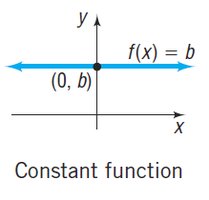
Constant Function: Defined as , where is a real number. The graph is a horizontal line.
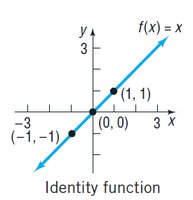
Identity Function: Defined as . The graph is a straight line passing through the origin with a slope of 1.
Square and Cube Functions
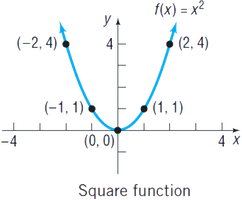
Square Function:
Domain: All real numbers
Range:
Even function (symmetric with respect to the y-axis)
Absolute minimum at
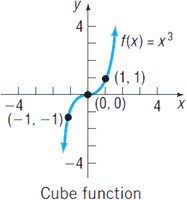
Cube Function:
Domain and Range: All real numbers
Odd function (symmetric with respect to the origin)
No local minima or maxima
Square Root and Cube Root Functions
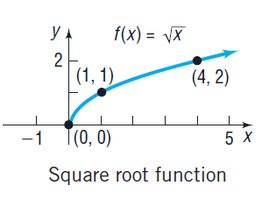
Square Root Function:
Domain:
Range:
Neither even nor odd
Absolute minimum at
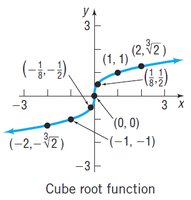
Cube Root Function:
Domain and Range: All real numbers
Odd function (symmetric with respect to the origin)
Increasing everywhere
Reciprocal and Absolute Value Functions
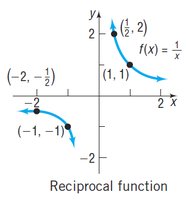
Reciprocal Function:
Domain:
Range:
Odd function (symmetric with respect to the origin)
Vertical and horizontal asymptotes at and
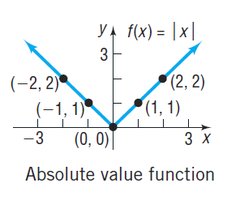
Absolute Value Function:
Domain: All real numbers
Range:
Even function (symmetric with respect to the y-axis)
Absolute minimum at
Greatest Integer Function
Greatest Integer Function (Floor Function): or
Returns the greatest integer less than or equal to
Graph is a step function
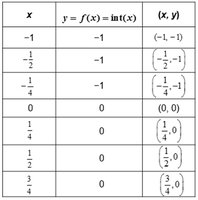
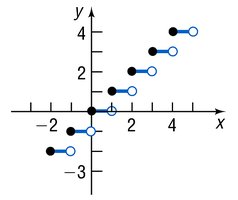
Graphing and Analyzing Library Functions
Example: Cube Root Function
Function:
Symmetry: Odd function (symmetric with respect to the origin)
Intercepts: Both x- and y-intercepts at (0, 0)
Table of Values:
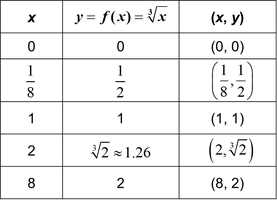
Graph:
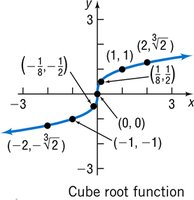
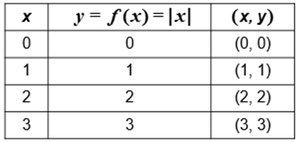
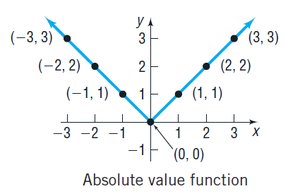
Example: Absolute Value Function
Function:
Symmetry: Even function (symmetric with respect to the y-axis)
Intercepts: Both x- and y-intercepts at (0, 0)
Table of Values:
Graph:
Piecewise-Defined Functions
Definition and Analysis
A piecewise-defined function is a function that is defined by different expressions for different intervals of the domain. Each "piece" applies to a specific part of the domain.
To analyze a piecewise-defined function:
Identify the intervals and the corresponding expressions.
Find the domain by considering all intervals.
Find intercepts by solving for and in each piece.
Graph each piece over its interval, paying attention to endpoints (open or closed circles).
Determine the range from the graph.
Example: Graphing a Piecewise-Defined Function
Given a function defined by different expressions on different intervals, graph each piece and combine them to form the complete graph.
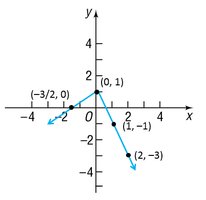
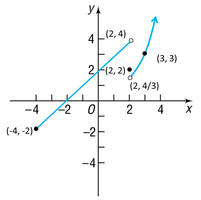
Example: Analyzing a Piecewise-Defined Function
Domain: Determined by the union of the intervals for which each piece is defined.
Intercepts: Found by evaluating for the y-intercept and solving for x-intercepts in each piece.
Graph: Draw each piece over its interval, noting open or closed endpoints.
Range: Determined from the graph as the set of all possible output values.
Applications of Piecewise-Defined Functions
Example: Cost of Electricity
Electricity cost is modeled as a piecewise-defined function, where the rate changes after a certain usage threshold.
For kWh used:
If ,
If ,
The graph consists of two linear pieces with different slopes, meeting at the point .
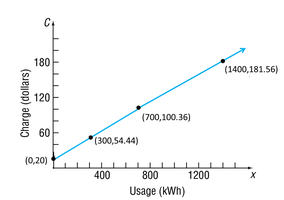
Additional info: Piecewise-defined functions are commonly used to model real-world situations where a rule or relationship changes at certain thresholds, such as tax brackets, shipping rates, or utility pricing.
