 Back
Linear Functions and Their Properties: Precalculus Study Guidance
Study Guide - Smart Notes
 Tailored notes based on your materials, expanded with key definitions, examples, and context.
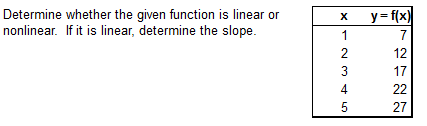
Q1. Determine whether the given function is linear or nonlinear. If it is linear, determine the slope.
Background
Topic: Linear Functions and Slope
This question tests your ability to recognize linear functions from a table of values and, if the function is linear, to calculate its slope.
Key Terms and Formulas:
Linear function: A function of the form .
Slope (): The rate of change between two points, calculated as .
Step-by-Step Guidance
Examine the differences between consecutive values and values in the table.
Calculate the change in for each step and check if it is constant.
If the change in is constant for each change in , the function is linear.
Use the slope formula with any two points to find the slope.
Try solving on your own before revealing the answer!
Final Answer:
The function is linear because the change in for each unit increase in is constant (5).
The slope is .
This means for every increase of 1 in , increases by 5.
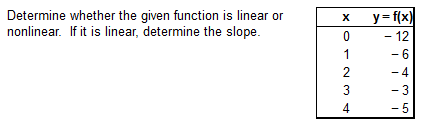
Q2. Determine whether the given function is linear or nonlinear. If it is linear, determine the slope.
Background
Topic: Linear Functions and Slope
This question tests your ability to analyze a table of values to determine linearity and calculate the slope if applicable.
Key Terms and Formulas:
Linear function:
Slope ():
Step-by-Step Guidance
Check the differences between consecutive values and values.
Calculate the change in for each step and see if it is constant.
If the change in is not constant, the function is nonlinear. If it is constant, proceed to find the slope.
Use the slope formula with any two points to find the slope.
Try solving on your own before revealing the answer!
Final Answer:
The function is nonlinear because the change in is not constant for each unit increase in .
For example, from to , changes from to (change of ), but from to , changes from to (change of ).
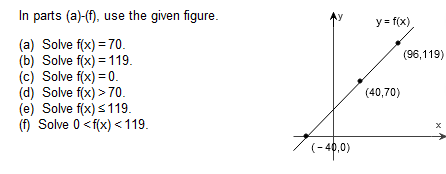
Q3. In parts (a)-(f), use the given figure.
Background
Topic: Solving Linear Equations and Inequalities Graphically
This question tests your ability to interpret a graph of a linear function and solve equations and inequalities based on the graph.
Key Terms and Formulas:
Linear function:
Solving : Find the value where the function equals .
Solving or : Find the range of values where the function is above or below .
Step-by-Step Guidance
Identify the points on the graph where equals the given values (e.g., at ).
For inequalities, determine the intervals on the -axis where the function is above or below the specified value.
For , find the -intercept.
For compound inequalities, identify the range of values that satisfy both conditions.
Try solving on your own before revealing the answer!
Final Answer:
(a) at
(b) at
(c) at
(d) for
(e) for
(f) for
Each answer is found by reading the graph and matching the values to the corresponding values.
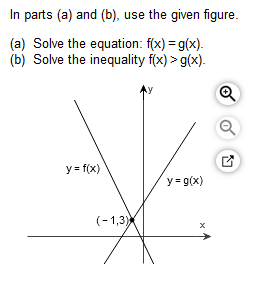
Q4. In parts (a) and (b), use the given figure.
Background
Topic: Solving Linear Equations and Inequalities Graphically
This question tests your ability to solve equations and inequalities involving two linear functions using their graphs.
Key Terms and Formulas:
Intersection point: Where
Inequality: means the value of is greater than for certain values.
Step-by-Step Guidance
Locate the intersection point of the two lines on the graph. This is where .
For the inequality , identify the region(s) on the -axis where the value of is above that of .
Use the coordinates of the intersection point to write the solution for the equation.
For the inequality, describe the interval(s) where is greater than .
Try solving on your own before revealing the answer!
Final Answer:
(a) at
(b) for
The intersection point gives the solution to the equation, and the region where is above gives the solution to the inequality.
