 Back
BackLogarithmic Functions and Their Properties: Study Guide
Study Guide - Smart Notes
 Tailored notes based on your materials, expanded with key definitions, examples, and context.
Logarithmic Functions
Definition and Basic Properties
The logarithmic function to the base a (where a > 0 and a \neq 1) is denoted as \( y = \log_a x \) and is defined by the relationship \( x = a^y \). The domain of the logarithmic function is x > 0, and x is called the argument of the logarithm.
Common Logarithm: Logarithm with base 10, written as \( \log x \).
Natural Logarithm: Logarithm with base e (Euler's number), written as \( \ln x \).
Fundamental Properties of Logarithms
Logarithms have several key properties that are essential for simplifying expressions and solving equations:
Property 1: \( \log_a 1 = 0 \) — The logarithm of 1 to any base is 0.
Property 2: \( \log_a a = 1 \) — The logarithm of the base to itself is 1.
Property 3: \( a^{\log_a M} = M \) — Exponential and logarithmic functions are inverses.
Property 4: \( \log_a a^r = r \) — The logarithm of a base raised to a power equals the exponent.
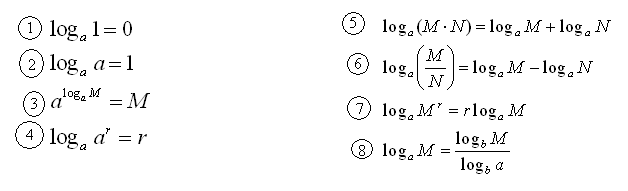
Property 5: \( \log_a (M \cdot N) = \log_a M + \log_a N \) — The logarithm of a product is the sum of the logarithms.
Property 6: \( \log_a \left( \frac{M}{N} \right) = \log_a M - \log_a N \) — The logarithm of a quotient is the difference of the logarithms.
Property 7: \( \log_a M^r = r \log_a M \) — The logarithm of a power is the exponent times the logarithm.
Property 8: \( \log_a M = \frac{\log_b M}{\log_b a} \) — Change of base formula, useful for evaluating logarithms with arbitrary bases.
Examples and Applications
Example 1: Rewrite using the definition of logarithms:
\( 2^4 = 16 \) → \( \log_2 16 = 4 \)
\( e^x = 6 \) → \( x = \ln 6 \)
\( \log_2 5 = b \) → \( 2^b = 5 \)
\( \ln 3 = x \) → \( e^x = 3 \)
Example 2: Find the exact value of the logarithm without a calculator:
\( \log_8 8 = 1 \) (since 8 is the base)
\( \log_3 25 \) — Not an integer, but can be written as \( \frac{\ln 25}{\ln 3} \) using the change of base formula.
Example 3: Find the domain of the function:
\( f(x) = \ln(x-1) \) — Domain: \( x > 1 \)
\( f(x) = \log_2 \left( \frac{5x-1}{3-x} \right) \) — Domain: \( 5x-1 > 0 \) and \( 3-x > 0 \)
Properties of Logarithms: Expanded Use
Logarithmic properties are used to simplify expressions, solve equations, and rewrite logarithmic expressions in different forms.
Product Rule: \( \log_a (MN) = \log_a M + \log_a N \)
Quotient Rule: \( \log_a \left( \frac{M}{N} \right) = \log_a M - \log_a N \)
Power Rule: \( \log_a M^r = r \log_a M \)
Change of Base: \( \log_a M = \frac{\log_b M}{\log_b a} \)
Solving Logarithmic and Exponential Equations
To solve logarithmic and exponential equations, use the properties above to isolate the variable and rewrite the equation in a solvable form.
Combine logarithms using product, quotient, and power rules.
Rewrite logarithmic equations as exponential equations and vice versa.
Check that solutions are within the domain of the original logarithmic function.
Financial Models: Compound Interest and Continuous Compounding
Logarithmic and exponential functions are used in financial models, such as compound interest and continuous compounding.
Compound Interest Formula:
Continuous Compounding:
Effective Rate of Interest: (compounding n times per year), (continuous compounding)
Exponential Growth and Decay Models
Exponential functions model growth and decay in natural processes, such as population growth, radioactive decay, and cooling.
Uninhibited Growth/Decay:
Newton's Law of Cooling:
Summary Table: Logarithmic Properties
Property | Formula | Description |
|---|---|---|
Identity | Logarithm of 1 is 0 | |
Base | Logarithm of base is 1 | |
Inverse | Exponential and logarithmic are inverses | |
Exponent | Logarithm of base to exponent is exponent | |
Product | Logarithm of product is sum | |
Quotient | Logarithm of quotient is difference | |
Power | Logarithm of power is exponent times logarithm | |
Change of Base | Change base of logarithm |
