 Back
BackLogarithmic Functions: Definitions, Properties, and Graphs
Study Guide - Smart Notes
 Tailored notes based on your materials, expanded with key definitions, examples, and context.
Logarithmic Functions
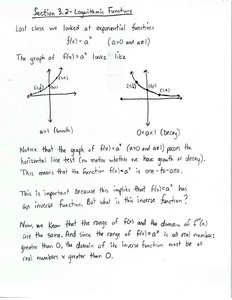
Exponential Functions and Their Inverses
Exponential functions are foundational in precalculus, and their inverses are logarithmic functions. Understanding the relationship between these two types of functions is essential for solving equations and modeling real-world phenomena.
Exponential Function: , where and .
The graph of is increasing if and decreasing if .
Exponential functions pass the horizontal line test, so they are one-to-one and have inverses.
The range of is all real numbers greater than 0; the domain is all real numbers.
Definition of Logarithmic Functions
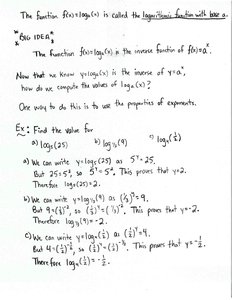
The logarithmic function is the inverse of the exponential function. It allows us to solve for exponents in equations of the form .
Logarithmic Function: , where , , and .
Inverse Relationship: if and only if .
Logarithms answer the question: "To what exponent must we raise to get ?"
Example Calculations:
because .
because .
because .
Graphs of Logarithmic Functions
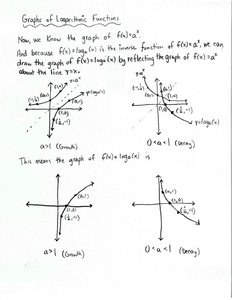
The graph of a logarithmic function is obtained by reflecting the graph of its corresponding exponential function across the line . The behavior of the graph depends on the base .
For , is increasing.
For , is decreasing.
The domain is and the range is .
The graph passes through because for any valid base .
Properties of Logarithmic Functions
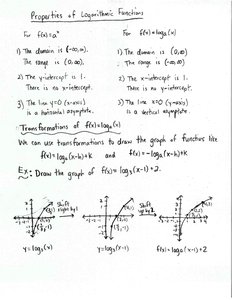
Logarithmic functions have several important properties that are useful for graphing and solving equations.
For | For |
|---|---|
Domain: | Domain: |
Range: | Range: |
Y-intercept: | X-intercept: |
No x-intercept | No y-intercept |
Horizontal asymptote: | Vertical asymptote: |
Transformations: The graph of can be shifted and stretched using transformations such as .
Horizontal shift: units right for
Vertical shift: units up for
Example: Graph by shifting right by 1 and up by 2.
Common and Natural Logarithms
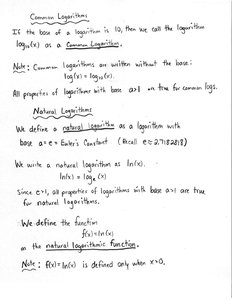
Special logarithms are used frequently in mathematics and science: the common logarithm (base 10) and the natural logarithm (base ).
Common Logarithm: , often written as .
Natural Logarithm: , written as , where (Euler's number).
All properties of logarithms with base apply to common and natural logarithms.
The function is defined only for .
Additional info: The natural logarithm is especially important in calculus and mathematical modeling due to its connection with continuous growth and the exponential function .
