 Back
BackPolar Coordinates: Representation, Conversion, and Equivalent Forms 6.3
Study Guide - Smart Notes
 Tailored notes based on your materials, expanded with key definitions, examples, and context.
Polar Coordinates
Introduction to Polar Coordinates
The polar coordinate system is an alternative to the rectangular (Cartesian) coordinate system. In polar coordinates, a point is represented as (r, θ), where r is the distance from the origin (called the pole) and θ is the angle measured from the positive x-axis (polar axis) in standard position.
r: The radius or directed distance from the origin.
θ: The angle, measured in degrees or radians, from the positive x-axis.
To plot a point, first draw the angle θ in standard position, then move outwards a distance of r units from the origin along that direction.
Plotting Points in Polar Coordinates
To plot a point in polar coordinates, follow these steps:
Draw the angle θ in standard position (counterclockwise from the positive x-axis for positive angles, clockwise for negative angles).
From the origin, move a distance of |r| units along the terminal side of the angle.
If r is negative, move in the direction opposite to the terminal side of the angle.
Examples:
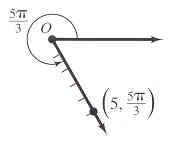
Plotting (5, \frac{5\pi}{3}): Draw an angle of \(\frac{5\pi}{3}\) radians (300°) and mark 5 units from the origin.
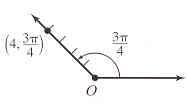
Plotting (4, \frac{3\pi}{4}): Draw an angle of \(\frac{3\pi}{4}\) radians (135°) and mark 4 units from the origin.
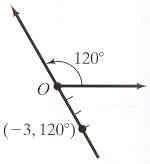
Plotting (-3, 120°): Draw an angle of 120° and, since r is negative, move 3 units in the direction opposite to the terminal side of the angle.
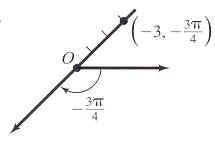
Plotting (-3, -\frac{3\pi}{4}): Draw an angle of -\(\frac{3\pi}{4}\) radians (-135°), then move 3 units in the direction opposite to the terminal side of the angle.
Equivalent Polar Coordinates
There are infinitely many ways to represent the same point in polar coordinates. The following relationships are useful for finding equivalent coordinates:
Adding or subtracting full rotations to the angle does not change the location: or
Changing the sign of r and adding/subtracting 180° (or π radians) to the angle gives the same point: or
Example: The point (5, 300°) can also be written as (-5, 120°) or (5, -60°), etc.
Conversion Between Polar and Rectangular Coordinates
To convert between polar and rectangular coordinates, use the following formulas:
From polar to rectangular:
From rectangular to polar:
Note: Adjust θ based on the quadrant of (x, y).
Converting Equations Between Coordinate Systems
To convert equations from polar to rectangular form, use the relationships:
To convert from rectangular to polar, solve for r and θ using the above relationships.
Examples of Conversion
Convert (\frac{5\pi}{3}, 5) to rectangular:
Convert (x, y) = (-3, 3) to polar:
(adjust for quadrant)
Since (-3, 3) is in the second quadrant, add 180°: or radians.
Summary Table: Polar and Rectangular Relationships
Polar | Rectangular |
|---|---|
Additional info: The notes also cover converting equations between polar and rectangular forms, including lines and circles, and solving for r in polar equations using trigonometric identities.
