 Back
Polynomial and Rational Functions: Key Concepts and Graphs
Study Guide - Smart Notes
 Tailored notes based on your materials, expanded with key definitions, examples, and context.
Complex Numbers and Quadratic Equations
Complex Numbers
Complex numbers extend the real number system by introducing the imaginary unit i, defined as . Any complex number can be written in the form a + bi, where a and b are real numbers.
Standard Form: a + bi
Operations: Addition, subtraction, multiplication, and division follow binomial rules.
Conjugate: The conjugate of a + bi is a - bi. The product of a complex number and its conjugate is always a real number.
Principal Square Root: For any positive real number b, .
Quadratic Equations with Complex Solutions
Quadratic equations of the form can have complex solutions if the discriminant is negative. These solutions are always conjugate pairs.
Quadratic Formula:
Discriminant: If , the equation has two complex conjugate solutions.
Quadratic Functions and Their Graphs
Standard Form and Vertex
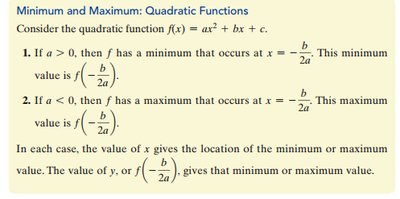
A quadratic function can be written in standard form as , where (h, k) is the vertex. The graph is a parabola, symmetric about the line x = h.
Direction: If a > 0, the parabola opens upward; if a < 0, it opens downward.
Vertex: The vertex is at or for .
Intercepts: Find x-intercepts by solving ; y-intercept is .
Axis of Symmetry: x = h or .
Domain: All real numbers; Range: if a > 0, if a < 0.
Polynomial Functions and Their Graphs
Definition and Properties
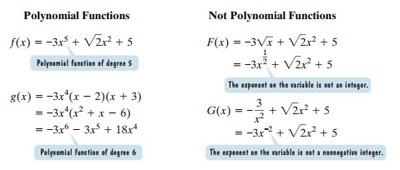
A polynomial function is an expression of the form , where n is a nonnegative integer and coefficients are real numbers.
Degree: The highest power of x; determines the function's behavior.
Leading Coefficient: The coefficient of the highest power term.
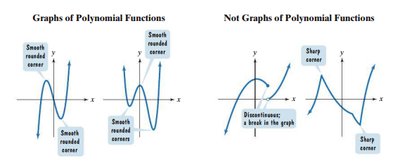
Graph Characteristics: Smooth and continuous, no sharp corners or breaks.
End Behavior: Leading Coefficient Test
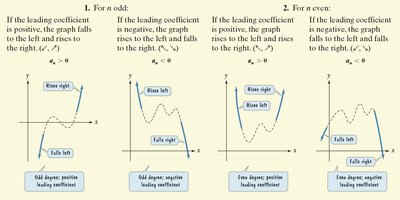
The end behavior of a polynomial function depends on its degree and leading coefficient.
Odd Degree: Positive leading coefficient: falls left, rises right. Negative leading coefficient: rises left, falls right.
Even Degree: Positive leading coefficient: rises both ends. Negative leading coefficient: falls both ends.
Zeros, Multiplicity, and x-Intercepts
The zeros of a polynomial function are the values of x for which . The multiplicity of a zero refers to how many times a factor appears in the factorization.
Even Multiplicity: Graph touches x-axis and turns around.
Odd Multiplicity: Graph crosses x-axis.
Maximum Turning Points: n - 1, where n is the degree.
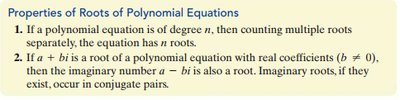
Properties of Roots of Polynomial Equations
If a polynomial equation is of degree n, it has n roots (counting multiplicities).
If is a root and coefficients are real, is also a root (conjugate pairs).
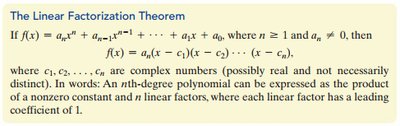
The Linear Factorization Theorem
Any nth-degree polynomial can be written as a product of n linear factors (possibly complex), multiplied by a constant.
Each linear factor corresponds to a root (zero) of the polynomial.
Descartes' Rule of Signs
Descartes' Rule of Signs helps estimate the number of positive and negative real zeros of a polynomial function by counting sign changes in the coefficients.
Positive Real Zeros: Number of sign changes in or less by an even integer.
Negative Real Zeros: Number of sign changes in or less by an even integer.
Rational Functions and Their Graphs
Definition and Domain
A rational function is a quotient of two polynomial functions: , where . The domain excludes values that make the denominator zero.
Vertical and Horizontal Asymptotes
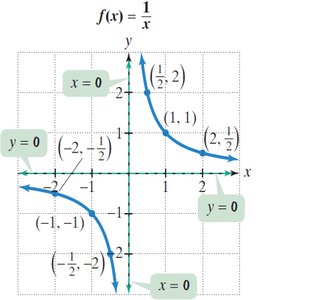
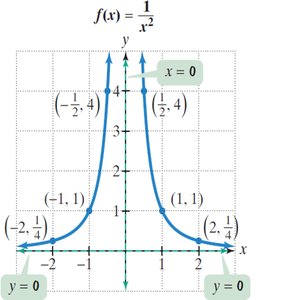
Vertical Asymptote: x = a, where and .
Horizontal Asymptote: Determined by degrees of numerator (n) and denominator (m): - If n < m: y = 0 - If n = m: y = (leading coefficient of numerator)/(leading coefficient of denominator) - If n > m: No horizontal asymptote
Basic Reciprocal Functions
Odd Function: , origin symmetry.
Even Function: , y-axis symmetry.
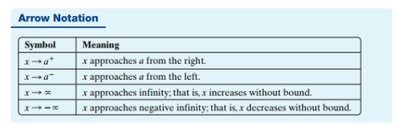
Arrow Notation
Arrow notation is used to describe the behavior of functions as x approaches certain values or infinity.
Symbol | Meaning |
|---|---|
x \to a^+ | x approaches a from the right. |
x \to a^− | x approaches a from the left. |
x \to \infty | x approaches infinity; x increases without bound. |
x \to -\infty | x approaches negative infinity; x decreases without bound. |
Solving Polynomial and Rational Inequalities
Definitions and Procedure
A polynomial or rational inequality is an inequality involving a polynomial or rational function, such as , , , or .
Express the inequality in standard form.
Solve to find boundary points.
Divide the number line into intervals using boundary points.
Test values in each interval to determine where the inequality holds.
Write the solution set, including boundary points if the inequality is non-strict ( or ).
Summary Table: Polynomial vs Not Polynomial Functions
Type | Example | Reason |
|---|---|---|
Polynomial | All exponents are nonnegative integers. | |
Not Polynomial | Exponent is not an integer. | |
Not Polynomial | Exponent is not a nonnegative integer. |
Summary Table: Arrow Notation
Symbol | Meaning |
|---|---|
x \to a^+ | x approaches a from the right. |
x \to a^− | x approaches a from the left. |
x \to \infty | x approaches infinity; x increases without bound. |
x \to -\infty | x approaches negative infinity; x decreases without bound. |
