 Back
Polynomials: Operations and Factoring – Precalculus Study Notes
Study Guide - Smart Notes
 Tailored notes based on your materials, expanded with key definitions, examples, and context.
Polynomials: Operations and Factoring
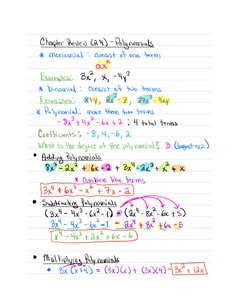
Monomials, Binomials, and Polynomials
Polynomials are algebraic expressions consisting of variables and coefficients, combined using only addition, subtraction, and multiplication. The number of terms determines the specific name:
Monomial: An expression with only one term (e.g., ).
Binomial: An expression with two terms (e.g., ).
Trinomial: An expression with three terms (e.g., ).
Polynomial: An expression with one or more terms (e.g., ).
Coefficients are the numerical factors in each term (e.g., in , 8 is the coefficient).
The degree of a polynomial is the highest power of the variable present (e.g., in , the degree is 4).
Operations with Polynomials
Polynomials can be added, subtracted, and multiplied using algebraic rules:
Adding Polynomials: Combine like terms (terms with the same variable and exponent).
Subtracting Polynomials: Distribute the negative sign and then combine like terms.
Multiplying Polynomials: Use the distributive property or the FOIL method for binomials.
Example (Addition): Combine like terms:
Example (Multiplication):
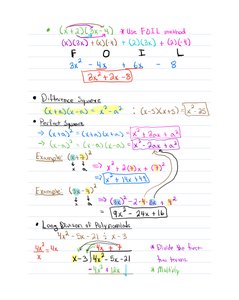
Multiplying Binomials: FOIL Method
The FOIL method is used to multiply two binomials:
First: Multiply the first terms.
Outer: Multiply the outer terms.
Inner: Multiply the inner terms.
Last: Multiply the last terms.
Example:
Special Products of Polynomials
Difference of Squares:
Perfect Square Trinomial: and
Example:
Long Division of Polynomials
Long division is used to divide polynomials, similar to numerical long division. Divide the leading term, multiply, subtract, and repeat until the remainder is of lower degree than the divisor.
Example: Divide by .
Factoring Polynomials
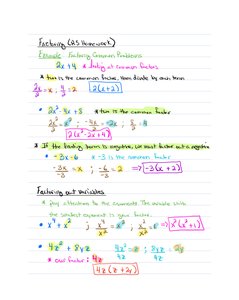
Factoring is the process of expressing a polynomial as a product of its factors. Common methods include factoring out the greatest common factor (GCF), factoring by grouping, and factoring special forms.
Factoring Out the Greatest Common Factor (GCF)
Identify the largest factor common to all terms.
Factor it out and write the remaining expression in parentheses.
Example:
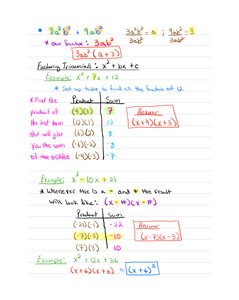
Factoring Trinomials
For trinomials of the form , find two numbers that multiply to and add to .
Example:
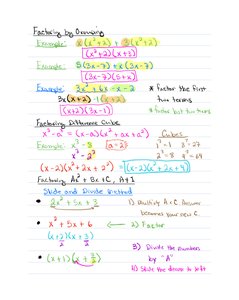
Factoring by Grouping
Used when a polynomial has four terms. Group terms to factor out common factors, then factor the resulting binomial.
Example:
Factoring Special Forms
Difference of Cubes:
Sum of Cubes:
Factoring Using the Slide and Divide Method
This method is used for trinomials where the leading coefficient is not 1. Multiply and , factor as usual, then divide the factors by and simplify.
Summary Table: Common Factoring Patterns
Pattern | Factored Form |
|---|---|
Difference of Squares | |
Perfect Square Trinomial | |
Difference of Cubes | |
Sum of Cubes |
Additional info: These notes cover essential Precalculus topics from Chapter 5: Polynomial and Rational Functions, including operations, factoring, and special products. Mastery of these concepts is foundational for advanced algebra and calculus.
