 Back
BackPrecalculus Exam 1 Review – Step-by-Step Guidance
Study Guide - Smart Notes
 Tailored notes based on your materials, expanded with key definitions, examples, and context.
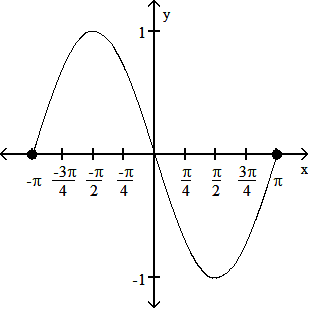
Q4. Determine whether the graph is that of a function. If it is, use the graph to find its domain and range, the intercepts, if any, and any symmetry with respect to the x-axis, the y-axis, or the origin.
Background
Topic: Graphs of Functions and Their Properties
This question tests your ability to analyze a graph to determine if it represents a function, and if so, to describe its domain, range, intercepts, and symmetries.
Key Terms and Concepts:
Function: A relation where each input (x-value) has exactly one output (y-value).
Domain: The set of all possible x-values for which the function is defined.
Range: The set of all possible y-values the function can take.
Intercepts: Points where the graph crosses the x-axis (x-intercepts) or y-axis (y-intercepts).
Symmetry: The graph may be symmetric with respect to the y-axis (even function), origin (odd function), or x-axis (not a function if symmetric about x-axis).
Step-by-Step Guidance
Check if the graph passes the vertical line test: For every x-value in the domain, does the graph intersect the vertical line at most once? If yes, it is a function.
Identify the domain by looking at the leftmost and rightmost x-values where the graph exists. Are there any breaks or restrictions?
Determine the range by finding the lowest and highest y-values the graph attains.
Find the intercepts by identifying where the graph crosses the axes. Look for points where y = 0 (x-intercepts) and x = 0 (y-intercept).
Check for symmetry: Is the graph symmetric about the y-axis, x-axis, or origin? For origin symmetry, check if rotating the graph 180° about the origin leaves it unchanged.
Try solving on your own before revealing the answer!
Final Answer:
The graph is a function. Domain: , Range: , Intercepts: , Symmetry: origin.
The graph passes the vertical line test, and the endpoints and intercepts are clearly marked. The function is odd, as it is symmetric about the origin.
