Back
BackPrecalculus Final Exam Review: Key Concepts and Problem Types
Study Guide - Smart Notes
 Tailored notes based on your materials, expanded with key definitions, examples, and context.
Review of Conic Sections
Ellipses: Standard Form and Properties
Ellipses are conic sections defined by the sum of the distances from any point on the ellipse to two fixed points (foci) being constant. The standard form of an ellipse centered at (h, k) is:
Horizontal major axis:
Vertical major axis:
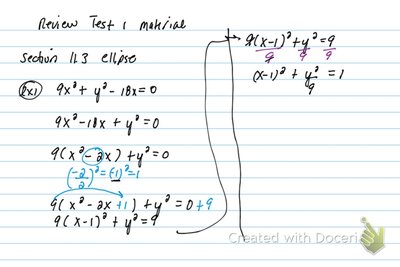
To rewrite a general quadratic equation as an ellipse, complete the square for both variables and rearrange into standard form.
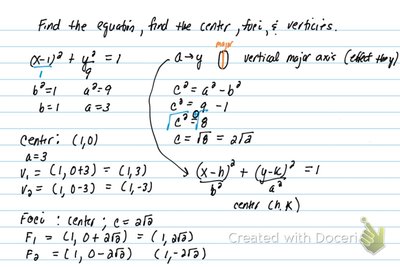
Vertices: Located at a distance a from the center along the major axis.
Foci: Located at a distance c from the center, where (for vertical major axis, ).
Center: The point (h, k).
Example: Rewrite as an ellipse and find its center, vertices, and foci.
Functions and Their Properties
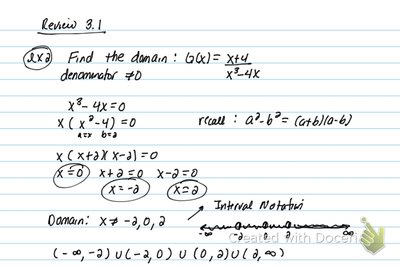
Domain of Rational Functions
The domain of a rational function is all real numbers except where the denominator is zero. To find the domain, set the denominator equal to zero and solve for excluded values.
Example: For , set and solve for .
Interval Notation: Express the domain as a union of intervals excluding the zeros of the denominator.
Difference Quotient
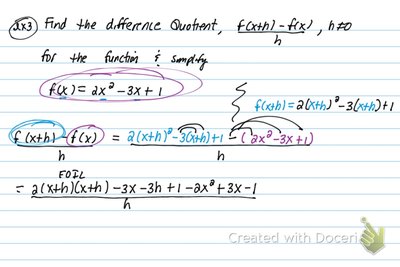
The difference quotient is a fundamental concept for understanding rates of change and the derivative. It is defined as:
,
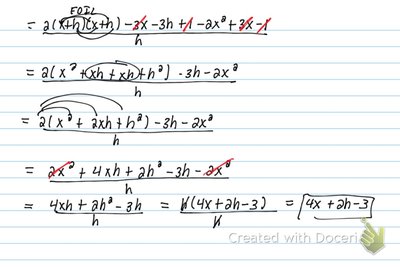
Expand , subtract , and simplify the expression.
Exponents and Radicals
Simplifying Expressions with Exponents
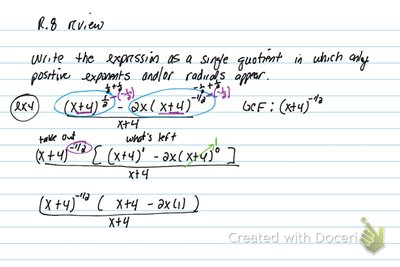
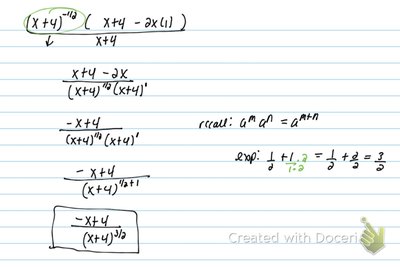
To write expressions as a single quotient with only positive exponents and/or radicals, factor out common terms and apply exponent rules:
Product Rule:
Quotient Rule:
Graphs and Properties of Functions
Absolute and Local Extrema
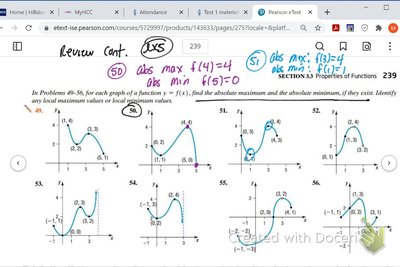
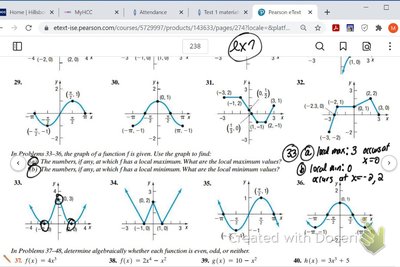
Absolute maximum and minimum values of a function are the highest and lowest points on the graph, respectively. Local extrema are the highest or lowest points in a neighborhood.
Identify extrema by analyzing the graph or using calculus techniques.
State the value and location of each extremum.
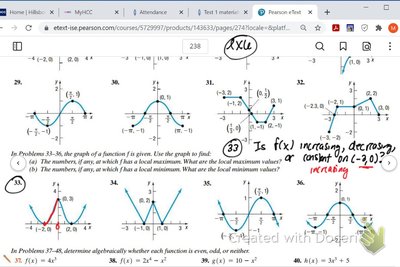
Increasing, Decreasing, and Constant Intervals
A function is increasing where its graph rises, decreasing where it falls, and constant where it is flat. These intervals can be determined visually from the graph.
Applications of Functions
Optimization Problems
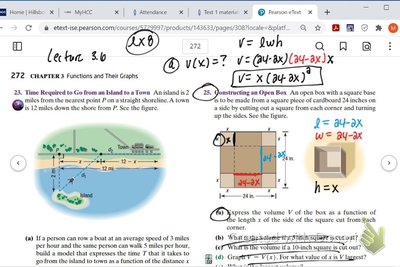
Optimization involves finding the maximum or minimum value of a function, often subject to constraints. Common applications include maximizing area, volume, or revenue.
Express the quantity to be optimized as a function of one variable.
Use algebraic manipulation and calculus (if applicable) to find extrema.
Quadratic and Polynomial Functions
Vertex and Maximum/Minimum of a Quadratic
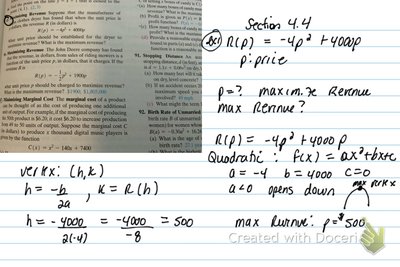
The vertex of a quadratic function is found at . For revenue or profit functions, this gives the price or quantity that maximizes the value.
Example: ; vertex gives maximum revenue.
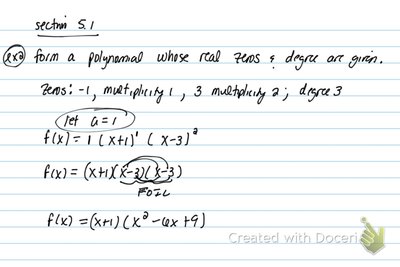
Forming Polynomials from Zeros
Given real zeros and their multiplicities, construct a polynomial by multiplying corresponding factors. For example, zeros at (multiplicity 1) and $3$ (multiplicity 2) yield:
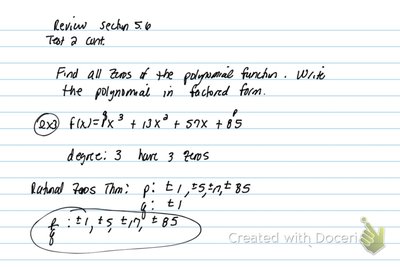
Finding All Zeros of a Polynomial
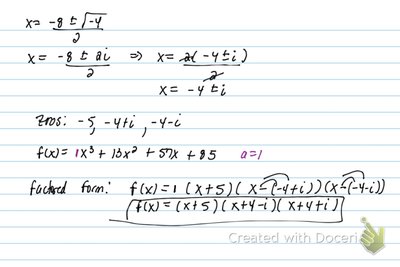
To find all zeros, use the Rational Zeros Theorem, synthetic division, and the quadratic formula as needed. Write the polynomial in factored form.
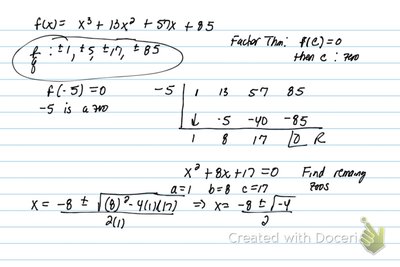
Exponential and Logarithmic Functions
Transformations of Exponential Functions
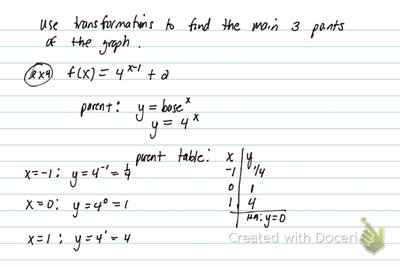
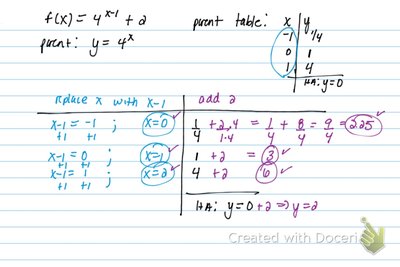
Transformations include shifts, stretches, and reflections. For , the graph of is shifted right by 1 and up by 2.
Construct a table of values to illustrate the transformation.
Identify the horizontal asymptote.
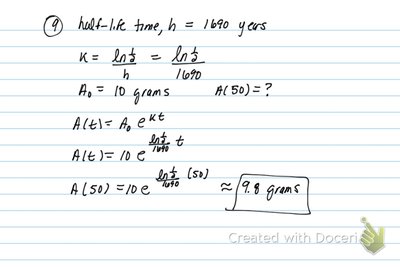
Exponential Growth and Decay; Half-Life
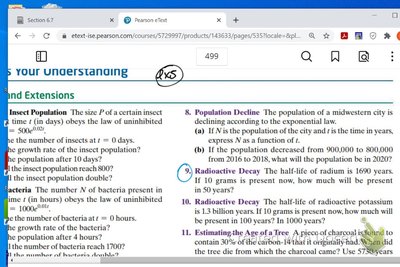
Exponential models describe population growth and radioactive decay. The general form is , where is the growth or decay constant. For half-life problems, , where is the half-life.
Example: Find the amount remaining after 50 years if the half-life is 1690 years and the initial amount is 10 grams.
Trigonometry
Quadrants and Angle Location
To determine the quadrant in which an angle lies, convert the angle to radians if necessary and compare to the standard positions on the unit circle. Positive angles are measured counterclockwise from the positive x-axis.
For large angles, subtract multiples of to find the coterminal angle.