 Back
BackPrecalculus Polynomial Functions and Theorems Study Guide
Study Guide - Smart Notes
 Tailored notes based on your materials, expanded with key definitions, examples, and context.
Q1. State the degree and leading coefficient of .
Background
Topic: Polynomial Functions
This question tests your understanding of how to identify the degree and leading coefficient of a polynomial function.
Key Terms and Formulas:
Degree: The highest power of in the polynomial.
Leading Coefficient: The coefficient of the term with the highest degree.
Step-by-Step Guidance
Look at the polynomial and identify the term with the highest exponent.
The degree is the exponent of this term.
The leading coefficient is the number in front of the highest degree term.
Try solving on your own before revealing the answer!
Final Answer:
The degree is 3 and the leading coefficient is 1.
This is because the highest power of is 3, and the coefficient of is 1.
Q2. For each function, determine if it is a polynomial. If yes, identify the degree.
Background
Topic: Identifying Polynomials
This question tests your ability to recognize polynomial functions and determine their degree.
Key Terms and Formulas:
Polynomial: An expression consisting of variables and coefficients, involving only non-negative integer exponents of variables.
Degree: The highest sum of exponents in any term of the polynomial.
Step-by-Step Guidance
Check each function to see if all exponents are non-negative integers and coefficients are real numbers.
If the function is a polynomial, identify the term with the highest exponent to determine the degree.
If any term has a variable in the denominator or a negative/non-integer exponent, it is not a polynomial.
Try solving on your own before revealing the answer!
Final Answer:
is a polynomial of degree 3.
is not a polynomial because is in the denominator.
is not a polynomial because the exponent is not an integer.
Q3. Use the Intermediate Value Theorem to show that the polynomial has a real zero between the given values.
Background
Topic: Intermediate Value Theorem (IVT)
This question tests your understanding of how to use the IVT to prove the existence of a real zero for a polynomial function within a given interval.
Key Terms and Formulas:
Intermediate Value Theorem: If is continuous on and and have opposite signs, then there is at least one in such that .
Step-by-Step Guidance
Evaluate the polynomial at the endpoints of the interval.
Check the signs of and .
If the signs are opposite, state that by IVT, there is a zero between and .
Try solving on your own before revealing the answer!
Final Answer:
Since and have opposite signs, by the Intermediate Value Theorem, there is at least one real zero between and .
Q4. For each zero of the polynomial, state the multiplicity, and whether the graph crosses or bounces at that zero.
Background
Topic: Zeros and Multiplicity of Polynomials
This question tests your understanding of how the multiplicity of a zero affects the graph of a polynomial at that zero.
Key Terms and Formulas:
Zero: A value of where .
Multiplicity: The number of times a zero is repeated.
If the multiplicity is odd, the graph crosses the -axis at that zero. If even, it bounces.
Step-by-Step Guidance
Factor the polynomial to find its zeros.
Determine the exponent (multiplicity) of each zero.
Decide if the graph crosses (odd multiplicity) or bounces (even multiplicity) at each zero.
Try solving on your own before revealing the answer!
Final Answer:
For (multiplicity 1), the graph crosses the -axis. For (multiplicity 2), the graph bounces at the $x$-axis.
Q5. Use the given functions to complete the table. Then graph.
Background
Topic: Graphing Polynomial Functions
This question tests your ability to analyze and graph polynomial functions, including identifying end behavior, intercepts, and multiplicity effects.
Key Terms and Formulas:
End Behavior: Describes how the function behaves as or .
Intercepts: Points where the graph crosses the axes.
Multiplicity: Affects whether the graph crosses or bounces at zeros.
Step-by-Step Guidance
For each function, identify the degree and leading coefficient to determine end behavior.
Find the -intercepts by setting and solving for $x$.
Find the -intercept by evaluating .
Analyze the multiplicity of each zero to determine if the graph crosses or bounces at each intercept.
Sketch the graph using this information.
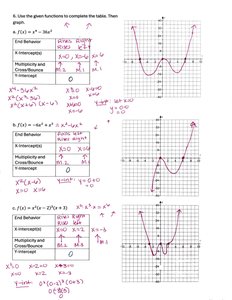
Try solving on your own before revealing the answer!
Final Answer:
The completed tables and graphs show the correct end behavior, intercepts, and crossing/bouncing behavior for each polynomial.
Q6. Use the graph to list the zeros, multiplicity, and write the equation using a leading coefficient of 1 or -1.
Background
Topic: Constructing Polynomial Equations from Zeros
This question tests your ability to write a polynomial equation given its zeros and their multiplicities, and to use the graph to determine the leading coefficient.
Key Terms and Formulas:
Zero: Value where the graph crosses or touches the -axis.
Multiplicity: Number of times a zero is repeated.
Polynomial Equation: where is the leading coefficient.
Step-by-Step Guidance
Identify the zeros from the graph and note their multiplicities (crosses = odd, bounces = even).
Write the polynomial as a product of factors corresponding to each zero and its multiplicity.
Determine the leading coefficient by considering the end behavior of the graph.
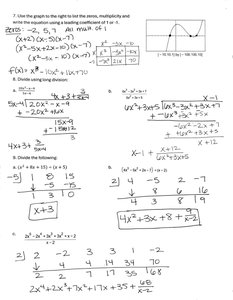
Try solving on your own before revealing the answer!
Final Answer:
The zeros are with multiplicities as indicated by the graph. The polynomial is (or similar, depending on the graph's end behavior).
Q7. Divide using long division or synthetic division as indicated.
Background
Topic: Polynomial Division
This question tests your ability to divide polynomials using long division or synthetic division.
Key Terms and Formulas:
Long Division: Standard algorithm for dividing polynomials.
Synthetic Division: Shortcut method for dividing by linear factors of the form .
Step-by-Step Guidance
Set up the division problem as indicated (long or synthetic division).
For synthetic division, use the zero of the divisor and write the coefficients of the dividend.
Perform the division step by step, bringing down coefficients and multiplying as needed.
Write the quotient and remainder, if any.
Try solving on your own before revealing the answer!
Final Answer:
The quotient and remainder are shown for each division problem, following the correct steps for long or synthetic division.
Q8. Use synthetic division to divide, then find all remaining zeros.
Background
Topic: Synthetic Division and Finding Zeros
This question tests your ability to use synthetic division to factor polynomials and find all zeros.
Key Terms and Formulas:
Synthetic Division: A method for dividing a polynomial by a linear factor.
Zeros: Solutions to .
Step-by-Step Guidance
Use synthetic division with a known zero to reduce the degree of the polynomial.
Factor the resulting polynomial further, if possible.
Solve for all zeros of the original polynomial.
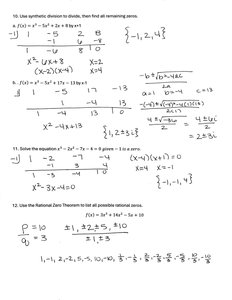
Try solving on your own before revealing the answer!
Final Answer:
All zeros of the polynomial are listed after performing synthetic division and factoring the result.
Q9. Use the Rational Zero Theorem to list all possible rational zeros.
Background
Topic: Rational Zero Theorem
This question tests your ability to use the Rational Zero Theorem to list all possible rational zeros of a polynomial.
Key Terms and Formulas:
Rational Zero Theorem: If is a polynomial with integer coefficients, every rational zero is of the form , where divides the constant term and divides the leading coefficient.
Step-by-Step Guidance
Identify the constant term () and leading coefficient () of the polynomial.
List all factors of and .
Form all possible fractions to get the list of possible rational zeros.
Try solving on your own before revealing the answer!
Final Answer:
All possible rational zeros are listed as .
Q10. Given , use the Remainder Theorem to find .
Background
Topic: Remainder Theorem
This question tests your ability to use the Remainder Theorem to evaluate a polynomial at a given value.
Key Terms and Formulas:
Remainder Theorem: If a polynomial is divided by , the remainder is .
Step-by-Step Guidance
Set up synthetic division for using the coefficients of .
Carry out the synthetic division process step by step.
The final value is the remainder, which equals .
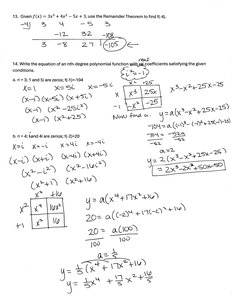
Try solving on your own before revealing the answer!
Final Answer:
This is the remainder when is divided by .
Q11. Write the equation of an nth-degree polynomial function with real coefficients satisfying the given conditions.
Background
Topic: Constructing Polynomial Equations
This question tests your ability to write a polynomial equation given specific zeros and conditions.
Key Terms and Formulas:
Polynomial Equation: where is a constant and are the zeros.
Use any additional conditions (like passing through a point) to solve for .
Step-by-Step Guidance
Write the general form of the polynomial using the given zeros.
Plug in any additional conditions to solve for the leading coefficient .
Write the final polynomial equation with all coefficients determined.
Try solving on your own before revealing the answer!
Final Answer:
The polynomial equation is (or as constructed from the given zeros and conditions).
