 Back
BackPrecalculus Practice Test 1 – Step-by-Step Study Guidance
Study Guide - Smart Notes
 Tailored notes based on your materials, expanded with key definitions, examples, and context.
Q1(a). Find the equation of the line that passes through the point (1, -3) and is parallel to the line 2x - y = 16.
Background
Topic: Equations of Lines
This question tests your understanding of how to find the equation of a line given a point and a condition of parallelism to another line.
Key Terms and Formulas
Slope-intercept form:
Parallel lines: Have the same slope.
Standard form:
Step-by-Step Guidance
Rewrite the given line in slope-intercept form to identify its slope.
Recall that parallel lines have the same slope, so use this slope for your new line.
Use the point-slope form with the point (1, -3) and the slope found in step 1.
Simplify the equation to your preferred form (slope-intercept or standard form), but stop before plugging in all values or simplifying completely.
Try solving on your own before revealing the answer!
Final Answer:
The slope of the given line is . Using point-slope form with (1, -3):
Simplifying:
This is the equation of the line parallel to passing through (1, -3).
Q1(b). Given , find and simplify the difference quotient , .
Background
Topic: Difference Quotient
This question tests your ability to compute and simplify the difference quotient, which is foundational for understanding derivatives in calculus.
Key Terms and Formulas
Difference Quotient:
Step-by-Step Guidance
Find by substituting into the function: .
Write the difference using the expressions for and .
Combine the two fractions over a common denominator.
Simplify the numerator as much as possible, but stop before dividing by and fully simplifying.
Try solving on your own before revealing the answer!
Final Answer:
So,
Combine over a common denominator and simplify:
Q2(a). Determine the equation and slope of a horizontal line through the point (4, -2).
Background
Topic: Equations of Horizontal Lines
This question tests your understanding of the properties of horizontal lines and how to write their equations.
Key Terms and Formulas
Horizontal line: Has the form where is a constant.
Slope of a horizontal line:
Step-by-Step Guidance
Recall that a horizontal line has a constant value for all .
Use the -coordinate of the given point to write the equation.
State the slope of any horizontal line.
Try solving on your own before revealing the answer!
Final Answer:
The equation is and the slope is $0$.
Q2(b). If the discriminant of a quadratic equation has a negative value, the equation has how many real solutions?
Background
Topic: Quadratic Equations and the Discriminant
This question tests your understanding of the discriminant and its implications for the nature of the solutions of a quadratic equation.
Key Terms and Formulas
Quadratic formula:
Discriminant:
Step-by-Step Guidance
Recall the quadratic formula and identify the discriminant.
Consider what happens when (the value under the square root is negative).
Think about whether real solutions exist when the square root is of a negative number.
Try solving on your own before revealing the answer!
Final Answer:
There are no real solutions (0 real solutions) when the discriminant is negative.
Q2(c). State the domain of the function , using interval notation.
Background
Topic: Domain of Rational Functions
This question tests your ability to determine the domain of a function, especially when the function involves division by a variable expression.
Key Terms and Formulas
Domain: The set of all real numbers for which the function is defined.
Undefined points: Occur when the denominator is zero.
Step-by-Step Guidance
Set the denominator equal to zero and solve for .
Exclude this value from the set of all real numbers.
Write the domain in interval notation, but stop before writing the final interval.
Try solving on your own before revealing the answer!
Final Answer:
The domain is all real numbers except , or .
Q3(a). Solve for :
Background
Topic: Solving Linear Equations
This question tests your ability to solve simple linear equations for a variable.
Key Terms and Formulas
Linear equation: An equation of the form .
Step-by-Step Guidance
Isolate by subtracting $2$ from both sides of the equation.
Write the resulting equation, but stop before stating the value of .
Try solving on your own before revealing the answer!
Final Answer:
Q3(b). Solve for :
Background
Topic: Solving Linear Equations with Fractions
This question tests your ability to solve linear equations that involve fractions.
Key Terms and Formulas
Linear equation: An equation of the form .
Step-by-Step Guidance
Subtract from both sides to get all terms on one side.
Add $1$ to both sides to get all constants on the other side.
Combine like terms and stop before dividing to solve for .
Try solving on your own before revealing the answer!
Final Answer:
Q3(c). Solve for :
Background
Topic: Exponential Equations
This question tests your ability to solve equations where the variable is in the exponent.
Key Terms and Formulas
Exponential equation: An equation where the variable appears in the exponent.
Properties of exponents: if .
Step-by-Step Guidance
Express $16.
Set the exponents equal to each other since the bases are the same.
Solve the resulting linear equation for , but stop before stating the value.
Try solving on your own before revealing the answer!
Final Answer:
Q3(d). Solve for :
Background
Topic: Solving Linear Equations with Parameters
This question tests your ability to solve for a variable in terms of other parameters.
Key Terms and Formulas
Linear equation: An equation of the form .
Step-by-Step Guidance
Subtract from both sides to isolate the term.
Divide both sides by to solve for , but stop before simplifying the expression.
Try solving on your own before revealing the answer!
Final Answer:
Q4. From the graph of a function to the right (the entire function is pictured), determine the following (estimating to the nearest tenth when necessary):
(a) the domain of
(b) the range of
(c) the -intercept
(d) the values of for which
(e) the interval(s) on which is increasing
Background
Topic: Reading Graphs of Functions
This question tests your ability to interpret a function's graph to determine its domain, range, intercepts, zeros, and intervals of increase.
Key Terms and Formulas
Domain: All -values for which the function is defined.
Range: All -values the function attains.
-intercept: The point where the graph crosses the -axis ().
Zeros: -values where (where the graph crosses the -axis).
Increasing interval: Where the graph rises as increases.
Step-by-Step Guidance
Examine the leftmost and rightmost points of the graph to estimate the domain (the -values covered).
Look at the lowest and highest points on the graph to estimate the range (the -values covered).
Find the point where the graph crosses the -axis to determine the -intercept.
Identify the -values where the graph crosses the -axis for the zeros.
Observe the intervals where the graph is moving upward as you move from left to right to find where is increasing. Stop before listing the exact intervals.
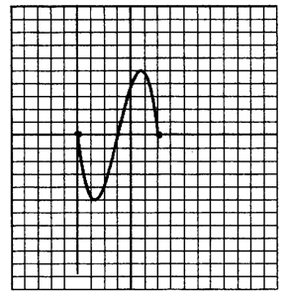
Try solving on your own before revealing the answer!
Final Answer:
(a) Domain:
(b) Range:
(c) -intercept:
(d) at and
(e) is increasing on and
Q5. A farmer has 200 feet of fencing to enclose three adjacent corrals. What measurements will produce an enclosed area of 1200 square feet? Set up a mathematical model (equation), stating clearly what each variable represents, then do the work to answer the question.
Background
Topic: Optimization and Mathematical Modeling
This question tests your ability to set up and solve an optimization problem involving area and perimeter constraints.
Key Terms and Formulas
Area of a rectangle:
Perimeter for three adjacent corrals: (since there are 2 lengths and 4 widths)
Step-by-Step Guidance
Let be the length and the width of each corral.
Write the area equation: .
Write the perimeter equation for three adjacent corrals: .
Solve one equation for one variable and substitute into the other, but stop before solving for the final values.
Try solving on your own before revealing the answer!
Final Answer:
Let be the length and the width. , .
Solving: ,
Multiply both sides by and solve the quadratic:
Solutions: ft, ft; or ft, ft (only the one that fits the perimeter constraint is valid: ft, ft).
Q6(a). Given , find .
Background
Topic: Evaluating Rational Functions
This question tests your ability to substitute a value into a rational function and simplify.
Key Terms and Formulas
Substitution: Replace with the given value in the function.
Step-by-Step Guidance
Substitute into the numerator and denominator.
Compute the numerator and denominator separately, but stop before dividing.
Try solving on your own before revealing the answer!
Final Answer:
Q6(b). Simplify .
Background
Topic: Simplifying Rational Expressions
This question tests your ability to factor and simplify rational expressions.
Key Terms and Formulas
Factoring: Expressing a polynomial as a product of its factors.
Step-by-Step Guidance
Factor the numerator .
Check if any factors cancel with the denominator .
Write the simplified expression, but stop before canceling or simplifying completely.
Try solving on your own before revealing the answer!
Final Answer:
, so does not simplify further since is not a factor of the numerator.
Q6(c). Simplify, writing the result with only positive exponents: .
Background
Topic: Exponents and Negative Exponents
This question tests your ability to simplify expressions with negative exponents and write the result with only positive exponents.
Key Terms and Formulas
Negative exponent rule:
Exponent rules:
Step-by-Step Guidance
Simplify the inside of the parentheses first: .
Apply the negative exponent to the entire fraction.
Rewrite the expression with only positive exponents, but stop before writing the final simplified form.
Try solving on your own before revealing the answer!
Final Answer:
Q6(d). Simplify .
Background
Topic: Simplifying Radical Expressions
This question tests your ability to simplify square roots, especially when the radicand is a sum.
Key Terms and Formulas
Square root:
Step-by-Step Guidance
Factor out any perfect squares from the radicand if possible.
Check if the expression can be written as a sum of squares or factored further, but stop before fully simplifying.
Try solving on your own before revealing the answer!
Final Answer:
Q6(e). Simplify without using a calculator: .
Background
Topic: Basic Arithmetic
This question tests your ability to multiply decimals and whole numbers without a calculator.
Key Terms and Formulas
Decimal multiplication:
Step-by-Step Guidance
Rewrite as a fraction.
Multiply the fraction by $250$ and simplify, but stop before stating the final value.
Try solving on your own before revealing the answer!
Final Answer:
Q7(a). A model rocket is fired upward from ground level at an initial velocity of 60 feet per second. (Use the position equation ) Determine how long it will take for the rocket to come back down to the ground.
Background
Topic: Quadratic Equations in Physics
This question tests your ability to use the position equation for vertical motion to solve for time when the object returns to the ground.
Key Terms and Formulas
Position equation:
Initial position: (ground level)
Initial velocity: ft/s
Step-by-Step Guidance
Set (when the rocket returns to the ground).
Write the equation: .
Rearrange to standard quadratic form and factor or use the quadratic formula, but stop before solving for .
Try solving on your own before revealing the answer!
Final Answer:
So (launch) or seconds (when it returns to the ground).
Q7(b). How high above ground is the rocket after 2 seconds?
Background
Topic: Evaluating Quadratic Functions in Physics
This question tests your ability to substitute a value into the position equation to find the height at a given time.
Key Terms and Formulas
Position equation:
Step-by-Step Guidance
Substitute into the position equation with and .
Calculate each term separately, but stop before adding them together for the final height.
Try solving on your own before revealing the answer!
Final Answer:
feet
