 Back
BackPrecalculus Practice Test 2: Step-by-Step Study Guidance
Study Guide - Smart Notes
 Tailored notes based on your materials, expanded with key definitions, examples, and context.
Q1. Vertex and Properties of a Quadratic Function
Background
Topic: Quadratic Functions and Their Graphs
This question tests your understanding of how to find the vertex, interpret function values, and identify maximum or minimum values for a quadratic function in standard form.
Key Terms and Formulas
Vertex: The turning point of a parabola, given by for .
Maximum/Minimum: For , the parabola opens upward (minimum); for , it opens downward (maximum).
Step-by-Step Guidance
Identify the coefficients , , and in the quadratic function .
Use the vertex formula to find the x-coordinate of the vertex.
Substitute this x-value back into to find the y-coordinate of the vertex.
Determine whether the function has a maximum or minimum value by examining the sign of .
Set up the function to find and interpret what this value represents on the graph.
Try solving on your own before revealing the answer!
Final Answer:
(a) The vertex of is at .
(b) , which corresponds to the point on the graph.
(c) The function has a minimum value, which is .
(d) The graph is a parabola opening upward with vertex at , x-intercepts at and , and y-intercept at .
Q2. Area of a Rectangular Garden in Terms of Width
Background
Topic: Quadratic Modeling and Optimization
This question asks you to express the area of a rectangle as a quadratic function of one variable, given a fixed perimeter.
Key Terms and Formulas
Perimeter of rectangle:
Area of rectangle:
Step-by-Step Guidance
Write the perimeter equation: .
Solve for in terms of .
Substitute this expression for into the area formula .
Simplify the resulting expression to obtain a quadratic function in terms of .
Try solving on your own before revealing the answer!
Final Answer:
The area as a function of width is .
This quadratic function models the area in terms of the width .
Q3. Sketching a Function with Given Properties
Background
Topic: Graphing Functions and Analyzing Intervals of Increase/Decrease
This question asks you to sketch a function with specified values and intervals where it increases or decreases.
Key Terms and Formulas
Increasing/Decreasing Intervals: Where the function's output rises or falls as increases.
Step-by-Step Guidance
Plot the points and on your graph.
Ensure the function decreases on and increases on .
Sketch a curve that passes through the given points and changes from decreasing to increasing at .
Try solving on your own before revealing the answer!
Final Answer:
The graph should pass through and , decrease for , and increase for . The point is likely a minimum.
Q4. Inverses and Domain/Range from Graphs
Background
Topic: Inverse Functions and Graph Analysis
This question tests your ability to sketch the inverse of a function and to determine the domain and range from a graph.
Key Terms and Formulas
Inverse Function: The graph of is a reflection of over the line .
Domain: Set of all possible input values (-values).
Range: Set of all possible output values (-values).
Step-by-Step Guidance
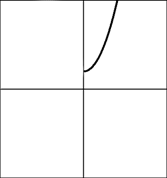
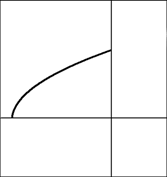
For part (a), reflect the given graph of over the line to sketch . Label at least one point by swapping the coordinates of a known point on $g(x)$.
For part (b), examine the graph of and identify the smallest and largest -values (domain) and -values (range) shown.
Try solving on your own before revealing the answer!
Final Answer:
(a) The inverse is a reflection of over . If , then is a labeled point.
(b) The domain of is and the range is (based on the graph).
Q5. Maximizing Profit with a Quadratic Model
Background
Topic: Quadratic Optimization
This question involves finding the number of units that maximizes profit and describing how to find the maximum value of a quadratic function.
Key Terms and Formulas
Vertex of a parabola: for .
Step-by-Step Guidance
Identify and in the profit function .
Use the vertex formula to find the value of that maximizes .
Describe how you would substitute this -value back into to find the maximum profit (but do not compute it).
Try solving on your own before revealing the answer!
Final Answer:
(a) The maximum profit occurs at units.
(b) To find the maximum profit, substitute into : .
Q6. Zeros, End Behavior, and Symmetry of a Cubic Function
Background
Topic: Polynomial Functions
This question asks you to find the zeros, describe end behavior, and determine symmetry (even/odd/neither) for a cubic function.
Key Terms and Formulas
Zero: Value of where .
End Behavior: How the function behaves as or .
Even Function: ; Odd Function: .
Step-by-Step Guidance
Set and solve for to find the zeros.
Analyze the leading term to describe the end behavior as and .
Test and compare it to and to determine if the function is even, odd, or neither.
Sketch the graph, labeling the x-intercepts found in step 1.
Try solving on your own before revealing the answer!
Final Answer:
(a) The zeros are .
(b) is an odd function.
(c) The graph passes through the x-axis at and has cubic end behavior.
Q7. Transformations of the Square Root Function
Background
Topic: Function Transformations
This question tests your understanding of reflecting, shifting, and writing equations for transformed functions.
Key Terms and Formulas
Reflection over x-axis:
Horizontal shift right by :
Vertical shift down by :
Step-by-Step Guidance
Start with .
Reflect over the x-axis: .
Shift 4 units to the right: .
Shift 2 units down: .
State the range and find the y-intercept by evaluating at .
Try solving on your own before revealing the answer!
Final Answer:
(a) The equation is .
(b) The range is and the y-intercept is undefined (since is the domain's starting point).
Q8. Intercepts and Asymptotes of a Rational Function
Background
Topic: Rational Functions
This question asks you to find the y-intercept, equation of the asymptote, and sketch the graph of a rational function.
Key Terms and Formulas
Y-intercept: Set and solve for .
Vertical Asymptote: Set denominator equal to zero and solve for .
Horizontal Asymptote: Compare degrees of numerator and denominator.
Step-by-Step Guidance
Find the y-intercept by evaluating .
Set the denominator to find the vertical asymptote.
Determine the horizontal asymptote by comparing degrees of numerator and denominator.
Sketch the graph, labeling intercepts and asymptotes.
Try solving on your own before revealing the answer!
Final Answer:
(a) The y-intercept is .
(b) The vertical asymptote is ; the horizontal asymptote is .
(c) The graph has a vertical asymptote at , a horizontal asymptote at , and passes through .
Q9. Composition and Inverses of Functions
Background
Topic: Function Composition and Inverses
This question asks you to use composition to determine if two functions are inverses.
Key Terms and Formulas
Composition:
Inverses: and for all in the domains.
Step-by-Step Guidance
Compute and simplify.
Compute and simplify.
Check if both compositions yield for all $x$ in the domains.
Try solving on your own before revealing the answer!
Final Answer:
The functions and are inverses because both compositions simplify to .
Q10. Function Operations, Logarithms, and Asymptotes
Background
Topic: Function Operations, Logarithms, and Asymptotes
This question covers function division, logarithmic evaluation, and identifying asymptotes of a rational function.
Key Terms and Formulas
Function Division:
Domain: Values of for which .
Logarithm Properties: and .
Asymptotes: Vertical (denominator zero), Horizontal (degree comparison).
Step-by-Step Guidance
For (a), write and simplify. State the domain by finding where .
For (b), use logarithm properties to evaluate and .
For (c), set the denominator to find vertical asymptotes, and compare degrees for the horizontal asymptote.
Try solving on your own before revealing the answer!
Final Answer:
(a) , domain: .
(b) , .
(c) Vertical asymptotes: ; Horizontal asymptote: .
