 Back
Precalculus Practice Test Guidance: Polynomial, Rational, Exponential, and Logarithmic Functions
Study Guide - Smart Notes
 Tailored notes based on your materials, expanded with key definitions, examples, and context.
Q1. Solve the equation given that is a root.
Background
Topic: Polynomial Equations and Factorization
This question tests your ability to solve cubic equations using known roots and polynomial division.
Key Terms and Formulas:
Root: A value of that makes the polynomial equal to zero.
Polynomial Division: Dividing a polynomial by a linear factor corresponding to a known root.
Synthetic Division: A shortcut method for dividing polynomials when the divisor is linear.
Step-by-Step Guidance
Since is a root, is a factor of the polynomial.
Use synthetic division to divide by .
Write the quotient as a quadratic polynomial.
Set the quadratic equal to zero and use factoring or the quadratic formula to find the remaining roots.
Try solving on your own before revealing the answer!
Final Answer:
The remaining roots are and .
Factoring or using the quadratic formula on the quotient gives these solutions.
Q2. Find so that is a factor of .
Background
Topic: Factor Theorem and Polynomial Roots
This question tests your understanding of the Factor Theorem, which relates factors to roots of polynomials.
Key Terms and Formulas:
Factor Theorem: If is a factor, then is a root.
Substitute into the polynomial and set it equal to zero to solve for .
Step-by-Step Guidance
Set and substitute into .
Calculate each term using .
Set the expression equal to zero and solve for .
Try solving on your own before revealing the answer!
Final Answer:
Substituting and solving gives this value for .
Q3. Find an nth-degree polynomial function with real coefficients satisfying the given conditions: ; $2 are zeros; .
Background
Topic: Constructing Polynomial Functions from Roots
This question tests your ability to build a polynomial given its roots and a specific function value.
Key Terms and Formulas:
Complex Conjugate Root Theorem: If a polynomial has real coefficients and a complex root, its conjugate is also a root.
Form the polynomial as .
Use to solve for .
Step-by-Step Guidance
Write the roots: $2, .
Express the polynomial as .
Expand the quadratic factor using .
Plug into the expanded polynomial and set to solve for .
Try solving on your own before revealing the answer!
Final Answer:
After expanding and solving for , this is the required cubic polynomial.
Q4. Find an nth-degree polynomial function with real coefficients satisfying the given conditions: ; (with multiplicity 2) and are zeros; .
Background
Topic: Constructing Polynomial Functions from Roots and Multiplicities
This question tests your ability to build a polynomial given roots, multiplicities, and a specific function value.
Key Terms and Formulas:
Multiplicity: The number of times a root appears.
Complex Conjugate Root Theorem: If is a root, is also a root.
Form the polynomial as .
Use to solve for .
Step-by-Step Guidance
Write the roots: (multiplicity 2), , .
Express the polynomial as .
Plug into the polynomial and set to solve for .
Try solving on your own before revealing the answer!
Final Answer:
After solving for , this is the required quartic polynomial.
Q5. For :
Background
Topic: Rational Zero Theorem, Descartes’s Rule of Signs, Synthetic Division, and Polynomial Roots
This question tests your ability to analyze and solve polynomial equations using several algebraic tools.
Key Terms and Formulas:
Rational Zero Theorem: Possible rational zeros are factors of the constant divided by factors of the leading coefficient.
Descartes’s Rule of Signs: Determines the possible number of positive and negative real zeros.
Synthetic Division: Used to test possible rational zeros.
Step-by-Step Guidance
List all possible rational zeros using the Rational Zero Theorem.
Apply Descartes’s Rule of Signs to estimate the number of positive and negative real zeros.
Use synthetic division to test each possible rational zero.
Once an actual zero is found, use the quotient polynomial to find the remaining zeros.
Try solving on your own before revealing the answer!
Final Answer:
The actual zeros are , , , and .
Each step uses the Rational Zero Theorem, synthetic division, and factoring.
Q6. For each given rational function, do the following tasks:
Background
Topic: Rational Functions—Domain, Asymptotes, Intercepts, and Graphing
This question tests your ability to analyze rational functions and their graphs.
Key Terms and Formulas:
Domain: All real values of for which the function is defined.
Vertical Asymptote: Values of where the denominator is zero and the function approaches infinity.
Hole: A removable discontinuity where both numerator and denominator are zero.
Horizontal Asymptote: The value approaches as goes to infinity.
Intercepts: Where the graph crosses the axes.
Step-by-Step Guidance
Factor the numerator and denominator to identify domain restrictions.
Find vertical asymptotes by setting the denominator equal to zero.
Check for holes by finding common factors in numerator and denominator.
Determine horizontal asymptotes by comparing degrees of numerator and denominator.
Find - and -intercepts by setting and respectively.
Analyze the behavior near vertical asymptotes and sketch the graph.
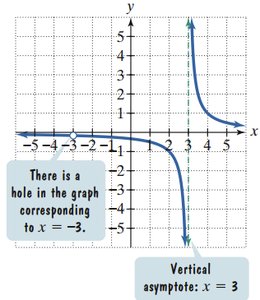
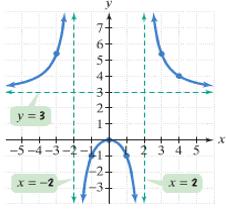
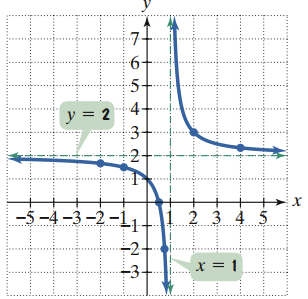
Try solving on your own before revealing the answer!
Final Answer:
Each function's domain, asymptotes, intercepts, and graph are determined by factoring and analyzing the expressions. See the images for visual guidance.
Q7. The graph of a rational function is given. Write an equation of a rational function that might have this graph.
Background
Topic: Rational Function Graphs and Equations
This question tests your ability to interpret a graph and write a corresponding rational function.
Key Terms and Formulas:
Vertical Asymptote: Where the function is undefined and the graph approaches infinity.
Hole: Removable discontinuity in the graph.
Step-by-Step Guidance
Identify the location of vertical asymptotes and holes from the graph.
Write a rational function with factors in the denominator for asymptotes and in both numerator and denominator for holes.
Adjust the numerator to match the graph's intercepts and behavior.
Try solving on your own before revealing the answer!
Final Answer:
An example equation:
This function has a hole at and a vertical asymptote at .
Q8. Given :
Background
Topic: Quadratic Inequalities
This question tests your ability to solve quadratic inequalities and express the solution in interval notation.
Key Terms and Formulas:
Quadratic Inequality: An inequality involving a quadratic expression.
Boundary Points: Values where the expression equals .
Interval Testing: Checking values between boundary points to determine where the inequality holds.
Step-by-Step Guidance
Set to find boundary points.
Plot the boundary points on a number line.
Test intervals between the boundary points to see where the inequality is true.
Express the solution set in interval notation.
Try solving on your own before revealing the answer!
Final Answer:
The solution set is , where and are the boundary points found from the quadratic equation.
Q9. Find the domain of each function:
Background
Topic: Domain of Radical and Rational Functions
This question tests your ability to determine the domain of functions involving square roots and rational expressions.
Key Terms and Formulas:
Domain: Set of all real values for which the function is defined.
Radical Function: Function involving a square root; the radicand must be non-negative.
Rational Function: Function involving a denominator; the denominator must not be zero.
Step-by-Step Guidance
For each function, set the radicand and denominator .
Solve the resulting inequalities to find the domain.
Express the domain in interval notation.
Try solving on your own before revealing the answer!
Final Answer:
Each function's domain is determined by solving the inequalities for the radicand and denominator.
Q10. Solve each inequality and graph the solution on a real number line:
Background
Topic: Absolute Value and Rational Inequalities
This question tests your ability to solve inequalities involving absolute values and rational expressions.
Key Terms and Formulas:
Absolute Value Inequality: means or .
Rational Inequality: Involves fractions; solve by finding common denominators and testing intervals.
Step-by-Step Guidance
For absolute value, set up two inequalities: and .
Solve each quadratic inequality separately.
For rational inequality, bring terms to one side and combine into a single fraction.
Find boundary points and test intervals.
Try solving on your own before revealing the answer!
Final Answer:
The solution sets are intervals on the real number line where the inequalities hold.
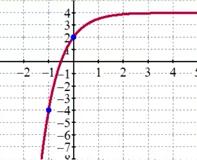
Q11. If the graph of below is obtained through a sequence of transformations of the exponential function , find an equation for in terms of .
Background
Topic: Exponential Functions and Transformations
This question tests your ability to identify transformations (shifts, stretches, reflections) applied to exponential functions.
Key Terms and Formulas:
Exponential Function:
Transformation: Includes shifts, stretches, and reflections.
Step-by-Step Guidance
Analyze the graph to identify horizontal and vertical shifts, stretches, or reflections.
Write the transformed equation based on the observed changes.
Try solving on your own before revealing the answer!
Final Answer:
An example equation: where and are determined by the graph's shifts.
Q12. For :
Background
Topic: Logarithmic Functions—Intercepts, Asymptotes, and Domain
This question tests your ability to analyze logarithmic functions for intercepts, asymptotes, and domain.
Key Terms and Formulas:
Logarithmic Function:
Vertical Asymptote: Occurs at .
Domain:
Step-by-Step Guidance
Set to find the domain.
Set to find the -intercept.
Identify the vertical asymptote at .
Try solving on your own before revealing the answer!
Final Answer:
-intercept: ; Vertical asymptote: ; Domain:
Q13. Let :
Background
Topic: Logarithmic Functions—Domain and Asymptotes
This question tests your ability to find the domain and asymptotes of a logarithmic function with a rational argument.
Key Terms and Formulas:
Logarithmic Function:
Domain: Argument must be positive:
Vertical Asymptote: Occurs where the argument approaches zero or infinity.
Step-by-Step Guidance
Set and solve for .
Find boundary points at and .
Test intervals to determine where the argument is positive.
Write the domain in interval notation and identify asymptotes.
Try solving on your own before revealing the answer!
Final Answer:
Domain: ; Asymptotes at and .
