 Back
BackPrecalculus Rational Functions and Transformations Review – Guided Study
Study Guide - Smart Notes
 Tailored notes based on your materials, expanded with key definitions, examples, and context.
Q1. For the rational function , identify the domain, zeros, asymptote(s), intercept(s), hole, and end behavior, if they exist. Write limit statements for each vertical asymptote.
Background
Topic: Rational Functions – Analysis of Key Features
This question tests your ability to analyze rational functions for their domain, zeros, vertical/horizontal asymptotes, holes, intercepts, and end behavior. It also asks you to write limit statements for vertical asymptotes, which is a key skill in understanding function behavior near undefined points.
Key Terms and Formulas
Domain: All real x-values for which the function is defined (denominator ≠ 0).
Zeros: x-values where the numerator is zero (and denominator is not zero).
Vertical Asymptote: x-values where the denominator is zero and the numerator is not zero.
Hole: x-values where both numerator and denominator are zero (common factor).
End Behavior: Describes the behavior of the function as or .
Limit Statement for Vertical Asymptote: and where is a vertical asymptote.
Step-by-Step Guidance
Factor both the numerator and denominator to identify any common factors and simplify if possible.
Find the domain by setting the denominator not equal to zero and solving for x.
Determine zeros by setting the numerator equal to zero and solving for x (make sure these x-values are not excluded from the domain).
Identify vertical asymptotes by finding values of x that make the denominator zero (and are not canceled by the numerator).
Check for holes by finding any x-values that are zeros of both the numerator and denominator (common factors).
Describe the end behavior by comparing the degrees of the numerator and denominator and, if needed, finding horizontal or oblique asymptotes.
Write the appropriate limit statements for each vertical asymptote, indicating the behavior as x approaches the asymptote from the left and right.
Try solving on your own before revealing the answer!
Final Answer:
Domain: Zeros: Vertical Asymptote(s): Hole: y-intercept: End Behavior: As , Limit Statements: , is the value of the hole (removable discontinuity).
We found the domain by excluding values that make the denominator zero, identified zeros and asymptotes, and wrote the required limit statements.
Q2. Write a limit statement that corresponds to the statement: “As the input values decrease without bound, the output values increase without bound.”
Background
Topic: Limits and End Behavior
This question tests your understanding of how to express end behavior using limit notation, specifically as x approaches negative infinity.
Key Terms and Formulas
Limit Statement:
Step-by-Step Guidance
Recall that “decrease without bound” means .
“Output values increase without bound” means .
Combine these ideas into a single limit statement using proper notation.
Try solving on your own before revealing the answer!
Final Answer:
This expresses that as x decreases without bound, the function values increase without bound.
Q3. Write the limit statements for both the left and right side of the vertical asymptotes in the following rational function:
Background
Topic: Limits at Vertical Asymptotes
This question tests your ability to write and interpret one-sided limits at points where the function has vertical asymptotes.
Key Terms and Formulas
Vertical Asymptote: Occurs where the denominator is zero and the numerator is not zero.
One-sided Limits: and
Step-by-Step Guidance
Set the denominator equal to zero to find the vertical asymptotes: .
List the x-values where vertical asymptotes occur.
For each vertical asymptote, write the left-hand and right-hand limit statements.
Consider the multiplicity of the factors to determine if the function approaches or from each side (but do not compute the final values yet).
Try solving on your own before revealing the answer!
Final Answer:
Vertical asymptotes at and Limit statements: , , At , since the factor is squared, both sides approach the same infinity. At , the sign changes on either side.
Q4. Identify the parent function and describe the transformations in .
Background
Topic: Transformations of Functions
This question tests your understanding of how to identify the parent function and describe shifts, reflections, and dilations.
Key Terms and Formulas
Parent Function: The simplest form of a function, e.g., .
Transformations: Shifts, reflections, and dilations applied to the parent function.
Step-by-Step Guidance
Identify the parent function (absolute value function).
Analyze the expression inside the absolute value to determine horizontal shifts.
Analyze the constants outside the absolute value for vertical shifts and reflections.
Describe each transformation in sequence.
Try solving on your own before revealing the answer!
Final Answer:
Parent function: Transformations: Shift right 3 units, reflect over the x-axis, and shift up 2 units.
Q5. A cubic function is shifted down 7 units, left 3 units, and horizontally dilated by a factor of ½. Write the function that contains these transformations.
Background
Topic: Function Transformations – Cubic Functions
This question tests your ability to apply multiple transformations to a parent function and write the resulting equation.
Key Terms and Formulas
Parent Function:
Transformation Formula:
Step-by-Step Guidance
Start with the parent function .
Apply the horizontal dilation by a factor of ½ (replace with ).
Apply the left shift by 3 units (replace with ).
Apply the vertical shift down by 7 units (subtract 7 from the function).
Try solving on your own before revealing the answer!
Final Answer:
This function represents a cubic function horizontally dilated by ½, shifted left 3 units, and down 7 units.
Q6. Graph the following rational function by using its transformations:
Background
Topic: Graphing Rational Functions Using Transformations
This question tests your ability to graph a rational function by applying transformations to the parent function .
Key Terms and Formulas
Parent Function:
Transformations: Horizontal and vertical shifts, reflections, and dilations.
Step-by-Step Guidance
Identify the parent function and its basic graph.
Apply the horizontal shift: means shift right 3 units.
Apply the vertical shift: means shift up 4 units.
Apply the negative sign to reflect the graph over the x-axis.
Try solving on your own before revealing the answer!
Final Answer:
The graph of is the graph of shifted right 3 units and up 4 units. Vertical asymptote at , horizontal asymptote at .
Q7. Write the following function in standard form:
Background
Topic: Expanding Polynomials
This question tests your ability to expand a product of polynomials and write the result in standard form (descending powers of x).
Key Terms and Formulas
Standard Form: A polynomial written as
Binomial Theorem: Used to expand
Step-by-Step Guidance
Expand using the binomial theorem or by multiplying out.
Multiply the result by .
Combine like terms to write the polynomial in standard form.
Try solving on your own before revealing the answer!
Final Answer:
Multiply by and combine like terms:
Q8. Write the following function in factored form:
Background
Topic: Factoring Polynomials
This question tests your ability to factor a cubic polynomial by taking out the greatest common factor and factoring further if possible.
Key Terms and Formulas
Factored Form: Expressing a polynomial as a product of its factors.
Step-by-Step Guidance
Factor out the greatest common factor from all terms.
Factor the remaining quadratic or cubic if possible.
Write the final expression as a product of linear and/or quadratic factors.
Try solving on your own before revealing the answer!
Final Answer:
Factor out : Factor the quadratic:
Q9. The graph of a rational function R has three x-intercepts, which account for a total multiplicity of 4 zeros. The degree of the denominator of R is 5, and the graph of R shows an oblique (slant) asymptote. Based on this information, R must have how many nonreal zeros?
Background
Topic: Rational Functions – Zeros and Asymptotes
This question tests your understanding of the relationship between the degree of the numerator and denominator, the number of real and nonreal zeros, and the presence of a slant asymptote.
Key Terms and Formulas
Multiplicity: The number of times a particular zero occurs.
Oblique Asymptote: Occurs when the degree of the numerator is one more than the denominator.
Fundamental Theorem of Algebra: A polynomial of degree n has n zeros (real or complex, counting multiplicity).
Step-by-Step Guidance
Let the degree of the numerator be and the denominator be 5.
Since there is a slant asymptote, .
There are 3 x-intercepts with a total multiplicity of 4, so there are 4 real zeros.
Subtract the number of real zeros from the total degree to find the number of nonreal zeros.
Try solving on your own before revealing the answer!
Final Answer:
There are nonreal zeros. This is because the numerator is degree 6, and only 4 real zeros are accounted for by the x-intercepts.
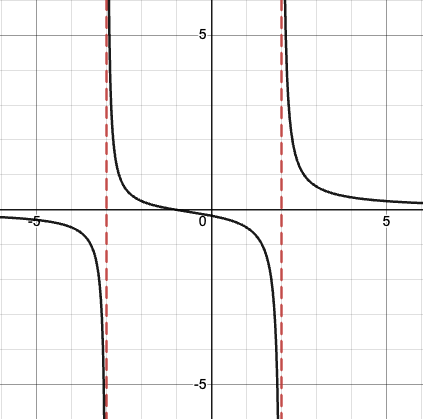
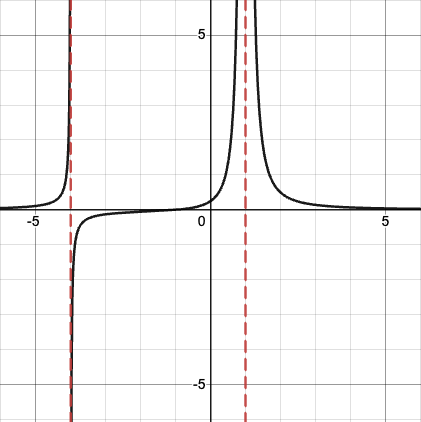
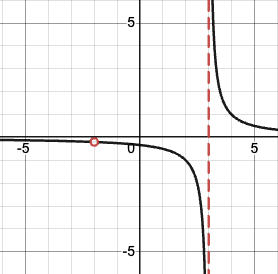
Q10. Use the graph to identify the domain, zero(s), asymptote(s), intercept(s), hole, and end behavior, if they exist, of the following rational function. Then, write the rational function that might have the given graph.
Background
Topic: Graphical Analysis of Rational Functions
This question tests your ability to interpret a graph of a rational function and deduce its algebraic properties and possible equation.
Key Terms and Formulas
Domain: All x-values except where the function is undefined (vertical asymptotes or holes).
Zeros: x-intercepts of the graph.
Vertical Asymptote: Vertical dashed lines where the function approaches infinity.
Hole: Open circle on the graph where the function is not defined.
End Behavior: How the function behaves as or .
Step-by-Step Guidance
Identify the locations of vertical asymptotes and holes from the graph.
Find the x-intercepts (zeros) and y-intercept.
Determine the end behavior by observing the horizontal or slant asymptote.
Write a possible rational function that matches these features.
Try solving on your own before revealing the answer!
Final Answer:
For the graph in image_28: Domain: Zeros: Vertical Asymptotes: Hole: None End Behavior: As , Possible function:
Q11. The function . Which of the following describes the end behavior of and explains why?
Background
Topic: End Behavior and Slant Asymptotes
This question tests your understanding of how the degrees of the numerator and denominator affect the end behavior and the presence of a slant asymptote.
Key Terms and Formulas
Slant (Oblique) Asymptote: Occurs when the degree of the numerator is one more than the denominator.
Long Division: Used to find the equation of the slant asymptote.
Step-by-Step Guidance
Compare the degrees of the numerator and denominator.
Since the numerator is degree 2 and the denominator is degree 1, there will be a slant asymptote.
Use polynomial long division to find the equation of the slant asymptote.
Match the result to the given answer choices.
Try solving on your own before revealing the answer!
Final Answer:
The slant asymptote is because the degree of the numerator exceeds the denominator by one, and long division gives this result.
Q12. Determine where each of the following rational functions have holes and/or vertical asymptotes:
Background
Topic: Holes and Vertical Asymptotes in Rational Functions
This question tests your ability to distinguish between holes (removable discontinuities) and vertical asymptotes (non-removable discontinuities).
Key Terms and Formulas
Hole: Occurs when a factor cancels from numerator and denominator.
Vertical Asymptote: Occurs when a factor remains in the denominator after simplification.
Step-by-Step Guidance
Factor both numerator and denominator completely.
Identify any common factors that cancel (these are holes).
Any remaining factors in the denominator correspond to vertical asymptotes.
Try solving on your own before revealing the answer!
Final Answer:
There is a hole at (common factor), and a vertical asymptote at (from the squared factor in the denominator).
Q13. In the xy-plane, the graph of a rational function has a vertical asymptote at . Which of the following expressions could define ?
Background
Topic: Identifying Vertical Asymptotes from Rational Functions
This question tests your ability to recognize which algebraic expressions produce a vertical asymptote at a given x-value.
Key Terms and Formulas
Vertical Asymptote: Occurs where the denominator is zero and the numerator is not zero.
Step-by-Step Guidance
Set the denominator of each expression equal to zero and solve for x.
Identify which expressions have as a solution.
Check for multiplicity and sign (if the denominator is or ).
Try solving on your own before revealing the answer!
Final Answer:
Any expression with or in the denominator (with any positive integer exponent) will have a vertical asymptote at .
Q14. The rational function . For what input values of are the output values of equal to 0?
Background
Topic: Zeros of Rational Functions
This question tests your ability to find the zeros of a rational function by setting the numerator equal to zero and ensuring the denominator is not zero at those points.
Key Terms and Formulas
Zeros: Set the numerator equal to zero and solve for x.
Domain Restrictions: Exclude any x-values that make the denominator zero.
Step-by-Step Guidance
Set the numerator equal to zero and solve for x.
Factor each quadratic and find all possible zeros.
Check which of these zeros do not make the denominator zero.
Try solving on your own before revealing the answer!
Final Answer:
The zeros are , except any that make the denominator zero.
Q15. A function is defined as . Identify the values of x for which .
Background
Topic: Solving Rational Equations
This question tests your ability to solve a rational equation for a specific output value.
Key Terms and Formulas
Rational Equation: Set the function equal to 4 and solve for x.
Step-by-Step Guidance
Set .
Multiply both sides by to clear the denominator.
Rearrange the equation to set it equal to zero and solve the resulting quadratic equation.
Check for extraneous solutions by ensuring the denominator is not zero for your solutions.
Try solving on your own before revealing the answer!
Final Answer:
Values of x are , excluding any x that make the denominator zero ().
