 Back
BackPrecalculus Review: Optimization, Quadratics, Polynomials, and Inequalities
Study Guide - Smart Notes
 Tailored notes based on your materials, expanded with key definitions, examples, and context.
Q1. Beth has 50 yards of fencing available to enclose a rectangular area.
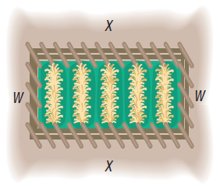
Background
Topic: Optimization and Functions
This question tests your ability to write and manipulate formulas for perimeter and area, express variables in terms of others, and use optimization techniques to maximize area.
Key Terms and Formulas
Perimeter of a rectangle:
Area of a rectangle:
Step-by-Step Guidance
Write the formula for perimeter in terms of and : .
Substitute to get .
Solve for in terms of : .
Express the area in terms of only by substituting the expression for into .
Set up the function and consider how to find the value of that maximizes the area (hint: use calculus or complete the square).
Try solving on your own before revealing the answer!
Final Answer:
(a) Perimeter formula:
(b)
(c) Area in terms of :
(d) The area is largest when yards.
(e) The maximum area is square yards.
We used the perimeter constraint to express in terms of , then substituted into the area formula. Maximizing the quadratic area function gives the optimal value.
Q2. A projectile is thrown upward: .
Background
Topic: Quadratic Functions and Maximum/Minimum Values
This question tests your understanding of quadratic functions, specifically how to find the vertex (maximum point) and interpret it in a physical context.
Key Terms and Formulas
Quadratic function:
Vertex formula for :
Step-by-Step Guidance
Identify the coefficients: , .
Use the vertex formula to find the time when the projectile reaches maximum height.
Plug this value of back into the original equation to find the maximum height.
Interpret the physical meaning: the vertex gives the highest point reached by the projectile.
Try solving on your own before revealing the answer!
Final Answer:
(a) The projectile reaches maximum height at seconds.
(b) The maximum height is meters.
The vertex formula gives the time, and substituting back gives the height.
Q3. Determine whether each expression is a polynomial. If so, state its degree and leading term.
Background
Topic: Polynomials and Their Properties
This question tests your ability to identify polynomials, determine their degree, and find the leading term.
Key Terms and Formulas
Polynomial: An expression consisting of variables and coefficients, using only addition, subtraction, multiplication, and non-negative integer exponents.
Degree: The highest power of the variable.
Leading term: The term with the highest degree.
Step-by-Step Guidance
For each expression, check if all exponents are non-negative integers and there are no variables in denominators or under radicals.
If it is a polynomial, identify the term with the highest exponent (degree) and write the leading term.
For non-polynomials, explain why (e.g., variable in denominator or under a root).
Repeat for each expression: (a) , (b) , (c) , (d) , (e) .
Try solving on your own before revealing the answer!
Final Answer:
(a) Polynomial, degree 4, leading term
(b) Not a polynomial (variable in denominator)
(c) Not a polynomial (variable under root)
(d) Polynomial, degree 5, leading term
(e) Not a polynomial (variable in denominator)
Polynomials must have only non-negative integer exponents and no variables in denominators or under roots.
Q4. Consider . Answer questions about intercepts, zeros, multiplicity, turning points, and graph.
Background
Topic: Polynomial Functions and Graph Analysis
This question tests your ability to analyze polynomial functions, find intercepts, zeros, multiplicity, turning points, and sketch graphs.
Key Terms and Formulas
x-intercept: Where
y-intercept: Where
Multiplicity: The number of times a zero is repeated
Turning points: Maximum number is degree minus one
Step-by-Step Guidance
Set and solve for to find x-intercepts (real zeros).
Plug into to find the y-intercept.
Determine the multiplicity of each zero by examining the factors.
Use multiplicity to decide if the graph crosses or touches the x-axis at each intercept.
Calculate the maximum number of turning points using the degree of the polynomial.
Use all this information to sketch the graph (stop before drawing or describing the full graph).
Try solving on your own before revealing the answer!
Final Answer:
(a) x-intercepts: ; y-intercept:
(b) Real zeros: (multiplicity 2), ,
(c) touches the axis (even multiplicity), and cross (odd multiplicity)
(d) Maximum number of turning points: 3
(e) The graph reflects all these features.
Q5. Solve the following inequalities algebraically:
Background
Topic: Solving Quadratic and Polynomial Inequalities
This question tests your ability to solve inequalities involving quadratic and polynomial expressions.
Key Terms and Formulas
Quadratic inequality: or
Factoring, finding critical points, and testing intervals
Step-by-Step Guidance
For each inequality, rewrite in standard form.
Factor the expression if possible to find critical points (where the expression equals zero).
Use a sign chart or test intervals between critical points to determine where the inequality holds.
Write the solution set in interval notation (stop before stating the final intervals).
Try solving on your own before revealing the answer!
Final Answer:
(a) : Solution or
(b) : Solution or
(c) : Solution
(d) : Solution or or (check discriminant and intervals)
Q6. Find the axis of symmetry and vertex of each quadratic function. Also determine concavity.
Background
Topic: Quadratic Functions, Vertex, Axis of Symmetry, Concavity
This question tests your ability to analyze quadratic functions, find their vertex and axis of symmetry, and determine whether the graph opens up or down.
Key Terms and Formulas
Vertex formula:
Axis of symmetry:
Concavity: If , graph opens up; if , graph opens down
Step-by-Step Guidance
For each function, identify and .
Calculate the axis of symmetry using .
Find the vertex by plugging the axis of symmetry value into the function.
Determine concavity based on the sign of .
Repeat for each function: (1) , (2) , (3) .
Try solving on your own before revealing the answer!
Final Answer:
(1) : Axis , vertex , concave up
(2) : Axis , vertex , concave down
(3) : Axis , vertex , concave down
We used the vertex formula and checked the sign of for concavity.
