 Back
BackPrecalculus Study Guidance: Trigonometry, Geometry, and Graphs
Study Guide - Smart Notes
 Tailored notes based on your materials, expanded with key definitions, examples, and context.
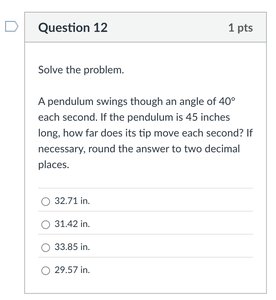
Q12. How far does the tip of a 45-inch pendulum move each second if it swings through an angle of 40°?
Background
Topic: Arc Length in Circles (Trigonometry)
This question tests your ability to calculate the arc length that a pendulum tip travels, given the radius (length of pendulum) and the angle swept.
Key formula:
Where:
= arc length (distance moved by tip)
= radius (length of pendulum, in inches)
= angle in radians
Step-by-Step Guidance
Identify the radius: inches.
Convert the angle from degrees to radians: .
Set up the arc length formula: .
Plug in the values for and (but do not calculate the final value yet).
Try solving on your own before revealing the answer!
Final Answer: 31.42 in.
radians$
inches
The tip moves about 31.42 inches each second.
Q13. What area does a windshield wiper cover in one cycle if it sweeps out an angle of 135°, with the base 12 inches and tip 32 inches from the pivot?
Background
Topic: Area of a Sector (Annular Sector)
This question tests your ability to find the area swept by a wiper, which forms an annular sector (area between two concentric circles).
Key formula:
Where:
= area of the annular sector
= angle in radians
= inner radius (base, 12 in.)
= outer radius (tip, 32 in.)
Step-by-Step Guidance
Convert the angle from degrees to radians: .
Calculate using the given radii.
Set up the formula: .
Plug in the values for , , and (but do not calculate the final value yet).
Try solving on your own before revealing the answer!
Final Answer: 1041.8 in2
radians$
in2
The wiper covers about 1041.8 square inches per cycle.
Q14. How far apart are two cars in the valley below a 1000-foot cliff, given angles of depression of 21° and 28°?
Background
Topic: Right Triangle Trigonometry (Angles of Depression)
This question tests your ability to use trigonometric ratios to find horizontal distances based on angles of depression and vertical height.
Key formula:
Where:
Opposite = height of cliff (1000 ft)
Adjacent = horizontal distance from cliff to car
Step-by-Step Guidance
Set up two equations for each car: and .
Solve for and (horizontal distances to each car).
Find the difference to get the distance between the cars.
Try solving on your own before revealing the answer!
Final Answer: 713.4 ft
,
Distance = ft
The cars are about 713.4 feet apart.
Q38. How tall is a house if a 25-foot ladder forms an angle of 41.5° with the wall?
Background
Topic: Right Triangle Trigonometry (Ladder Problems)
This question tests your ability to use trigonometric ratios to find the height reached by a ladder.
Key formula:
Where:
Opposite = height of the house
Hypotenuse = length of ladder (25 ft)
= angle with the wall (41.5°)
Step-by-Step Guidance
Set up the equation: .
Solve for (height of the house).
Try solving on your own before revealing the answer!
Final Answer: 16.6 ft
ft
The house is about 16.6 feet tall.
Q39. How tall is a ladder leaning against a building if the wall slants away at 96° with the ground, the base is 23 ft from the wall, and it reaches a point 52 ft up the wall?
Background
Topic: Law of Cosines (Oblique Triangles)
This question tests your ability to use the Law of Cosines to find the length of a ladder in a triangle where the angle is greater than 90°.
Key formula:
Where:
= distance from base to wall (23 ft)
= height up the wall (52 ft)
= angle between them (96°)
= length of ladder
Step-by-Step Guidance
Set up the Law of Cosines: .
Solve for (length of the ladder).
Try solving on your own before revealing the answer!
Final Answer: 59 ft
ft
The ladder is about 59 feet long.
Q40. How high is an airplane if two ground observers 3 miles apart report angles of elevation of 14° and 20°?
Background
Topic: Law of Sines (Oblique Triangles)
This question tests your ability to use the Law of Sines to find the height of an object given two angles and the distance between observers.
Key formula:
Where:
= height of airplane
= distance between observers (3 mi)
, , = angles in triangle
Step-by-Step Guidance
Draw a triangle with the observers and the airplane.
Label the angles and sides appropriately.
Use the Law of Sines to set up the equation for the height.
Plug in the values for the angles and the distance (but do not calculate the final value yet).
Try solving on your own before revealing the answer!
Final Answer: 0.73 mi
Using Law of Sines, the height is about 0.73 miles.
Q41. Find the distance AB across a river given BC = 447 m, B = 101.1°, and C = 18.1°.
Background
Topic: Law of Sines (Oblique Triangles)
This question tests your ability to use the Law of Sines to find an unknown side in a triangle given two angles and one side.
Key formula:
Where:
= unknown side (AB)
= known side (BC = 447 m)
, = angles
Step-by-Step Guidance
Find the third angle using .
Set up the Law of Sines: .
Solve for (but do not calculate the final value yet).
Try solving on your own before revealing the answer!
Final Answer: 140 m
m
Q42. How far apart are points A and B if C is 55 ft from A, 72 ft from B, and angle ACB is 53°?
Background
Topic: Law of Cosines (Oblique Triangles)
This question tests your ability to use the Law of Cosines to find the distance between two points given two sides and the included angle.
Key formula:
Where:
= 55 ft
= 72 ft
= 53°
= distance between A and B
Step-by-Step Guidance
Set up the Law of Cosines: .
Solve for (distance between A and B).
Try solving on your own before revealing the answer!
Final Answer: 102.9 ft
ft
Q43. Given B = 84°, b = 5, a = 24, determine if the triangle is possible and solve for all sides and angles.
Background
Topic: Law of Sines (Ambiguous Case, SSA)
This question tests your ability to determine the number of possible triangles given two sides and a non-included angle (SSA), and to solve for all angles and sides.
Key formula:
Where:
= 24
= 5
= 84°
Step-by-Step Guidance
Use Law of Sines to solve for angle .
Check if the triangle is possible (if is valid).
If possible, solve for angle and side .
Try solving on your own before revealing the answer!
Final Answer: One triangle, A = 42°, C = 54°, c = 29
Only one triangle is possible with the given values.
Q44. Given a = 7, b = 9, B = 49°, determine if the triangle is possible and solve for all sides and angles.
Background
Topic: Law of Sines (Ambiguous Case, SSA)
This question tests your ability to determine the number of possible triangles given two sides and a non-included angle (SSA), and to solve for all angles and sides.
Key formula:
Where:
= 7
= 9
= 49°
Step-by-Step Guidance
Use Law of Sines to solve for angle .
Check if two triangles are possible (if is valid and is acute).
If possible, solve for angle and side for each triangle.
Try solving on your own before revealing the answer!
Final Answer: Two triangles
Both solutions are possible for the given values.
Q54. Find an equation for the given graph.
Background
Topic: Trigonometric Graphs (Sine and Cosine Functions)
This question tests your ability to identify the equation of a trigonometric function based on amplitude, period, and phase shift.
Key formula:
or
Where:
= amplitude
= frequency (affects period)
Period =
Step-by-Step Guidance
Identify the amplitude from the graph (distance from midline to peak).
Determine the period by measuring the length of one cycle on the x-axis.
Compare the graph to the standard sine and cosine forms to identify the equation.
Try solving on your own before revealing the answer!
Final Answer:
The graph matches a sine function with amplitude 5, period , and is reflected.
