Back
BackPrecalculus Study Guide: Algebraic and Polynomial Functions (Exam 1 Objectives)
Study Guide - Smart Notes
 Tailored notes based on your materials, expanded with key definitions, examples, and context.
Chapter 1: Fundamental Concepts of Algebra and Polynomial Functions
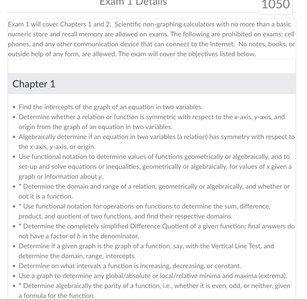
Intercepts and Symmetry of Equations
Understanding the intercepts and symmetry of equations in two variables is foundational for graphing and analyzing functions.
Intercepts: The x-intercept is where the graph crosses the x-axis (), and the y-intercept is where it crosses the y-axis ().
Symmetry: A relation is symmetric with respect to the x-axis, y-axis, or origin if substituting or yields the same equation.
Example: The equation is symmetric about the y-axis.
Functions and Relations
Functions assign each input exactly one output. Relations may not be functions if an input maps to multiple outputs.
Definition: A function is a relation where each element of the domain is paired with exactly one element of the range.
Vertical Line Test: If a vertical line crosses the graph more than once, it is not a function.
Example: passes the vertical line test; does not.
Operations and Composition of Functions
Functions can be combined using addition, subtraction, multiplication, division, and composition.
Operations: , , , (if ).
Composition: .
Example: If and , then .
Domain and Range
The domain is the set of possible input values; the range is the set of possible output values.
Finding Domain: Exclude values that cause division by zero or negative square roots.
Example: For , domain is .
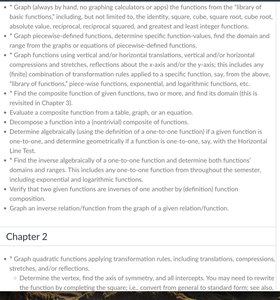
Graphing Functions and Piecewise Functions
Graphing by hand is essential for understanding function behavior, including basic and piecewise-defined functions.
Basic Functions: Identity, square, cube, square root, cube root, absolute value, reciprocal, and greatest integer.
Piecewise Functions: Defined by different expressions over different intervals.
Example:
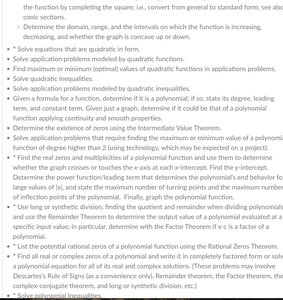
Quadratic Functions and Equations
Quadratic functions are polynomials of degree 2 and have a characteristic parabolic graph.
Standard Form:
Vertex:
Factoring: Expressing as a product of binomials, e.g.,
Solving: Set and solve for .
Polynomial Functions
Polynomials are sums of powers of with real coefficients. Their degree, leading term, and zeros determine their behavior.
Degree: Highest power of .
Leading Term: Term with the highest degree.
Zeros: Values where .
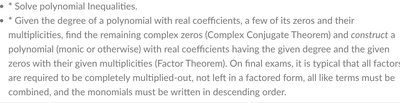
Factor Theorem: If , then is a factor.
Complex Conjugate Theorem: If is a zero, so is (for real coefficients).
Application Problems and Optimization
Quadratic and polynomial functions are used to model real-world scenarios and optimize values.
Maximum/Minimum: The vertex of a quadratic function gives the maximum or minimum value.
Example: has a maximum at .
Solving Equations and Inequalities
Solving equations and inequalities involves finding values that satisfy the given conditions.
Quadratic Equations: Use factoring, completing the square, or quadratic formula:
Polynomial Inequalities: Find intervals where the polynomial is positive or negative.
Intermediate Value Theorem
The Intermediate Value Theorem states that if a function is continuous on and and have opposite signs, there is at least one zero between and .
Application: Used to prove existence of roots.
Rational Functions and Rational Roots
Rational functions are ratios of polynomials. The Rational Root Theorem helps find possible rational zeros.
Rational Root Theorem: Possible rational zeros are , where divides the constant term and divides the leading coefficient.
Example: For , possible rational zeros are .
Graphing and Analyzing Functions
Graphing by hand and analyzing function properties, such as domain, range, intervals of increase/decrease, and concavity, are essential skills.
Concavity: A function is concave up where its second derivative is positive, concave down where negative.
Inflection Points: Where concavity changes.
Inverse Functions
An inverse function reverses the roles of inputs and outputs. A function must be one-to-one to have an inverse.
Horizontal Line Test: If a horizontal line crosses the graph more than once, the function is not one-to-one.
Finding Inverse: Solve for in terms of .
Summary Table: Key Properties of Functions
Property | Definition | Example |
|---|---|---|
Intercepts | Where graph crosses axes | at (0,0) |
Symmetry | Invariant under reflection | (y-axis) |
Domain | Allowed input values | for |
Range | Possible output values | for |
Zeros | Where | for |
Inverse | Reverses input/output |
Additional info:
Some objectives reference the use of the Factor Theorem, Rational Root Theorem, and Complex Conjugate Theorem, which are standard in precalculus polynomial analysis.
Graphing by hand and analyzing basic functions is emphasized, including transformations and piecewise functions.