 Back
Precalculus Study Guide: Algebraic Expressions, Equations, and Polynomials
Study Guide - Smart Notes
 Tailored notes based on your materials, expanded with key definitions, examples, and context.
Algebraic Expressions and Simplification
Basic Operations with Numbers and Variables
Algebraic expressions involve numbers, variables, and arithmetic operations. Simplifying these expressions is a foundational skill in precalculus, requiring the application of arithmetic rules, properties of exponents, and order of operations.
Addition and Subtraction: Combine like terms (terms with the same variable and exponent).
Multiplication: Use the distributive property and properties of exponents.
Division: Simplify fractions and reduce to lowest terms.
Order of Operations: Follow PEMDAS (Parentheses, Exponents, Multiplication/Division, Addition/Subtraction).
Example: Simplify First, calculate the exponent: Then, inside p
arentheses: Multiply: Add:
Fractions and Least Common Multiple (LCM)
Operations with Fractions
When adding or subtracting fractions, it is necessary to find a common denominator, often the least common multiple (LCM) of the denominators.
LCM: The smallest positive integer that is a multiple of two or more numbers.
Example: The LCM of 18 and 12 is 36.
Adding Fractions: Find LCM (36), convert fractions:
Opposites and Reciprocals
Definitions and Examples
Opposite: The opposite of a number is .
Reciprocal: The reciprocal of a nonzero number is .
Example: The opposite of $19-19\frac{5}{2}\frac{2}{5}$.
Solving Linear Equations
Isolating the Variable
To solve linear equations, isolate the variable on one side using inverse operations.
Example: Subtract from both sides: Divide by :
Exponents and Radicals
Properties and Simplification
Exponents and radicals are used to express repeated multiplication and roots. Simplifying expressions with exponents often involves applying the laws of exponents.
Product Rule:
Quotient Rule:
Power Rule:
Negative Exponent:
Radical to Exponent:
Example:
Polynomials: Addition, Subtraction, and Multiplication
Combining and Expanding Polynomials
Polynomials are algebraic expressions with terms consisting of variables raised to whole-number exponents. Operations include addition, subtraction, and multiplication.
Standard Form: Write terms in descending order of exponents.
Example:
Multiplying Binomials:
Factoring Polynomials
Common Methods
Factoring is the process of expressing a polynomial as a product of its factors. Common methods include factoring out the greatest common factor, difference of squares, and the AC method for trinomials.
Difference of Squares:
Trinomial Factoring: where and are numbers such that and
Example:
Solving Quadratic Equations
Factoring and the Quadratic Formula
Quadratic equations are equations of the form . They can be solved by factoring, completing the square, or using the quadratic formula.
Factoring: Set each factor equal to zero and solve for .
Quadratic Formula: For , the solutions are:
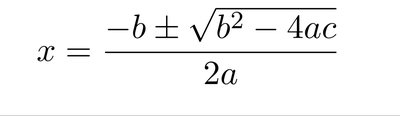
Example: Solve using the quadratic formula: , ,
Summary Table: Key Algebraic Properties
Property | Formula | Example |
|---|---|---|
Product of Powers | ||
Quotient of Powers | ||
Power of a Power | ||
Negative Exponent | ||
Difference of Squares | ||
Quadratic Formula |
